Feasibility Study for Deep Underground Rainwater Tunnel in Hangang-ro and Gildong
Establishing a Linked System with Storage Tanks, Retention Ponds, and Pumping Stations
Sadang Station Area to Connect with Isu-Gwacheon Combined Tunnel
Phase 1 Sections in Gangnam and Gwanghwamun Ready for Construction
Seoul City is set to proceed with the second phase expansion of the 'Deep Underground Rainwater Drainage Tunnel' project to prevent large-scale flooding. Due to the assessment that flood damage areas are expanding because of abnormal climate conditions, a preliminary survey will first be conducted targeting the Hangang-ro area. The first phase of the project, covering Gangnam Station and Gwanghwamun areas which suffer annual flood damage, is ready for construction.
According to the maintenance industry on the 8th, Seoul City recently began a feasibility study for installing the deep underground rainwater drainage tunnel in the Hangang-ro area of Yongsan-gu and the Gildong area of Gangdong-gu. The Hangang-ro section is a total of 2.0 km, and the Gildong section is 1.8 km, both of which are habitual flood-prone areas during the monsoon season requiring disaster prevention facilities.
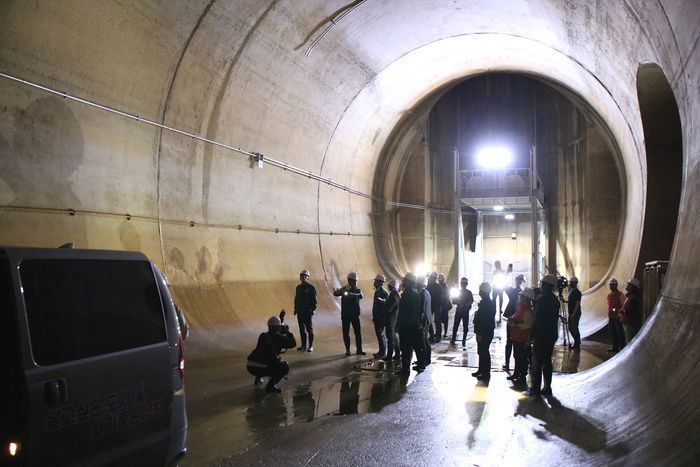 Inspection site of the stormwater drainage tunnel in Sinwol-dong, Yangcheon-gu, Seoul. Provided by the Seoul Metropolitan Government
The deep underground rainwater drainage tunnel is a facility that creates a large tunnel 40 to 50 meters underground to store rainwater during heavy rains and discharge it into rivers. After record-breaking heavy rains in 2022 caused large-scale damage including eight deaths in Seoul alone, the city announced a 'Comprehensive Safety Plan for Wind and Water Disasters' centered on installing deep underground rainwater drainage tunnels. The plan involves investing 1.5 trillion won to construct 18.9 km of deep drainage tunnels in six locations including Gangnam.
However, under former Mayor Park Won-soon's administration, some project plans were canceled or changed, and the only facility operated in Seoul was the Sinwol rainwater storage and drainage facility completed in 2020. Seoul City held design evaluation meetings for the deep underground rainwater drainage tunnel construction at Gangnam Station, Gwanghwamun, and Dorimcheon in October last year, giving approval for the basic design and priority construction detailed design of each project.
Seoul City's goal is to establish a flood damage prevention system across the entire city. The discussion to start the second phase of the deep underground rainwater drainage tunnel project is in the same context. Although the feasibility study targets were limited to Hangang-ro and Gildong, the process will also examine an organic linkage system with existing disaster prevention facilities such as storage tanks, retention ponds, pumping stations, and water recycling centers.
The area around Sadang Station will also review the disaster prevention performance of the Isu-Gwacheon combined tunnel and storage tanks. The Isu-Gwacheon combined tunnel was promoted to simultaneously resolve habitual traffic congestion on Gwacheon and Dongjak-daero and flooding issues in Sadang and Isu areas. It is a project to install a four-lane underground road and a rainwater drainage tunnel together deep underground. The rainwater drainage tunnel will be constructed over approximately 3.45 km from Sadang Station to the Olympic-daero area.
The Hangang-ro and Gildong rainwater tunnels are planned to be completed by 2032. However, since the feasibility study alone takes more than a year, there is a possibility of project delays. In the mid to long term, disaster prevention facilities within each autonomous district will also be inspected. During this process, additional areas for installing deep underground rainwater drainage tunnels may be added.
The first phase sites at Gangnam Station, Gwanghwamun, and Dorimcheon have completed all preparations for construction. Joint briefings and technical review meetings were held with the Hanshin Construction Consortium (Gangnam Station), Daewoo Construction Consortium (Dorimcheon), and DL E&C Consortium (Gwanghwamun), and the final design evaluation has been completed.
Construction is expected to begin first on the priority construction sections for which detailed designs have been completed. These include the green space on the traffic island at Banpo IC ramp near Gangnam Station and the temporary ventilation shaft excavation work at the Gwanghwamun Jeokseon bus public parking lot. For Dorimcheon, temporary facility and excavation work will be prioritized at the inflow retention basin (near Boramae Park South Gate close to Line 2 Sindaebang Station) and temporary facility work at five vertical shafts.
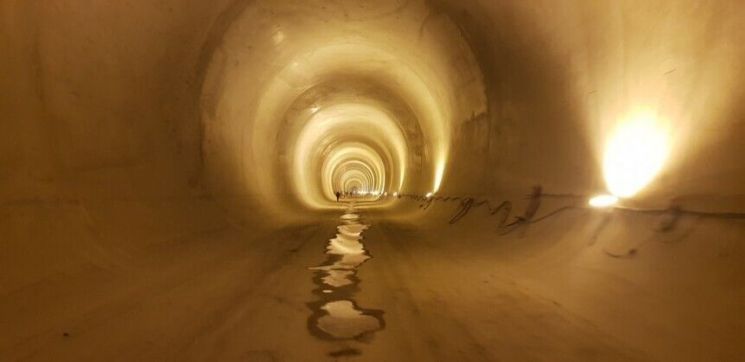 Interior view of the deep tunnel installed in Sinwol-dong, Yangcheon-gu, Seoul. Provided by Seoul City
© The Asia Business Daily(www.asiae.co.kr). All rights reserved.
!["The Woman Who Threw Herself into the Water Clutching a Stolen Dior Bag"...A Grotesque Success Story That Shakes the Korean Psyche [Slate]](https://cwcontent.asiae.co.kr/asiaresize/183/2026021902243444107_1771435474.jpg)

















