"Further Decline Possible Depending on Verdict"
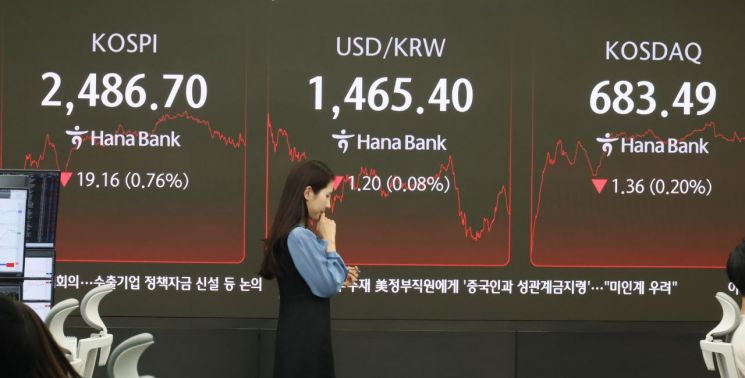 The status board in the dealing room of Hana Bank headquarters in Jung-gu, Seoul, displayed the KOSPI, the won-dollar exchange rate, and the KOSDAQ index the previous afternoon. Photo by Yonhap News
On the 4th, the won-dollar exchange rate started with a sharp drop of 16.5 won. This reflected the global dollar weakness caused by the shock of mutual tariffs in the United States. There is also an analysis that additional volatility could expand depending on the impeachment trial result of President Yoon Seok-yeol on that day.
In the Seoul foreign exchange market that day, the won-dollar exchange rate at 9:06 a.m. recorded 1,452.3 won, down 14.7 won compared to the previous day’s weekly closing price (as of 3:30 p.m.). The won-dollar exchange rate opened at 1,450.5 won, down 16.5 won, briefly fell below the 1,450 level, then slightly rebounded.
The previous day, the mutual tariffs announced by U.S. President Donald Trump raised concerns about a U.S. economic recession due to the full-scale global tariff war, causing the New York stock market to plunge overnight. The Dow Jones Industrial Average fell 3.98%, the Standard & Poor’s (S&P) 500 index dropped 4.84%, and the Nasdaq Composite Index plunged 5.97%.
Global dollar weakness was also prominent. The dollar index, which shows the value of the dollar against six major currencies, fell to the 102 level.
On that day, the exchange rate could show significant volatility depending on the impeachment trial verdict of President Yoon, scheduled for 11 a.m. Min Kyung-won, a researcher at Woori Bank, said, "If the impeachment is upheld, additional declines should be considered," adding, "if export companies engage in follow-up selling, the drop could be even greater."
© The Asia Business Daily(www.asiae.co.kr). All rights reserved.
![Clutching a Stolen Dior Bag, Saying "I Hate Being Poor but Real"... The Grotesque Con of a "Human Knockoff" [Slate]](https://cwcontent.asiae.co.kr/asiaresize/183/2026021902243444107_1771435474.jpg)
















