Although the United States announced reciprocal tariffs, there is a forecast that negotiations among major countries will unfold as these tariffs negatively impact the economies of various nations.
Jeon Gyu-yeon, a researcher at Hana Securities, explained this on the 4th in his report titled "The Intuitive Meaning of Trump's Reciprocal Tariffs and Better Alternatives."
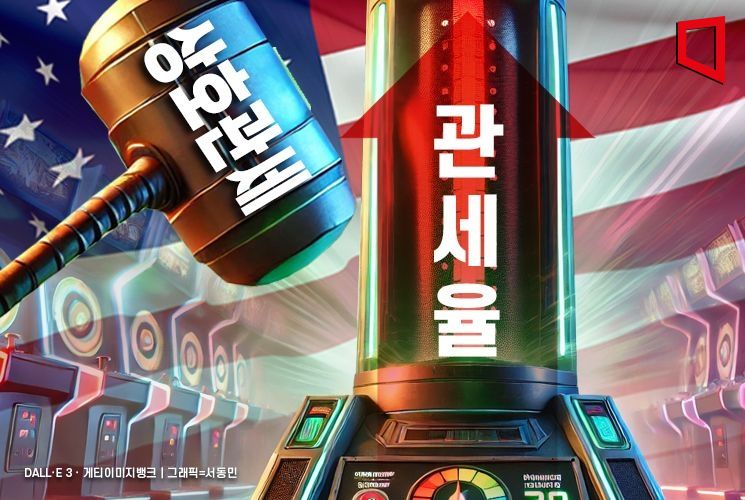
U.S. President Donald Trump announced reciprocal tariffs on the 2nd (local time). A universal tariff of 10% will be imposed on all countries, and among them, about 60 countries with large trade deficits will face reciprocal tariffs. Specifically, tariffs of 34% on China, 46% on Vietnam, 32% on Indonesia, 24% on Japan, and 20% on the European Union (EU) will be imposed, with South Korea's reciprocal tariff set at 25%.
Researcher Jeon explained, "The Trump administration stated that it would comprehensively consider not only the tariffs other countries impose on the U.S. but also various regulations and tax systems that hinder U.S. companies' exports, quantifying these as reciprocal tariff rates," adding, "The actual announced tariff rates represent half of the 'tariffs imposed on the U.S. by each country, including currency manipulation and trade barriers,' making it appear as if Trump applied the rates generously."
He continued, "Even if the weak Korean won and trade barriers have hindered exports of some U.S. companies, it is hard to say that South Korea imposed tariffs as high as 50% on the U.S.," and pointed out, "The figures calculated by the U.S. Trade Representative for tariffs imposed by each country on the U.S. exactly match the ratio of the U.S.'s 2024 trade deficit by country divided by the import amount from each country."
He emphasized, "Ultimately, if the trading partner countries do not purchase more than 80% of the amount the U.S. imports from them, the U.S. plans to impose additional tariffs to cover half of its trade deficit through tariff revenues."
However, he forecasted that such reciprocal tariffs would be difficult to implement in practice. Researcher Jeon explained, "Because the global economy operates organically, raising tariff rates will reduce not only U.S. imports but also exports," adding, "If tariff rates rise and U.S. imports decrease, the dollar reserves of the trading partner countries will decline, causing the dollar's value to increase, which in turn leads to a simultaneous decrease in U.S. exports."
He noted, "The fortunate point is that U.S. Treasury Secretary Janet Yellen mentioned that the reciprocal tariff rate is a ceiling, not a floor, and that there is room for negotiation," and predicted, "Considering that retaliatory responses from trading partners negatively affect the economies of various countries, it is highly likely that negotiations among major countries will proceed for the time being."
© The Asia Business Daily(www.asiae.co.kr). All rights reserved.

![User Who Sold Erroneously Deposited Bitcoins to Repay Debt and Fund Entertainment... What Did the Supreme Court Decide in 2021? [Legal Issue Check]](https://cwcontent.asiae.co.kr/asiaresize/183/2026020910431234020_1770601391.png)














