Lee Chang-yoon, the 1st Vice Minister, stated, "The importance of CCU technology as a scientific and technological solution to achieve carbon neutrality is growing."
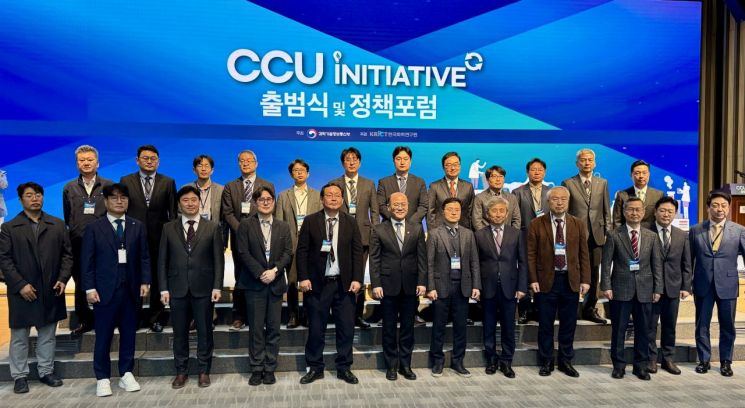 On the 4th, attendees are taking a commemorative photo at the 'CCU Initiative Launch Ceremony' held at the Korea Science and Technology Center in Yeoksam-dong, Seoul. Photo by Baek Jong-min, Tech Specialist
On the 4th, Lee Chang-yoon, Minister of Science and ICT, emphasized at the launch ceremony of the 'Carbon Capture and Utilization (CCU) Initiative' held at the Seoul Science and Technology Center that the government and the private sector must join forces to actively develop CCU technology for the realization of carbon neutrality.
The 'Carbon Capture and Utilization (CCU) Initiative,' launched as an alliance between the government and companies to proactively secure future core source technologies for achieving carbon neutrality by 2050, held an event where about 150 experts from industry, academia, and research institutes gathered to discuss the industrialization of CCU technology, aiming for private-sector-led carbon neutrality technological innovation.
CCU technology captures carbon dioxide from industrial activities and the atmosphere and converts it into useful materials, simultaneously achieving carbon reduction and the production of high value-added products. It is especially recognized as one of the few large-scale reduction methods in industries such as cement and petrochemicals.
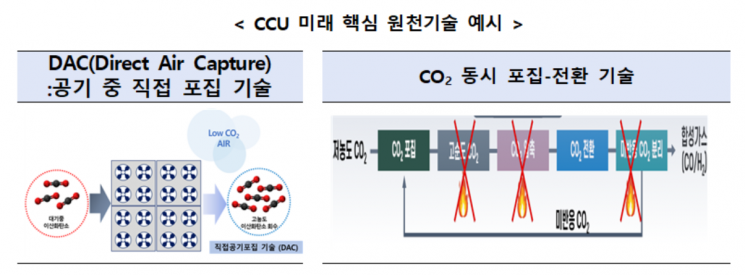
On this day, the Ministry of Science and ICT announced the 'CCU Focused Promotion Strategy,' presenting key directions centered on technology development and industrial promotion. In the short term, designated CCU focused research labs will be operated to consolidate research capabilities, and global flagship projects will promote joint research with overseas partners. In the mid to long term, large-scale demonstration projects and next-generation technology development, such as direct air capture (DAC) technology, will also be strengthened.
The Ministry plans to prioritize government-supported large-scale demonstration projects focusing on industries with high carbon dioxide emissions such as refining, petrochemicals, cement, steel, and power generation, and then expand to other companies. It will also support next-generation CCU technology development, including direct air capture (DAC) and capture-free conversion.
While the initiative is operated mainly by government-funded research institutes such as the Korea Research Institute of Chemical Technology, Korea Research Institute of Bioscience and Biotechnology, Korea Institute of Geoscience and Mineral Resources, and Korea Institute of Energy Technology this year, the focus will shift to companies starting next year.
© The Asia Business Daily(www.asiae.co.kr). All rights reserved.
![Clutching a Stolen Dior Bag, Saying "I Hate Being Poor but Real"... The Grotesque Con of a "Human Knockoff" [Slate]](https://cwcontent.asiae.co.kr/asiaresize/183/2026021902243444107_1771435474.jpg)

















