A City Mobilizes All-Out Efforts to Pass Preliminary Feasibility Study for the Pyeongtaek~Anseong~Bubal Railway
Total Length of 62.2 km, Project Cost Estimated at 2.2383 Trillion Won
Anseong City in Gyeonggi Province is putting all its efforts into passing the preliminary feasibility study for the Pyeongtaek~Bubal railway project. On the 3rd, Anseong City stated in a press release, "We are making an all-out effort to pass the preliminary feasibility study for the Pyeongtaek~Bubal railway project."
There is a reason why Anseong City is concentrating its administrative power on the railway project, even using the term "all-out effort." It is the only city in the Seoul, Incheon, and Gyeonggi metropolitan area that has neither a railway station nor a railway line passing through it.
A City Without Railways Since the Closure of the 'Anseong Line' in 1989
 Anseong City transformed the old Anseongseon railway bridge remains into a complex cultural space called 'Anseong Station 100'. Photo by Anseong City
It is not that Anseong City never had railways. The railway history dates back exactly 100 years to the 'Anseong Line,' which connected Cheonan in Chungnam and Anseong. According to the "80 Years of Korean Railways History (1979, Korea Railroad Administration)," the Anseong Line was constructed during the Japanese colonial period starting in 1922 and opened in November 1925. It had a total length of 28.4 km, with six stations including one regular station, one assigned simple station, and four unassigned simple stations. At the time of opening, it was called the 'Gyeonggi Line' and was renamed the 'Anseong Line' in 1956.
The Anseong Line, which handled major passenger and freight transport between the Chungcheong and Gyeonggi regions, was eventually closed in January 1989 due to a sharp decline in demand caused by the expansion of the Gyeongbu Line railway's transport capacity and the development of expressway networks such as the Gyeongbu Expressway. The site of the now-defunct Anseong Station is currently occupied by the Anseong branch of Korea Electric Power Corporation. Anseong City has created and operates a complex cultural space called 'Anseong Station 100' at 389-3 Oksan-dong, where traces of the Anseong Line's railway bridge remain.
The expectation for the revival of railways in the Anseong area grew when the government's '3rd National Railway Network Construction Plan' in 2016 included the 'Pyeongtaek~Bubal Line general railway' as a new line. This line, with a total length of 62.2 km, connects Poseung-eup in Pyeongtaek City, passes through Anseong, and links to Bubal in Icheon. It was also included in the '4th National Railway Network Construction Plan' in 2021. The National Railway Network Construction Plan is the highest-level plan for railway network development, and all new railway constructions and extensions are carried out according to this plan.
Especially in the 4th plan, the inclusion of the metropolitan inland line connecting Hwaseong Dongtan~Anseong~Jincheon~Cheongju Airport means that if the railway is newly constructed as planned, Anseong Station will be transformed into a double station area where two railway lines intersect.
Hope to Pass the Preliminary Feasibility Study Threshold with the 'Semiconductor Materials, Parts, and Equipment Specialized Complex'
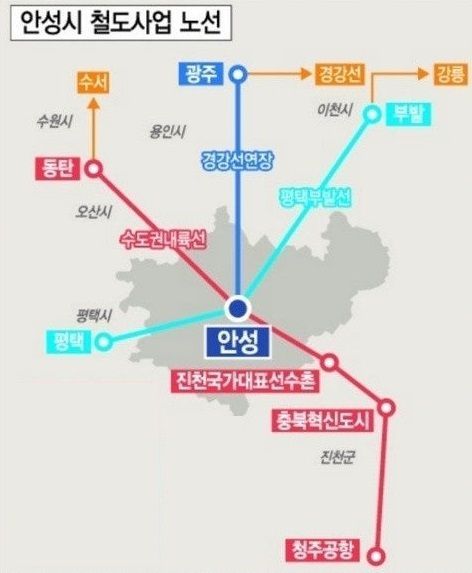
The problem lies in economic feasibility. In 2021, the Korea Development Institute (KDI) started a preliminary feasibility study for the Pyeongtaek~Bubal Line, but the cost-benefit (B/C) analysis value was low, causing the project to fall behind in priority. This is why the city is putting its life on passing this preliminary feasibility study. If it fails to pass this time, the revival of Anseong's railway could once again remain just a rosy plan without realization.
Anseong City is focusing its administrative power on promoting the railway project to improve the poor public transportation accessibility for its citizens. In preparation for the comprehensive preliminary feasibility evaluation (AHP) scheduled for the first half of this year, Mayor Kim Bora, local members of the National Assembly, and residents are showing strong determination to push forward the railway project.
The comprehensive preliminary feasibility evaluation is conducted by KDI PIMAC, the investigation agency, which performs economic analysis. Additionally, a financial project evaluation subcommittee composed of private experts in fields such as roads, architecture, and environment conducts policy analysis, and the results are combined to produce the final outcome. If the preliminary feasibility study passes, subsequent procedures such as feasibility study, basic planning, and basic and detailed design will follow.
The city particularly expects that the project's feasibility will improve significantly if recent changes in conditions are reflected. A representative factor is the designation of the 'Semiconductor Materials, Parts, and Equipment Specialized Complex.' Since the Dongshin General Industrial Complex in Anseong was designated by the government in 2023 as a 'Semiconductor Materials, Parts, and Equipment Specialized Complex' for national advanced industry promotion, the city believes that this favorable factor could raise the B/C value.
The Dongshin Industrial Complex is a large-scale industrial complex planned by the Korea Industrial Complex Corporation, covering 1.57 million square meters in Dongshin-ri 515-2, Bogae-myeon, Anseong. Construction is scheduled to start in 2027 and be completed by 2030.
A city official said, "The establishment of a new railway in Anseong is a project that must be realized from the perspective of regional innovation, transportation infrastructure enhancement, and balanced national development," adding, "We will do our utmost until the end toward the opening of the Anseong railway era, the dream of 200,000 Anseong citizens."
© The Asia Business Daily(www.asiae.co.kr). All rights reserved.


















