Claimed Comprehensive Calculation of Taxes and Non-Tariff Barriers
In Reality, Trade Deficit Simply Divided by Import Value
Confusion Arises from Differences Between Trump and White House Figures
On the 2nd (local time), the United States imposed tariff rates considering only import and export amounts, contrary to its initial explanation that it would comprehensively consider taxes and non-tariff barriers in addition to tariffs when calculating reciprocal tariffs by country. This is why criticism has arisen that the Trump administration created a "custom formula" to impose "reciprocal tariffs." Furthermore, in the case of South Korea, confusion arose due to discrepancies between the tariff rates announced by U.S. President Donald Trump and those stated in official White House documents.
The U.S. Trade Representative (USTR) disclosed the method for calculating reciprocal tariffs by country on its website that day, acknowledging that "calculating the impact of tens of thousands of tariffs, regulations, tax systems, and other policies by country on trade deficits is complex if not impossible," and explained that it derived tariff rates that could reduce the U.S. trade deficit in bilateral trade to zero.
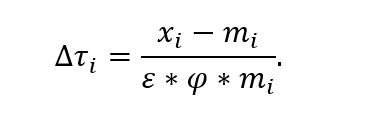
The formula disclosed by USTR is essentially the trade deficit divided by import value. The denominator's ε (price elasticity of import demand) is set at 4, and φ (price elasticity of import with respect to tariffs) is set at 0.25, which when multiplied equals 1. Therefore, the only variables are total export amount (x) and total import amount (m).
The Trump administration imposed half of this calculated ratio as reciprocal tariffs on each country. Although the Trump administration explained in February that in calculating reciprocal tariff rates, it would comprehensively consider tariffs, various regulations, tax systems, and all trade barriers hindering U.S. exports imposed by other countries and quantify them into tariff rates, the actual formula turned out to be different.
According to Bloomberg News, China recorded a $295 billion trade surplus with the U.S. last year, with total exports to the U.S. amounting to $438 billion. This is a 68% ratio, and half of this, 34%, is the tariff rate imposed on China. Similar methods were applied to other economic zones such as Japan, South Korea, and the European Union (EU).
These suspicions surfaced earlier when U.S. journalist James Surowiecki raised them on social media. He explained that the Trump administration defined the ratio of the U.S. trade deficit with a specific country divided by import value as that country's tariff rate on the U.S., then imposed half of that ratio as reciprocal tariffs.
Surowiecki pointed out that the tariffs the Trump administration claimed other countries imposed on the U.S. were "made-up numbers," noting that "South Korea, which has a trade agreement with us, does not impose a 50% tariff on U.S. exports." However, Surowiecki analyzed that if the U.S. recorded a trade surplus or if the ratio of trade deficit to import value was less than 10%, the basic tariff of 10% was applied.
In South Korea's case, this formula also fits. The U.S. recorded a trade deficit of $66 billion and imports of $132 billion in goods trade with South Korea last year. Dividing $66 billion by $132 billion yields 50%. The Trump administration announced that South Korea's tariff rate on the U.S. was 50%, and the reciprocal tariff imposed on South Korea was 25%.
Confusion also arose due to discrepancies between the figures President Trump disclosed and the reciprocal tariff rates stated in official White House documents. When President Trump announced reciprocal tariffs at the White House Rose Garden that day, the panel he held showed a 25% tariff rate for South Korea. This was the same in the table later released on X (formerly Twitter). However, the annex to the executive order later released by the White House showed South Korea's tariff rate as 26%.
For countries other than South Korea, including India, Switzerland, South Africa, the Philippines, Pakistan, Serbia, and Botswana, the tariff rates in the annex were 1 percentage point higher than the figures on the panels held at the time of the announcement.
© The Asia Business Daily(www.asiae.co.kr). All rights reserved.

















