KOSPI Starts with Sharp Drop,
Recovers Some Losses to Close Down 0.7%
The U.S. administration under Donald Trump announced reciprocal tariffs against trade partners, leading to a decline in the domestic stock market. However, the market, which started with a sharp drop, narrowed its losses thanks to bargain buying by institutional investors.
On the 3rd, the KOSPI index closed at 2486.70, down 19.16 points (-0.76%) from the previous trading day. The market opened at the 2430 level, down sharply by 2.7%, but the decline gradually lessened from early in the session. Foreign investors consistently showed net selling, while individuals steadily bought. In the afternoon, institutions, led by pension funds, turned to net buying and defended the index.
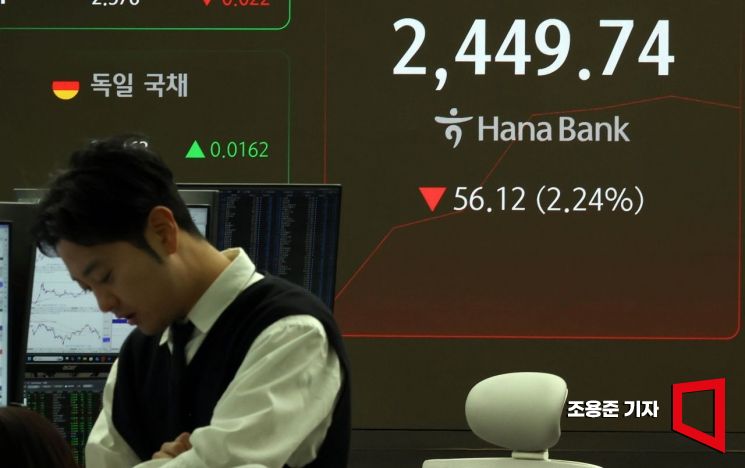 A dealer is working in the dealing room at the headquarters of Hana Bank in Jung-gu, Seoul, on the 3rd, where the Trump administration of the United States applied a 25% reciprocal tariff rate to Korea. On that day, the KOSPI opened at 2,437.43, down 68.43 points (2.73%) from the previous day, the won/dollar exchange rate rose 4.4 won to 1,471.0 won, and the KOSDAQ started at 670.75, down 14.10 points (2.06%). April 3, 2025 Photo by Jo Yongjun
The KOSPI index was dragged down by foreign investors' net selling of about 1.37 trillion KRW, while individuals and pension funds supported the index with net purchases of approximately 800 billion KRW and 270 billion KRW, respectively.
Top market capitalization stocks on the Korea Exchange reflected the impact of U.S. tariff impositions directly. Samsung Electronics and SK Hynix, the largest market cap stocks, fell by 2.04% and 1.67%, respectively. Although semiconductors were designated as exempt from reciprocal tariffs, tariffs on information technology (IT) devices were not waived, so the sector could not avoid the tariff impact. Automobile-related stocks such as Hyundai Motor (-1.27%) and Kia (-1.41%) also retreated.
However, pharmaceuticals were identified as a tariff-free zone amid the Trump tariffs, with Samsung Biologics alone rising about 6%. Celltrion also increased by 2.24%. Hanwha Aerospace announced a contract to export K9 self-propelled howitzers to India, causing its stock price to surge during the session with a volatility exceeding 5%.
The KOSDAQ index closed at 683.49, down 1.36 points (0.20%) from the previous day. In the KOSDAQ market, foreign investors sold about 64.5 billion KRW, pulling the market down. Individuals and pension funds bought about 66 billion KRW and 1.6 billion KRW, respectively, supporting the downside.
Among the top market cap stocks on KOSDAQ, bio-related stocks excluded from reciprocal tariffs closed higher. Alteogen (0.69%), HLB (0.53%), Samchundang Pharmaceutical (4.74%), and Rigachem Bio (2.01%) showed strength. Conversely, Ecopro BM (-0.22%) and Silicon Two (-5.96%) closed weaker.
The impeachment trial scheduled for tomorrow is also expected to affect the stock market.
Jaewon Lee, a researcher at Shinhan Investment Corp., evaluated, "The KOSPI is experiencing sectoral differentiation amid tariff rates exceeding expectations, and foreign capital outflows continue ahead of tomorrow’s impeachment trial verdict event."
On the day, the won-dollar exchange rate ended the weekly trading at 1467.0 won, up 0.4 won.
© The Asia Business Daily(www.asiae.co.kr). All rights reserved.
![Clutching a Stolen Dior Bag, Saying "I Hate Being Poor but Real"... The Grotesque Con of a "Human Knockoff" [Slate]](https://cwcontent.asiae.co.kr/asiaresize/183/2026021902243444107_1771435474.jpg)
















