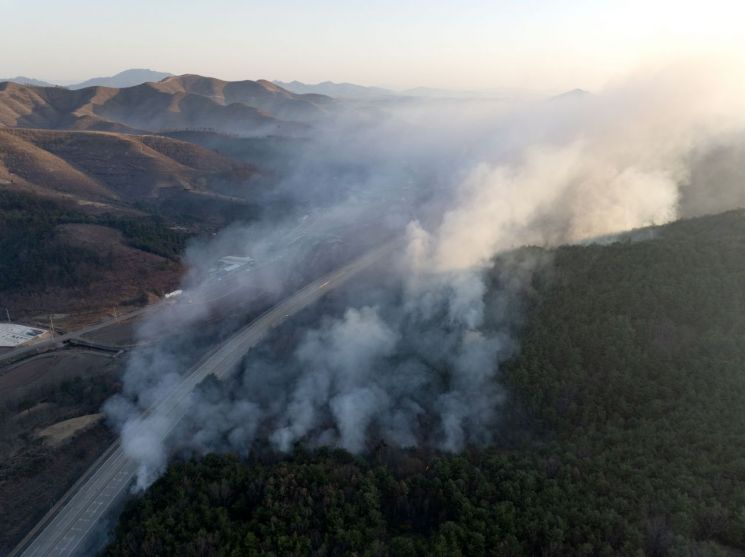
 On the 29th of last month, a wildfire broke out near Gohari, Namhu-myeon, Andong-si, Gyeongbuk, with smoke rising.
The Ministry of Environment and the Ministry of Agriculture, Food and Rural Affairs announced on the 3rd that they will implement an "Emergency Plan to Prevent the Spread of African Swine Fever (ASF) in Wild Boars during Spring" to manage ASF in the wildfire-affected areas of Gyeongbuk.
The government will strategically redeploy 10 thermal imaging drones and 1,500 GPS-enabled capture traps mainly in Gumi and Gimcheon cities, Chilgok and Cheongdo counties in Gyeongbuk, and Okcheon and Yeongdong areas in Chungbuk, which are located along the ASF containment line. Additionally, five feeding sites will be established to lure wild boars for concentrated capture. In areas difficult for human access, 12 detection dogs will be deployed to collect carcasses.
With the farming season underway, environmental samples such as soil and water around pig farms will be collected and analyzed in advance to check for ASF virus transmission factors. Hunters, hunting dogs, firearms, and carcass storage facilities, which could potentially cause artificial transmission, will be under intensive surveillance. To prevent contamination sources, safety management inspections will also be conducted to check for leachate leakage, loss, or collapse.
This measure aims to prevent the spread of ASF caused by the Gyeongbuk wildfires. The large-scale wildfires that occurred last month in Uiseong and Cheongsong, Gyeongbuk, have significantly altered the habitat environment of wild boars in the region. There is concern that ASF could spread as wild boars die or move to other areas.
Meanwhile, the government will revise the "Standard Operating Procedure (SOP) for Wild Boar African Swine Fever (ASF)." This is to eradicate fraudulent acts such as collecting samples over a period after capturing wild boars and submitting them all at once, or splitting samples to apply for rewards multiple times.
Kim Tae-o, Director of the Natural Conservation Bureau at the Ministry of Environment, explained, "The risk of disease transmission may increase due to large-scale wildfires and the full-scale farming activities," adding, "We will do our best to prevent the spread of ASF in wild boars caused by wildfires by implementing tailored measures including the introduction of scientific techniques."
© The Asia Business Daily(www.asiae.co.kr). All rights reserved.

















