Damage to SME Partners Supplying Parts and Materials Snowballs
Ministry of SMEs and Startups and Korea Customs Service Hold Joint On-site Meeting
"Support Needed for Discovering Alternative Markets and Securing Supply Chains"
U.S. President Donald Trump’s announcement of a 25% reciprocal tariff on Korea has put domestic small and medium-sized enterprises (SMEs) on high alert. Following steel and aluminum, automobiles are now subject to high tariffs, which could cause the damage to small partner companies supplying intermediate goods such as parts and materials to large corporations entering the U.S. market to snowball. Experts advise that since the government’s rapid financial support measures are temporary, long-term support policies to discover alternative markets should be strengthened.
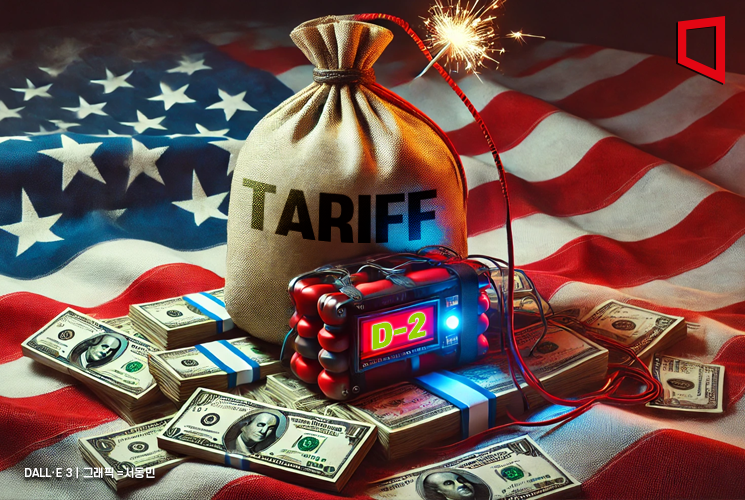
According to the government and SME sectors on the 3rd, following the Trump administration’s decision to impose reciprocal tariffs that day, thousands of SMEs supplying parts to major automakers such as Hyundai Motor, Kia, and Korea GM have been directly hit. Especially, small parts manufacturers without production bases in the U.S. have no choice but to bear the full burden of tariffs, unlike large corporations. According to the Korea International Trade Association, last year’s total exports to the U.S. amounted to $127.8 billion, with the highest share being 'automobiles' ($34.74 billion), followed by 'general machinery' ($15.07 billion), 'semiconductors' ($10.68 billion), and 'auto parts' ($8.22 billion).
Cases of SMEs suffering damage due to failure to deliver scheduled export volumes or indefinite delays are already emerging. Choi, the CEO of an SME operating an auto parts factory in Pyeongtaek, Gyeonggi Province, said, "Since last month, inquiries for exports to the U.S. have completely stopped, and we have yet to secure any delivery orders," adding, "But we cannot tighten our belts and lower prices to offset the tariff increase."
Related authorities, including the Ministry of SMEs and Startups, have also rolled up their sleeves to prepare support measures. On the morning of the same day, the Ministry of SMEs and Startups and the Korea Customs Service held a joint on-site meeting and announced rapid financial support measures for tariff-affected companies through programs such as the 'Export Baro Program.' As part of the Ministry’s export voucher project, a fast-track method is applied, providing support within one month after application. Additionally, they plan to connect regional SME offices with nationwide main customs offices to promptly provide necessary tariff information to exporting SMEs at regional SME offices.
Although the government has stepped up support, the industry’s general view is that these are temporary measures to put out the fire, and the support scale of only 29 billion won through the 'Export Baro Program' is clearly limited. Considering the current industrial structure’s high dependence on the U.S., voices calling for urgent consideration of more fundamental and structural alternatives are growing louder.
Professor Jung Se-eun of the Department of Economics at Chungnam National University said, "This tariff measure is tantamount to proof that the U.S. has become an unreliable trading nation," adding, "In the current situation, rapid financial support is only a temporary measure to overcome the situation, and relevant authorities must take action to pioneer new markets such as China and Russia and secure supply chains."
© The Asia Business Daily(www.asiae.co.kr). All rights reserved.
![Clutching a Stolen Dior Bag, Saying "I Hate Being Poor but Real"... The Grotesque Con of a "Human Knockoff" [Slate]](https://cwcontent.asiae.co.kr/asiaresize/183/2026021902243444107_1771435474.jpg)











