"The Size of Authority Ultimately Proportional to Responsibility"
A President with Excessive Power and Insufficient Checks
Need to Curb Presidential Authority Through Constitutional Amendment
And Establish Mechanisms to Check Legislative Power
Pursue Constitutional Amendments for Technology, Welfare, and Local Governments as Well
People Power Party lawmaker Ahn Cheol-soo declared his support for President Yoon Suk-yeol less than a week before the 2022 presidential election, achieving a last-minute unification. Ahn and President Yoon promised to create a "National Unity Government" through this unification. After President Yoon's election, Ahn was appointed chairman of the presidential transition committee, leading many to believe this vision would be realized, but Ahn was eventually excluded.
On the 3rd, in a phone interview with Asia Economy, Ahn shared behind-the-scenes stories following the unification. He said, "It was not like the DJP coalition (a coalition cabinet formed for about three years after the inauguration of the Kim Dae-jung administration) where things were split evenly. I only proposed recommending people and policies in areas where I have expertise, such as healthcare, management, and education, but (President Yoon) did not use the people I recommended and instead started appointing others."
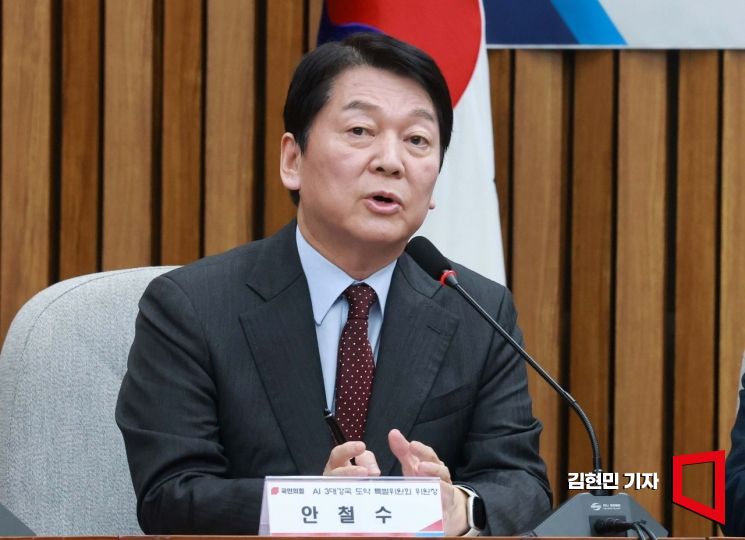 Ahn Cheol-soo, a member of the People Power Party, is speaking at the party-government meeting to strengthen AI competitiveness held at the National Assembly on February 18. 2025.2.18 Photo by Kim Hyun-min
At the time, Ahn remained silent. When asked why he held back, he said, "Ultimately, the size of authority is proportional to the size of responsibility. I interpreted it as the president himself taking full responsibility for the entire state affairs." He added, "We made promises in front of the entire nation during the unification, but in the end, those promises were not kept. Watching policies being pushed forward, such as healthcare reform and cuts to university research funding, was truly regrettable."
Ahn emphasized, "The system has excessive power but insufficient checks and balances, so no matter how capable a person is, being human means mistakes can happen. But when people are not allowed to speak about those mistakes, and those mistakes accumulate, the president's approval rating sharply declines as the term progresses. The presidential powers need to be reduced."
"A Situation Requiring Reduction of Presidential Powers"
Ahn explained that the reason why the Korean president is called a "kingly president" is because the powers held by the president are like the "One Ring" from the novel The Lord of the Rings. The president holds authority over the entire administration, has personnel rights to appoint ministers even if the National Assembly rejects them, possesses audit rights, and can even exercise legislative power through government legislation.
To reduce presidential powers, Ahn believes constitutional amendment is essential. He pointed out, "Since the 1987 system, five presidents have gone to prison, two presidents had sons who went to prison, one president made an extreme choice. Even President Moon Jae-in seems to be on the verge of being summoned by the prosecution. Ultimately, the problem is not the person but the system."
As a measure to reduce presidential powers, he argued that the Board of Audit and Inspection should be made an independent constitutional body rather than part of the executive branch, so it can audit the executive. At the same time, he expressed the need for legislative reform. He said, "Excessive legislative power can paralyze the government. You can see this from impeaching 30 people over 300 days." He added, "If an independent audit body is established, it could conduct preliminary reviews when the National Assembly processes impeachment motions, preventing the government from functioning for political purposes."
However, Ahn stressed that before restructuring the power system, changes related to IT technology support need to be made, and a constitutional amendment including provisions to strengthen the state's responsibility for citizens' welfare and to transfer powers monopolized by the central government to local governments is necessary to improve citizens' basic rights.
Although not a constitutional amendment issue, Ahn also emphasized the need to reform the election law. The current winner-takes-all system produces wasted votes. When there is a gap between the actual thoughts of the people and the elected legislative body, trust is ultimately lost. Ahn predicted, "If members are elected through a multi-member district system like Germany's, wasted votes can be reduced. This would mean no party would hold a majority, coalition governments would be inevitable, and differing opinions would result in moderate policies."
© The Asia Business Daily(www.asiae.co.kr). All rights reserved.
![Clutching a Stolen Dior Bag, Saying "I Hate Being Poor but Real"... The Grotesque Con of a "Human Knockoff" [Slate]](https://cwcontent.asiae.co.kr/asiaresize/183/2026021902243444107_1771435474.jpg)











