South Korea and Japan Can Use Advanced Technology as a Bargaining Chip in Tariff Negotiations
Room Remains for Further Negotiations Despite Trump's Tariff Bomb
On the 2nd (local time), as U.S. President Donald Trump imposed a 'tariff bomb,' a former U.S. Department of Defense official predicted that South Korea and Japan could use their advanced technological capabilities as a 'card' in subsequent tariff negotiations. In the context of intensifying U.S.-China hegemonic competition, the U.S. could use technological cooperation with these countries as a means to pressure China.
Siddharth Mohandas, former Deputy Assistant Secretary of Defense for East Asia at the U.S. Department of Defense, made this forecast during a panel discussion titled "The Future of Trilateral Cooperation among South Korea, the U.S., and Japan" hosted by the think tank Center for Strategic and International Studies (CSIS) on the 2nd. The discussion was held prior to President Trump's tariff announcement.
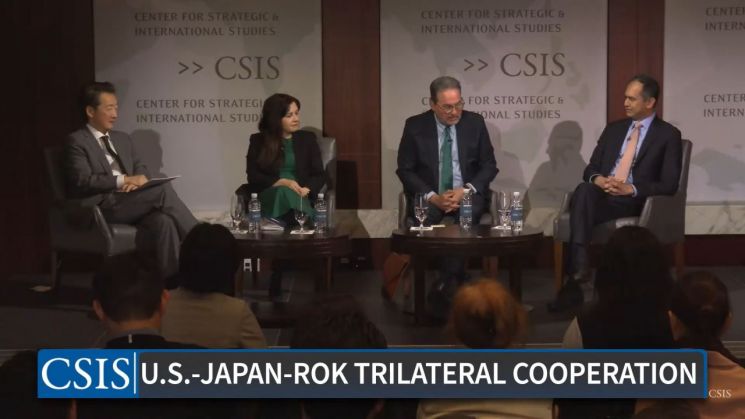 A roundtable on "The Future of Trilateral Cooperation among Korea, the U.S., and Japan" held by the Center for Strategic and International Studies (CSIS) on the 2nd (local time). Screenshot from CSIS YouTube
Former Deputy Assistant Secretary Mohandas said, "Whatever is announced regarding tariffs is not a final ultimatum," adding, "Allied countries that discuss issues such as security with the U.S. will have cards to play in tariff-related negotiations with the U.S."
He also noted, "The Trump administration has clearly stated that (reciprocal tariffs) are a 'table setting' for negotiations," and predicted that countries would be able to negotiate following the announcement of reciprocal tariffs. He continued, "There will be trade measures targeting China," emphasizing, "There is deep concern about China's overproduction problem, so coordination with allies will be a major part of addressing this issue."
He stressed, "To be effective in sanctions against China across all areas?including semiconductor technology competition, biotechnology, dual-use (military and civilian) technology, and space technology?advanced technology allies like South Korea and Japan are necessary."
This suggests that although President Trump imposed high tariffs on allies such as South Korea and Japan, he left room for subsequent tariff negotiations, allowing these countries to leverage cooperation in key technological fields as a bargaining chip in the U.S.-China hegemonic rivalry.
Despite the trade war intensifying with President Trump imposing high tariffs even on major allies, trilateral security cooperation among South Korea, the U.S., and Japan is expected to continue. Michael Green, a nonresident senior adviser at CSIS and former director for Asia at the White House National Security Council (NSC) during the George W. Bush administration, said, "Defense cooperation between the U.S. and its allies will continue to grow despite the fallout from tariffs, and trade conflicts will not stop this," adding, "Because China is a more threatening presence."
© The Asia Business Daily(www.asiae.co.kr). All rights reserved.

















