Three major domestic art support organizations?the Korea Arts & Culture Education Service, the Arts Management Support Center, and the Korea Artists Welfare Foundation?are planning to establish an integrated regional office.
On the 2nd, the Ministry of Culture, Sports and Tourism (MCST) held a forum on the roles of art support organizations at the Artist’s House in Daehangno, Seoul, announcing this plan. This is part of MCST’s top policy priority, "Balanced Regional Cultural Development." The aim is to rebuild a cooperative system for cultural and artistic policies between central and regional levels by establishing integrated regional offices.
Last month on the 6th, MCST announced ‘Cultural Korea 2035,’ a cultural and artistic policy vision for the next 10 years. Among the six core tasks, the first was selected as balanced regional cultural development, prioritizing the relocation of national art organizations and institutions to regions and the reconstruction of cooperation models.
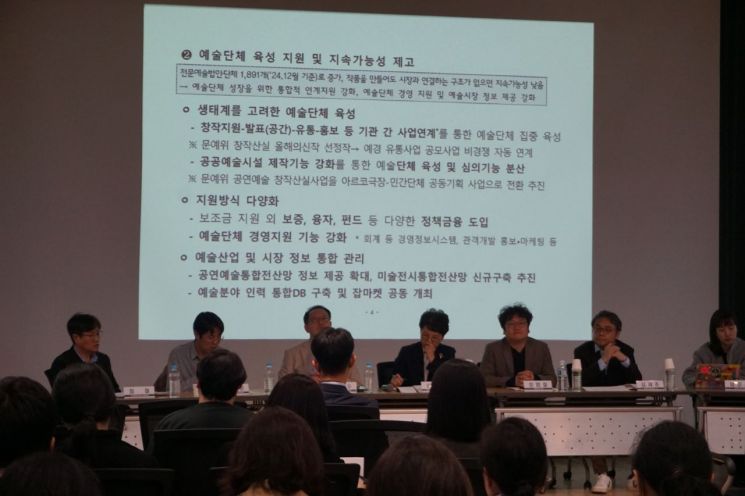 On the 2nd, participants are discussing the agenda at a forum on the role of art support organizations held at the Artist's House in Daehangno, Seoul.
Through the integrated regional offices, the plan is to reduce overlapping functions among the three art support organizations and the 152 regional cultural foundations nationwide, and to expand cooperative projects within the regional cultural and artistic ecosystem. Currently, there are 152 regional cultural foundations across the country. The metropolitan-level regional cultural foundations, which began with the Gyeonggi Cultural Foundation in 1997, have increased to 17, and the local government-level regional cultural foundations have been established in 135 municipalities nationwide since Gangneung in 1998.
Kang Ji-eun, head of the Arts Policy Division at MCST, emphasized the necessity of establishing integrated regional offices, stating, "It is necessary to reduce overlapping functions and expand cooperative projects to develop the regional cultural and artistic ecosystem."
MCST is considering establishing integrated regional offices in five zones (Capital area, Gangwon area, Chungcheong area, Gyeongsang area, and Jeolla area). Since the Arts Management Support Center is located in Seoul and the Korea Arts & Culture Education Service headquarters is in Naju, Jeollanam-do, the plan is to open new integrated offices in the Gangwon, Chungcheong, and Gyeongsang areas. The establishment is scheduled to begin next year.
Additionally, to facilitate smooth market connections for artworks by art organizations, MCST plans to strengthen integrated linkage support and manage art industry and market information comprehensively to improve convenience, allowing artists to utilize information more efficiently.
Meanwhile, MCST is facing conflicts with some organizations while promoting the relocation of national art organizations to regions. The national art organizations targeted for relocation have repeatedly issued statements opposing the move, calling it "unilateral government control."
In response, Yong Ho-seong, the first vice minister of MCST, stated, "We will actively communicate with art organizations." He added, "Although MCST has received much criticism during the policy announcement process, we realized the importance of creating more opportunities to share and discuss policy content. We will establish a discussion framework and gather opinions during the process to develop the policy further."
© The Asia Business Daily(www.asiae.co.kr). All rights reserved.
![Clutching a Stolen Dior Bag, Saying "I Hate Being Poor but Real"... The Grotesque Con of a "Human Knockoff" [Slate]](https://cwcontent.asiae.co.kr/asiaresize/183/2026021902243444107_1771435474.jpg)
















