From $50,000 to $1.5 Million Per Vessel
U.S. Energy and Agriculture Sectors Voice Discontent
USTR Considers Trade Remedies Including Section 301
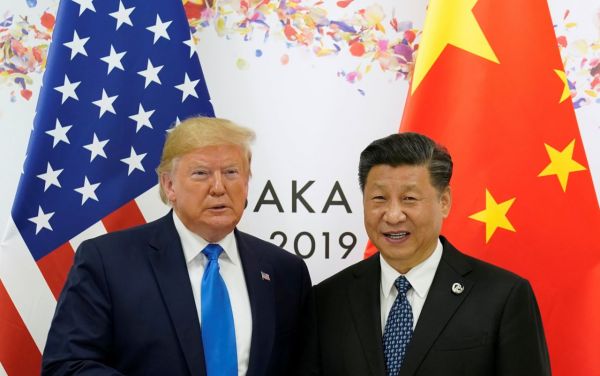 In 2019, Donald Trump (left), President of the United States, and Xi Jinping, President of China, are taking a commemorative photo before their bilateral summit at the G20 (Group of Twenty) summit held in Osaka, Japan. Photo by Reuters-Yonhap News
U.S. President Donald Trump is pushing ahead with sanctions on Chinese vessels despite complaints from domestic energy and agricultural companies. If the U.S. Trade Representative (USTR) finalizes plans to impose fines on shipping companies using Chinese-made or China-operated vessels, port entry costs could increase up to 30 times the current rates, according to some analyses.
On the 2nd (local time), the South China Morning Post (SCMP) cited the maritime traffic information site MarineTraffic, reporting that the current port entry cost for Chinese bulk carriers or oil tankers is about $50,000, but under U.S. sanctions, the cost could soar to as much as $1.5 million.
Given the high proportion of Chinese vessels in the shipping industry, the future impact is expected to be significant. According to MarineTraffic, from January to the end of February last year, 2,717 vessels built at Chinese shipyards entered U.S. ports, with a total of 16,870 port entries.
The USTR also directly targeted the Chinese shipping industry in its "2025 National Trade Estimate Report on Foreign Trade Barriers (NTE)" published on March 31. While the NTE is an annual report assessing trade barriers by country, this edition was particularly significant as it was prepared ahead of the U.S. reciprocal tariffs taking effect on April 2. It is also expected to serve as a benchmark for future reciprocal tariff policies by country.
The report pointed out, "The U.S. shipbuilding industry faces a serious challenge of losing commercial shipbuilding capacity and competitiveness." It added, "This is largely due to unfair practices by the Chinese shipbuilding industry." The report also noted that China's commercial vessel market share increased from 5% in 1999 to over 50% in 2023.
Furthermore, it stated, "We continue to consider the use of trade remedies, including Section 301 of the Trade Act of 1974, to address the harm." Earlier, the market had reported that the U.S. government was considering measures such as increasing port entry fees exclusively for Chinese vessels.
Within the U.S., concerns have been raised not only by the shipping industry but also by the energy and agricultural sectors. At a two-day public hearing held last week by the USTR to gather opinions, Alejandra Castillo, president of the North American Export Grain Association (NAEGA), said, "About one-quarter of grain and 40% of oilseed crops produced in the U.S. are exported," emphasizing that "this is a key support for American agriculture and rural economies." According to NAEGA, about 50% of the world's bulk cargo shipping vessels are built at Chinese shipyards, while U.S.-built vessels account for only 0.2%.
NAEGA stated that if the measure is implemented, it plans to request exemptions for agricultural exports as well as essential imported materials for agricultural production and livestock feed industries. The U.S. Soybean Export Council expressed similar concerns.
The International Dairy Foods Association (IDFA) also issued a public statement criticizing the USTR report immediately after its release on March 31. They commented that imposing port entry fees of up to $1 million on Chinese vessels and effectively sanctioning them would negatively impact the U.S. dairy industry.
Meanwhile, the sale of the Panama Canal operating rights, triggered by U.S.-China tensions since President Trump's inauguration, is also causing controversy. Originally, CK Hutchison Holdings of the Li Ka-shing Group, which operated the Panama Canal, announced on April 4 that it would sell all port assets outside China, including Panama, to a consortium led by U.S. investment firm BlackRock for $23 billion. However, the Chinese government has blocked this. According to SCMP, due to China's antitrust review, the deal is unlikely to be completed before the unofficial deadline of April 2.
© The Asia Business Daily(www.asiae.co.kr). All rights reserved.

















