Industrial Water Cluster Plans Finalized at Briefing Session
Treated Wastewater to Be Filtered Through Seawater Desalination Facility
"Industrial Water Supply to Begin in 2030 Upon Completion of Occupancy"
The city of Busan (Mayor Park Hyungjoon) announced on the 2nd that it has established an 'Industrial Water Supply Plan for the Eastern Busan Industrial Complex' utilizing the Gijang Seawater Desalination Facility to alleviate the burden on businesses in the Eastern Busan Industrial Complex.
On this day, the city held a briefing session in the city hall video conference room on the supply of industrial water to the Eastern Busan Industrial Complex using the Gijang Seawater Desalination Facility and the site of the former Gangseo Industrial Water Purification Plant, as well as plans for the creation of the Busan Water Industry Cluster.
Attending the briefing session were Mayor Park Hyungjoon, city council members Lee Seungwoo and Park Jongcheol, representatives from demand companies (Koryo Steel, Sungwoo Hitech, Geumyang, Asan Innotech, Ganglim Insu, etc.), the Eastern Busan Industrial Complex Development Council, and the Clean Water Industry Promotion Association?about 20 people in total?who decided on the optimal supply plan.
This supply plan involves supplying industrial water by reusing treated wastewater discharged from sewage treatment plants near the Eastern Busan Industrial Complex, such as Gijang and Ilgwang. It is the first system of its kind to be introduced in the Busan-Ulsan-Gyeongnam region.
While the Western Busan Industrial Complex has been using industrial water at a rate of 1,140 won per ton, companies in the Eastern Busan Industrial Complex have had to use domestic water at a much higher rate of 2,410 won per ton due to the lack of an industrial water supply.
As a result, since last year, businesses in the Eastern Busan Industrial Complex have complained about difficulties in their operations due to the high cost of domestic water, prompting the city to immediately begin devising a plan to supply more affordable industrial water to the area.
The city comprehensively reviewed three options utilizing existing water sources and two options utilizing treated wastewater for supplying industrial water to the Eastern Busan Industrial Complex. As a result, it selected the optimal plan of reusing treated wastewater from the Gijang and Ilgwang sewage treatment plants, filtering it through the seawater desalination facility, and producing industrial water.
The three options using existing water sources were deemed unsuitable due to the high project cost of at least 100 billion won, concerns about increased user fees, and the city's financial losses from covering the difference between production costs and user fees.
Of the two options utilizing treated wastewater from sewage treatment plants near the Eastern Busan Industrial Complex, the optimal plan was selected as the one that links the currently idle Gijang Seawater Desalination Facility for use.
Accordingly, 7.99 billion won will be invested to install 24 km of water pipelines and refurbish the core reverse osmosis facility at the Gijang Seawater Desalination Facility, enabling a stable supply of 36,000 tons of industrial water per day to the Eastern Busan Industrial Complex.
The industrial water supply rate will be 800 won per ton, which is expected to significantly reduce the burden on companies in the Eastern Busan Industrial Complex.
Of the Gijang Seawater Desalination Facility, a 9,000-ton unit will be established as a demonstration facility for water industry research and development and technology verification.
This will enable specialized demonstration, certification, and research on Busan's advanced desalination technology, as well as research and demonstration in cutting-edge water industry fields such as seawater desalination technology advancement, brine resource utilization, salinity gradient power generation, and hydrogen production.
The city aims to begin supplying industrial water in 2030, when occupancy of the Eastern Busan Industrial Complex is complete, and will proceed without delay with related administrative procedures such as signing MOUs with demand companies, securing national funding, and selecting private investment (BTO) operators.
Mayor Park Hyungjoon stated, "The reuse of treated wastewater is a significant step toward stably supplying industrial water to the Eastern Busan Industrial Complex and enabling future-oriented circular use of water resources. At the same time, it is an innovative plan to utilize the seawater desalination facility, which has been idle for a long time. We will ensure the smooth implementation of this project to transform Busan into a leading water circulation city in Korea and establish it as a global hub for the water industry."
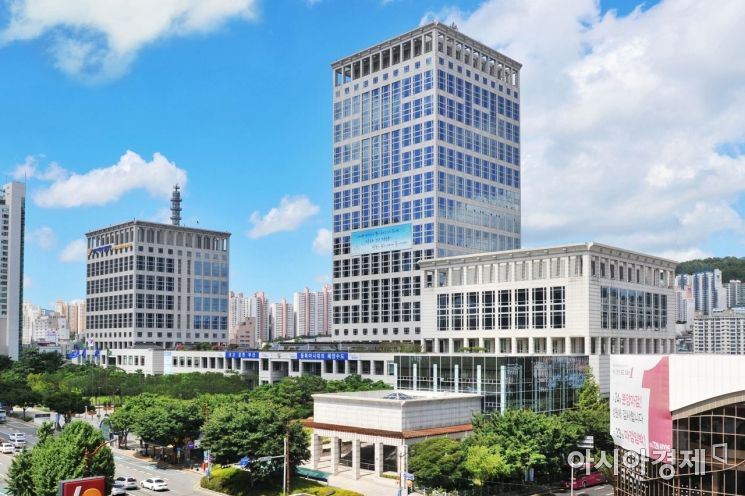 Busan City Hall.
© The Asia Business Daily(www.asiae.co.kr). All rights reserved.
















