If Yoon’s Impeachment Is Upheld, Early Presidential Election Will Spark a “Race for Clarity”
If Dismissed or Rejected, Political Turmoil Likely to Stall Negotiations
Commercial Act Amendment: Ruling Party Says “Party-Line Rejection,” Opposition Vows “Renewed Push”
With the Constitutional Court scheduled to deliver its ruling on President Yoon Suk Yeol’s impeachment trial on April 4, negotiations between the ruling and opposition parties over the supplementary budget (extra budget) have effectively come to a halt. The two sides have yet to narrow their differences over whether the budget should be set at 10 to 15 trillion won, as proposed by the government, or at 35 trillion won, as proposed by the Democratic Party of Korea. Regardless of the outcome of President Yoon’s impeachment ruling, intense confrontation is expected to follow.
According to political sources on April 2, Kweon Seongdong, floor leader of the People Power Party, told reporters at the National Assembly the previous day that it may be difficult to discuss the extra budget before the impeachment ruling is delivered. He said, “The government’s proposal has not even been submitted yet. Once it is submitted, it must be reviewed by the Special Committee on Budget and Accounts and by each standing committee.”
On this day as well, the policy chiefs of both the People Power Party and the Democratic Party of Korea remained at odds over the scope of the extra budget. Kim Sanghoon, the People Power Party’s policy chief, said in an interview with MBC Radio on the morning of April 2, “We are planning to set the budget at 10 trillion won, including support for people’s livelihoods. Although I have not seen the detailed allocation, I expect about 3 trillion won will be allocated to stimulate the economy.” He also made it clear that the Democratic Party’s proposal for a 250,000-won payment to all citizens was excluded. Kim further emphasized that this supplementary budget is intended for recovery from wildfire damage in the Yeongnam region.
Regarding the specific timing for the government to submit its extra budget proposal to the National Assembly, Kim said, “On December 10 last year, the Democratic Party unilaterally cut the budget. This time, it must not be handled unilaterally. We are asking for a promise that it will be processed by agreement between the ruling and opposition parties, but the Democratic Party has not responded.” He stressed, “Since the right to review the budget lies with the National Assembly, it must be reviewed through bipartisan consultation.”
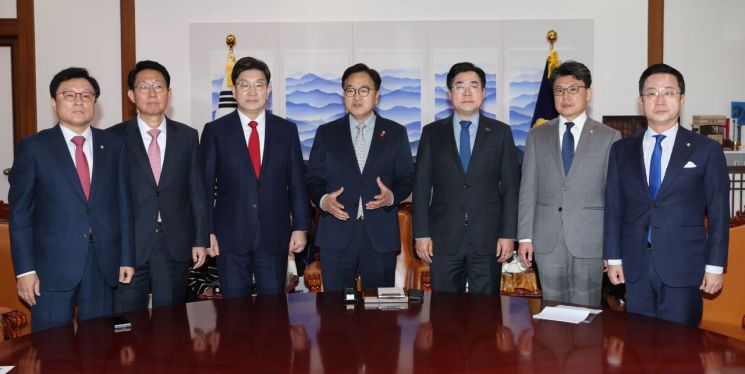
On the other hand, Jin Sungjoon, the Democratic Party’s policy chief, reiterated on MBC Radio that the government’s extra budget proposal is nothing more than a “stopgap measure,” making it clear that there is no intention to reach an agreement. Jin pointed out, “Not only wildfires, but our economy has been mired in a prolonged recession, and the growth rate is expected to fall even further. There are even forecasts that growth will remain in the 0% range. We are in a desperate situation that requires at least minimal economic defense.” Jin also argued, “If funding is needed for wildfire response, it can be included as a project item. The government should specify how much is needed for each item and submit that. Instead, they are lumping everything together into the reserve fund without proper estimates, but the reserve fund is already sufficient.”
There are also predictions that negotiations over the extra budget will become even more difficult after the ruling on President Yoon’s impeachment. If the impeachment is upheld, the parties will likely engage in a competition for clarity in the lead-up to an early presidential election. If the impeachment is dismissed or rejected, the political arena itself could be thrown into turmoil. The large number of contentious bills, such as the amendment to the Commercial Act and the bill to extend the terms of Constitutional Court justices, is also a problem. Kim stated that regarding the amendment to the Commercial Act, for which Prime Minister and acting President Han Ducksoo exercised the right to request reconsideration (veto), “Our party’s lawmakers share concerns over several issues, so if it is adopted as the party’s official position, I believe it will be rejected in the plenary session upon re-vote. The problems are serious enough that it is highly likely to become the party’s official stance.” Jin countered, “Korean companies have long been run opaquely by controlling shareholders, causing significant harm to minority shareholders. Correcting this is in line with global standards. If the amendment is voted down, we will push for it again.”
© The Asia Business Daily(www.asiae.co.kr). All rights reserved.

















