Overall Prices of Agricultural and Livestock Products Stabilize... Up 0.4% in March
Wildfire Damage Surveys and Supply-Demand Impact Analysis Planned
Although prices of agricultural and livestock products are stabilizing, the government has decided to continue supplying stockpiled quantities, expanding imports, and providing discount support to ease consumer burdens on cabbage, radish, cabbage, carrots, and other items whose prices have risen due to supply shortages.
The Ministry of Agriculture, Food and Rural Affairs announced on the 2nd that the consumer price index for agricultural and livestock products rose by 0.4% compared to the same month last year.
Prices of agricultural products fell by 1.1% year-on-year as prices of fruits and facility-grown vegetables stabilized. A ministry official explained, "Prices of cabbage, radish, cabbage, and carrots, whose production has decreased, and onions, which have a higher loss rate during storage, are showing strength," adding, "Production of cabbage, radish, cabbage, and carrots decreased due to high temperatures during the transplanting (sowing) period in August-September last year and poor growth caused by heavy snow and cold waves in winter."
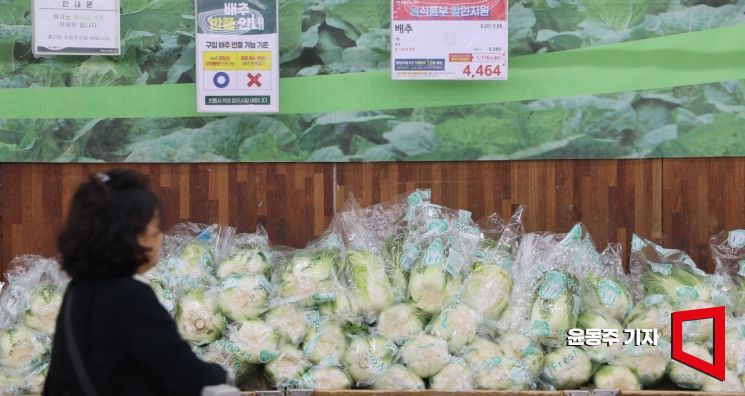
According to a survey by Dae-A Cheonggwa, a wholesale corporation at Garak Market, cabbage stockpiles as of the 31st of last month were 48,290 tons, an increase of 10.1% compared to last year and 3.8% compared to the average year. However, the Ministry of Agriculture, Food and Rural Affairs expects prices to remain somewhat high due to strong prices forecasted in April and substitution consumption of radish caused by decreased production.
Winter cabbage and winter carrots, mainly produced in Jeju, are in the final stages of harvest, and recent favorable weather conditions have improved growth. Accordingly, wholesale prices peaked in early March and have turned downward, but prices are expected to remain somewhat higher than the previous and average years in April.
To alleviate supply shortages of cabbage, radish, cabbage, and carrots, the ministry is expanding private imports by applying an allocation tariff (0% tariff rate) until the end of this month. The government is also promoting direct imports of cabbage and radish. Additionally, to ease consumer burdens, discount support (up to 40%) is being provided at large supermarkets and traditional markets not only for cabbage, radish, and cabbage but also for carrots and substitute vegetables such as young radish leaves and Eolgari.
Along with this, the ministry imported the entire quota (26,450 tons) of the 2025 low-tariff quota (TRQ) by early this month and is distributing domestic stockpiles (1,130 tons) to the market.
Livestock products showed a 3.1% increase compared to the same month last year, with pork prices higher than last year. The ministry attributes the rise in pork prices to increased demand for domestic substitutes such as hind legs, as prices of imported raw materials used for meat processing rose due to exchange rate effects. Accordingly, the ministry plans to ease consumer burdens through discount events using the Korean Pork Fund and to accurately assess pork inventory levels and consider applying allocation tariffs on raw materials for processed meat through the Livestock Supply and Demand Adjustment Council.
Egg supply and prices are relatively stable, but to stabilize prices of food products such as bakery and confectionery that use eggs as raw materials, the ministry plans to consider applying allocation tariffs on processed egg products.
Processed food prices rose 3.6% year-on-year due to factors such as raw material prices, exchange rates, and labor cost increases. The ministry plans to expand the list of food raw materials subject to allocation tariffs (from 13 to 19 items), provide tax benefits such as import VAT exemptions on some items, and support purchasing funds for food materials such as wheat, cocoa, coffee, and oils to reduce the management burden on the food industry. It will also manage food prices to stabilize through continuous communication.
Dining-out prices rose 3.0% year-on-year due to complex factors including food material costs, labor costs, rent, and delivery app fees. The ministry plans to ease the management burden on the dining-out industry by expanding the introduction of foreign workers, building a portal on the 7th that consolidates public delivery apps scattered across local governments to promote competition with private delivery apps.
Following recent large-scale wildfires centered in the Gyeongnam and Gyeongbuk regions, the ministry plans to conduct rapid damage surveys and impact analyses amid concerns that agricultural and livestock product prices may rise. The wildfire-affected areas are major production regions for spring cabbage, garlic, dried chili peppers, apples, and plums, so some items may be affected in supply and demand.
Additionally, the ministry plans to support the livelihood stabilization and swift return to farming of farmers in the affected areas and prepare and implement preemptive supply stabilization measures if negative impacts on agricultural product supply and demand are anticipated. In particular, for fruit orchards such as apple orchards directly damaged by the wildfires, the ministry will actively promote support measures for orchard maintenance and new facility and seedling establishment.
© The Asia Business Daily(www.asiae.co.kr). All rights reserved.

















