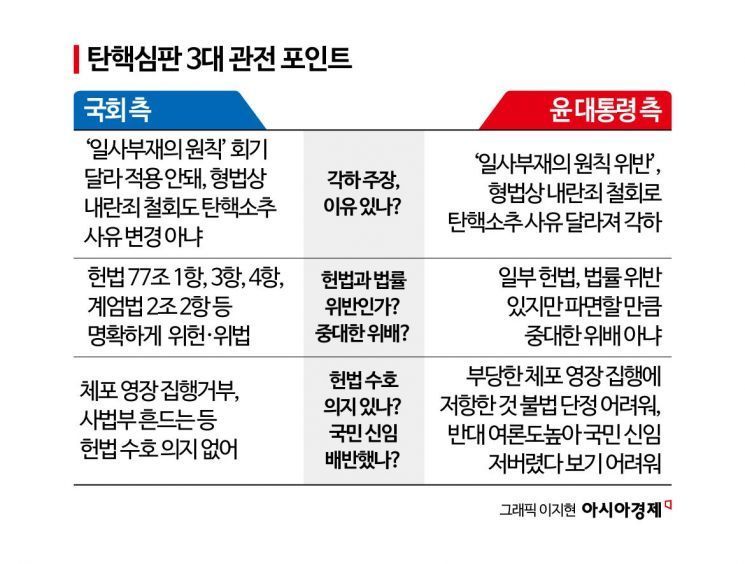
① Possibility of Dismissal Due to Withdrawal of the Treason Charge
② Is It a "Serious" Violation of the Law or Constitution?
③ Did He Betray the People's Trust?
On the morning of the 2nd, just two days before the Constitutional Court justices are set to deliver their ruling on President Yoon Seok-yeol's impeachment trial, they held a deliberation session to continue final discussions. It is reported that the conclusion regarding whether to dismiss President Yoon was already reached through a verdict on the 1st. During the deliberation on the 2nd, there were minor adjustments related to the wording of the decision document to be announced. The impeachment ruling will be finalized once the justices complete detailed opinion coordination and each justice signs the document.
The contents of the decision document on President Yoon's impeachment ruling mainly include ① judgments on procedural issues (preliminary objections), ② judgments on substantive issues regarding unconstitutionality, and ③ judgments on whether the respondent committed serious unconstitutional or illegal acts warranting dismissal. The document is written in this order, and it is highly likely that Acting Chief Justice Moon Hyung-bae will follow this sequence when reading the ruling.
◆Is the Withdrawal of the Charge of Treason a Ground for Dismissal?
The controversy over the withdrawal of the treason charge arose when the National Assembly side stated during the preparation hearing that they would "effectively withdraw the charge of treason under the Criminal Act" as grounds for impeachment. They requested that the court omit the treason charge, which is time-consuming and difficult to prove, and only judge the constitutional violation issue. President Yoon's side opposed this, arguing that withdrawing the treason charge amounts to withdrawing 80% of the impeachment charges and that the impeachment trial should be dismissed.
Legal opinions are divided. Professor Lim Ji-bong of Sogang University Law School said, "During former President Park Geun-hye's impeachment, the impeachment resolution initially included 'third-party bribery,' but during the trial, the grounds were changed to constitutional violations such as the freedom of corporate management," adding, "It is within the Constitutional Court's discretion to decide how to contest the grounds for impeachment." On the other hand, Professor Kim Sang-gyeom, Emeritus Professor at Dongguk University Law School, said, "Since a major part of the petition has been changed under procedural law, the legal requirements are dismissed."
◆Is it a Serious Violation of the Constitution or Law?
The Constitutional Court previously summarized five grounds for impeachment: violation of the requirements for declaring martial law, unconstitutionality and illegality of the proclamation, attempts to block the National Assembly by mobilizing military and police forces, orders to arrest politicians, and attempts to seize control of the National Election Commission. Many in the legal community view the deployment of martial law troops to the National Assembly and the Election Commission, as well as the improper declaration of martial law, as unquestionably unconstitutional and illegal. However, opinions may differ on whether these constitute 'serious violations.'
Professor Cha Jin-ah of Korea University Law School said, "To determine seriousness, it must be recognized that there was an 'intent' to block the National Assembly, and evidence must be examined to judge whether the arrest orders were actually given or whether lawmakers were ordered to be removed." Particularly, the 'order to arrest politicians' may be subject to differing opinions. The key issue is how the Constitutional Court assesses the credibility of the 'Hong Jang-won memo,' which is considered a decisive clue. If opinions on the memo differ, the justices may review interrogation records of suspects such as former commander Yeo and Police Chief Jo Ji-ho and may present separate supplementary opinions."
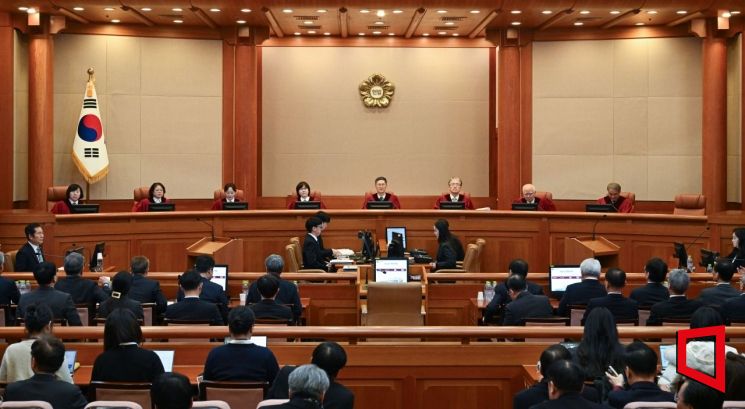 Acting Chief Justice Moon Hyung-bae and other constitutional justices entered the Grand Bench of the Constitutional Court in Jongno-gu, Seoul, on the 25th to attend the final arguments in the impeachment trial of President Yoon Seok-yeol, waiting for the trial to begin.
 ◆Did He Betray the People's Trust?
Eight years ago, the Constitutional Court cited 'commitment to uphold the Constitution' and 'betrayal of the people's trust' as decisive reasons for dismissing former President Park Geun-hye. During the Choi Soon-sil political scandal, Park promised cooperation in uncovering the truth through a public address but did not comply with special prosecutor or prosecution investigations and refused a search of the Blue House. The Court mentioned this in its ruling, stating, "From the perspective of upholding the Constitution, maintaining the presidency is unacceptable," recognizing the seriousness and ordering dismissal.
In President Yoon's case, refusal to cooperate with the Corruption Investigation Office for High-ranking Officials (CIO) investigation and failure to comply with an arrest warrant can be seen as similar acts. However, whether these are viewed as exercising the right to defense or as responsibility for perpetuating illegal situations is within the Court's judgment. Unlike former President Park's case, public opinion on impeachment is split 60-40. Professor Cha said, "Since there is room to dispute whether the exercise of public authority to execute the arrest warrant was legitimate, it is difficult to definitively say that there was illegal resistance to lawful official action." Professor Jung Tae-ho of Kyung Hee University Law School said, "President Yoon's pre-arrest recorded video, in which he incited supporters by saying 'the country's laws have all collapsed,' can be evidence showing a lack of commitment to uphold the Constitution."
© The Asia Business Daily(www.asiae.co.kr). All rights reserved.


















