Hyundai, Ford, Toyota, and Others See Sales Surge Last Month
"Urgency Grows to Buy Before Price Increases"
As the Trump administration's tariffs on imported cars are set to take effect, demand to purchase vehicles before prices rise in the United States has surged, leading to a sharp increase in sales for major automakers.
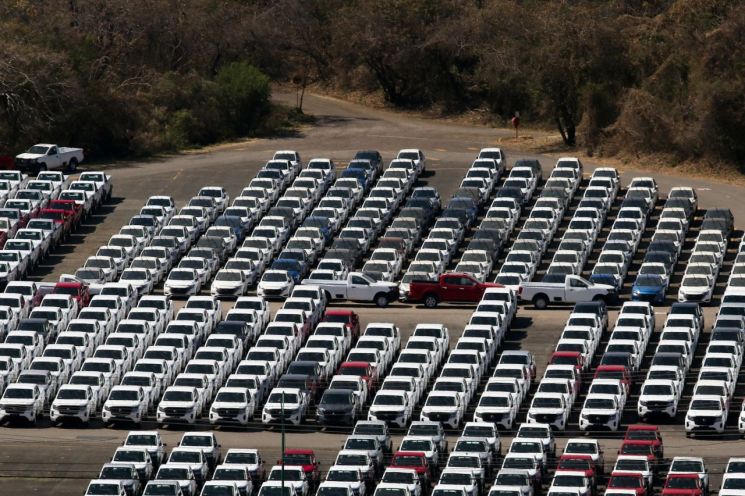
According to Bloomberg and The New York Times (NYT) on the 1st (local time), Ford's sales last month increased by 19% compared to the same period last year. Additionally, General Motors (GM) reported that its first-quarter sales this year rose by 17% compared to last year. During the same period, Hyundai and Kia's sales also increased by 10% and 11%, respectively.
Randy Parker, CEO of Hyundai Motor America, said, "Last weekend was the best weekend we've seen in a very long time," adding, "Especially, many people flocked to avoid the tariffs." Ret Likert, a dealer selling Ford, Chevrolet, and Hyundai vehicles in Ohio, also said, "There is a sense of urgency among consumers that they need to buy now before the price increases."
Thomas King, head of data and analytics at U.S. market research firm JD Power, explained, "The outlook on tariffs has already started to impact the industry," adding, "Sales last month were particularly strong. This is the result of consumers accelerating purchases to avoid tariff-related price increases."
In particular, demand surged for small cars as profitability is expected to deteriorate significantly once tariffs take effect, leading to substantial price hikes. Sales of GM Chevrolet's small sport utility vehicle (SUV) Trax, produced in Korea, jumped 57% last month compared to the same period last year, while sales of the small SUV Tucson and small sedan Elantra (Avante) also increased by more than 25%, setting record highs for the month.
Duane Paddock, a GM Chevrolet dealer, said the company unusually shipped a large amount of inventory to the U.S. in advance, considering the recent surge in consumer demand. Bloomberg reported that U.S. dealers typically hold 60 to 90 days' worth of inventory, allowing them to prepare for the immediate impact of tariff increases.
President Trump announced on the 26th of last month that a 25% tariff would be imposed on cars imported into the United States starting from the 3rd. He also stated that a 25% tariff would be applied to key components such as car engines, transmissions, and powertrains before the 3rd of next month.
The U.S. think tank Anderson Economic Group predicted that tariffs could increase vehicle production costs by up to $12,000. Bloomberg reported, "It is unclear how much of this new cost will be borne by automakers, parts suppliers, or consumers, but prices are expected to rise significantly," adding, "Especially, some low-priced models may become unsellable."
© The Asia Business Daily(www.asiae.co.kr). All rights reserved.

















