Ministry of Land, Infrastructure and Transport Revises 'Construction Work Quality Management Guidelines'
Industry Opposition Leads to Temporary Policy Shift
"Fundamental Solutions Needed, Not Just Simple Deregulation"
The government, which had announced plans to relax the installation standards for 'batch plants,' the ready-mix concrete production facilities within construction sites, has decided to take a step back and seek common ground for now. Until now, the installation and production of on-site batch plants were only allowed under restricted standards, providing business opportunities to nearby ready-mix concrete companies. However, after deciding to ease these restrictions, strong opposition from the ready-mix concrete industry led to the decision to continue discussions. Experts emphasize that instead of unconditional deregulation, fundamental solutions must be sought.
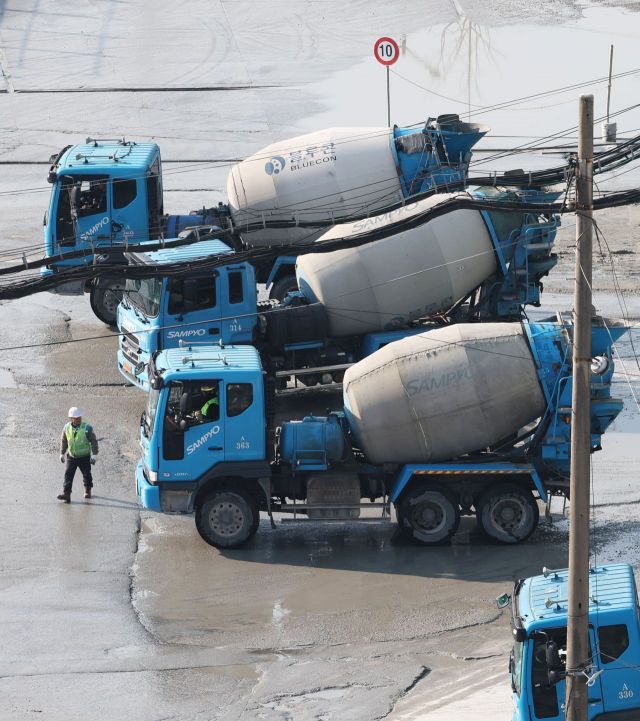 Ready-mix concrete trucks are busily moving at a ready-mix concrete plant in Seoul. Photo by Yonhap News
According to the government and related industries on the 2nd, the Ministry of Land, Infrastructure and Transport recently issued an administrative notice on the revision of the 'Construction Work Quality Management Guidelines,' which includes easing the standards for installing on-site batch plants, and collected opinions from institutions and organizations. This was part of the 'Measures to Revitalize the Construction Industry' announced by the government on December 23 last year.
However, the Ministry of Land, Infrastructure and Transport has recently shifted its stance to suspend the implementation of the revision, taking into account the voices of the ready-mix concrete and transportation industries. A ministry official said, "Since the industry's concerns are very significant, we intend to gather more opinions and find common ground to refine the plan," adding, "There are parts that the industry has misunderstood, so we plan to explain those accurately and take more time to bridge the gap."
An on-site batch plant refers to equipment that allows construction companies to directly produce and supply ready-mix concrete by combining cement, sand, gravel, and other materials at the construction site. Using this equipment has the advantage of improving construction efficiency by eliminating the need to procure ready-mix concrete from manufacturers.
Upon the disclosure of the Ministry of Land, Infrastructure and Transport's plan, the ready-mix concrete industry, including the Korea Ready-Mix Concrete Industrial Cooperative Federation, strongly opposed it. They argued that the revision would suffocate small and medium-sized ready-mix concrete companies nationwide. An industry representative said, "If batch plants are installed at many construction sites due to deregulation, there will be no need to use products from nearby ready-mix concrete companies, reducing their workload," and added, "We will closely watch how the ministry proceeds and are prepared to take stronger measures if necessary."
The core of the revision announced by the ministry is to expand the installation standards for on-site batch plants from being limited to 'island and remote areas or traffic congestion zones where supply to construction sites within 90 minutes is impossible' to 'all cases where supply to construction sites within 90 minutes is impossible.' It also includes removing the limit that restricted production at on-site batch plants to 50% or less of the required amount, allowing full production and supply of ready-mix concrete at the batch plant. Additionally, it permits the transportation of ready-mix concrete produced at on-site batch plants to nearby construction sites.
Experts propose 'diversification of ready-mix concrete production methods' as a way to resolve delivery disruptions at construction sites while minimizing industry damage. With the decision to close the Sampyo Pungnap plant by the end of this year, the number of ready-mix concrete plants remaining in Seoul will be reduced to two. This has raised concerns about difficulties in supplying ready-mix concrete to construction sites planned in areas such as Banpo, Hannam, and Jangwi-dong in Seoul.
Park Sangheon, a senior researcher at the Korea Construction Industry Research Institute, said, "In countries like the United States, 'dry-mix concrete,' where water is mixed directly at the construction site rather than at a ready-mix concrete plant, is used. Using this production method can solve many problems caused by the '90-minute on-site arrival' condition," adding, "Until now, there has been no attempt to try production methods other than wet-mix concrete domestically, but now efforts to diversify must be pursued simultaneously."
© The Asia Business Daily(www.asiae.co.kr). All rights reserved.

















