Obstacle to Rearmament in the EU and South Korea: Low Willingness to Enlist Among Citizens
Calls for Reflection: "We Have Abandoned the Youth"
Amid growing geopolitical anxieties worldwide due to U.S. President Donald Trump's unpredictable foreign policy, the reluctance of younger generations to enlist in the military is being reexamined as a social issue. Surveys have emerged showing that not only countries struggling to expand voluntary recruitment but also young people claim they have no intention of fighting even in the face of war threats.
Obstacle to European Rearmament... Youth Avoiding Military Service
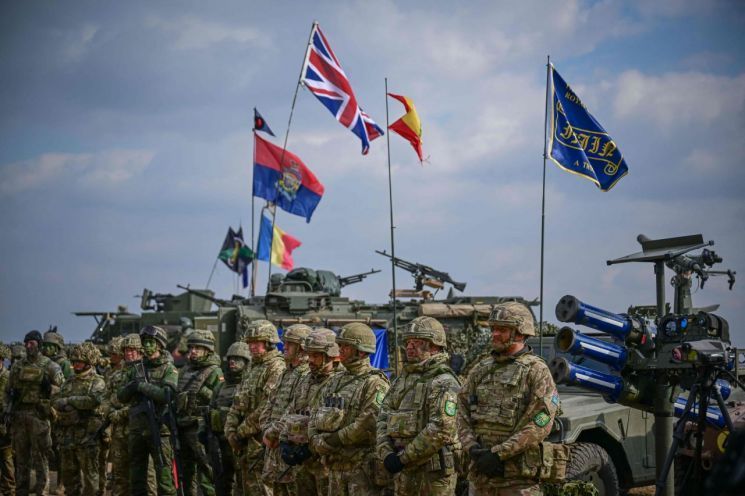 In February, soldiers from NATO member countries participated in joint military training at the Smardan training ground located in Gala?i, Romania. Photo by AFP
Earlier this year, as President Trump pushed forward ceasefire and peace negotiations with Russia, European countries began full-scale military rearmament. Although there are calls to spend 3-5% of Gross Domestic Product (GDP) on defense, the declining number of soldiers is hindering the expansion of European military power.
Germany is a representative European country where young people are avoiding military enlistment. Despite the German government investing a cumulative 100 billion euros (approximately 160 trillion won) in special funds to strengthen defense since 2022, the supply of young recruits is insufficient due to enlistment avoidance. According to the German Ministry of Defense, one in four (25%) of the new recruits enlisted by the German Army last year was discharged within six months. As a result of the decrease in young recruits, the total strength of the German military has dropped to about 180,000 personnel, and the average age of soldiers increased from 33.1 years in 2021 to 34 years last year.
Olle N?men, a freelance journalist in Germany, recently published a book titled "Why I Do Not Want to Fight for My Country." In a media interview, he argued, "(If occupied by a foreign power) life would be a mess, but that is better than dying."
In the UK, a survey revealed that young people have no intention of enlisting even in wartime. In February this year, market research firm YouGov asked the British Generation Z (born between 1997 and 2012) whether they would enlist and fight for their country if war broke out, and only 10% said they would enlist. This figure is half of the 22% who responded affirmatively in a similar survey conducted in 2004.
British Generation Z also appears less proud of their country compared to 20 years ago. In another YouGov survey, the proportion of young people who said they were proud to be British was 41% last year, about half of the 80% recorded in a similar survey in 2005.
Declining Willingness to Participate in Korean Peninsula War Domestically
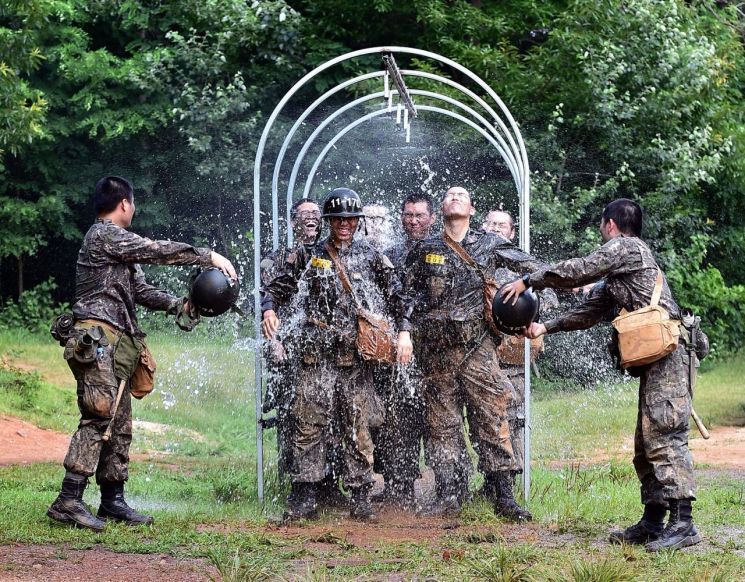 Trainees undergoing chemical, biological, radiological, and nuclear (CBRN) training. Photo by Yonhap News
South Korea is also experiencing a decline in willingness to participate in combat. According to a nationwide security awareness survey released by the Korea National Defense University last October, only 13.9% responded that they would "participate in possible combat" if a war broke out on the Korean Peninsula. The response rates to the same question have steadily decreased over the years: 22.7% in 2014 and 20.9% in 2020.
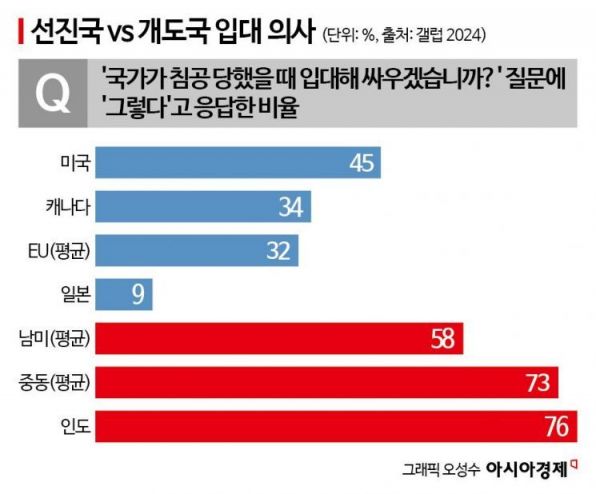
Last year, the international polling firm Gallup surveyed adults worldwide on their "willingness to defend their country." The proportion of citizens in developed countries who said they would enlist and respond to conflict was significantly lower than in developing countries. The European Union (EU) as a whole was at 32%, Canada at 34%, and Japan recorded the lowest at 9%. Even the United States, which had a relatively higher response rate, was at 41%, falling short of a majority. In contrast, the average in the Middle East, a region with many conflicts, was 73%, and 76% in India said they would enlist.
Gallup commented, "Citizens of developed countries are on average twice as unlikely to take up arms compared to those in developing countries," adding, "Although international conflicts have increased in recent years, the willingness to fight appears to have decreased in developed countries."
Experts attribute the weakened willingness to respond among citizens of developed countries, especially the youth, to prolonged economic recessions and political turmoil accumulated over many years. The British media outlet The Spectator pointed out, "The establishment has done nothing for young people struggling with housing rents and has instead pushed them into low-wage competition. It is natural that young people do not take pride in their country," adding, "We have abandoned the youth."
Professor Cho Jin-man of the Department of Political Science and Diplomacy at Duksung Women's University explained, "Many developed countries, including South Korea, have experienced various political crises such as the rise of populism and the crisis of the rule of law," and added, "The sense of loss and disappointment is likely greater among the younger generation, who are more familiar with democracy, than the older generation who experienced authoritarian politics."
However, the "rally 'round the flag effect" is an aspect that can be expected in emergencies. The rally 'round the flag effect is a political science term referring to the phenomenon where citizens show united will in the face of national crises, a theory devised by John Mueller, a political science professor at Ohio State University.
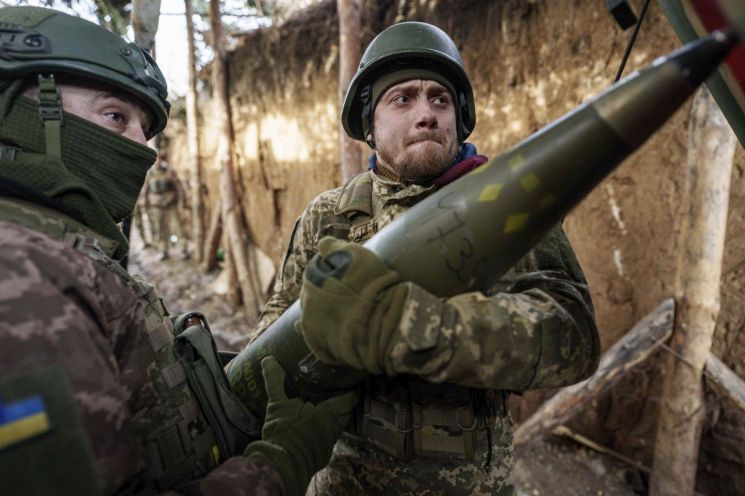
Currently, Ukraine is considered the country experiencing the most dramatic rally 'round the flag effect. According to an analysis by the Spanish international political think tank CIBOB, before the war, public opinion in Ukraine was conflicted between a conciliatory policy toward Russia and pro-EU and Western policies. However, since February 2022, when the invasion became imminent, public opinion has firmly shifted to anti-Russian and pro-Western stances. Since then, Ukraine has shown a clear will to resist.
© The Asia Business Daily(www.asiae.co.kr). All rights reserved.
!["The Woman Who Threw Herself into the Water Clutching a Stolen Dior Bag"...A Grotesque Success Story That Shakes the Korean Psyche [Slate]](https://cwcontent.asiae.co.kr/asiaresize/183/2026021902243444107_1771435474.jpg)


















