Commuters Can Reach Seoul Station from Unyang Station and Gamjeong-dong in 45-50 Minutes
Demand for Lines 33 and 33-2 Triples in Three Months, Boosting Citizen Satisfaction
City Plans to Make Rush Hour-Only Routes 70C and 70D Regular Lines
Gimpo City in Gyeonggi Province has proven the high practical operational effect as the demand for lines 33 and 33-2, which are connected to the GTX-A Kintex Station line opened on January 1 this year, tripled in just three months.
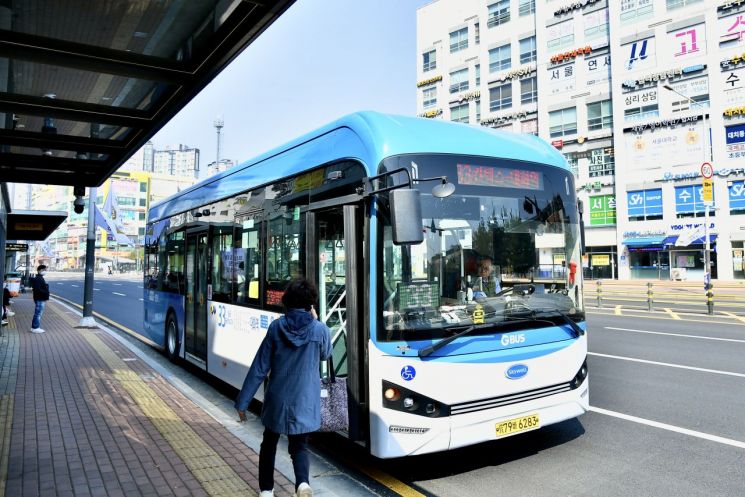 A citizen of Gimpo City is riding the No. 33 bus, a GTX-A Kintex Station connection line that opened on January 1. Provided by Gimpo City
Lines 33 and 33-2 were highly demanded by citizens to connect to nearby urban railways. Since last year, the city has proactively considered establishing connecting lines to enhance convenience for the Metropolitan Express Railway (GTX-A), which is scheduled to be extended and opened by the end of December 2024.
The city planned lines 33 and 33-2 after listening to various citizen opinions and accurately identifying difficulties through on-site administration. First, line 33 was designed to improve the convenience of northern area residents traveling to Hangang New Town, and by connecting Hangang New Town to GTX-A (Kintex Station) and Subway Line 3 (Daehwa Station), it secured convenience for travel toward Seoul and Goyang City.
Next, line 33-2 was planned to expand convenience for residents of the old downtown areas such as Sau-dong, Bukbyeon-dong, Gamjeong-dong, and Geolpo-dong for city travel, and by linking to GTX-A (Kintex Station), it made commuting by public transportation toward Seoul smoother.
At the time of planning, it was expected that traveling from Goldline Unyang Station or Gamjeong-dong (Homeplus) to Seoul Station via GTX-A Kintex Station using lines 33 and 33-2 would take about 45 to 50 minutes, allowing quick access to downtown Seoul, and this prediction proved accurate.
As a result of these efforts, three months after the operation of lines 33 and 33-2 began, the demand increased about threefold since the start of service: line 33 from 508 to 1,555 passengers, and line 33-2 from 187 to 530 passengers. Demand is expected to continue rising after March.
Although establishing new city bus routes requires a significant budget, the city applied for the project through the city bus public management system (quasi-public operation system) promoted by Gyeonggi Province. After being selected through a proposal briefing for new projects, the city received 30% of the provincial subsidy from the Gyeonggi Province budget and partial financial support from Goyang City, which helped reduce the financial burden on Gimpo City.
A Gimpo City official stated, “We are continuously negotiating route adjustments focusing on connections to nearby urban railways to expand public transportation use among Gimpo citizens,” and added, “We will actively strive to ensure that more Gimpo citizens can benefit from public transportation without blind spots.”
Meanwhile, to alleviate congestion on the Goldline, Gimpo City is actively promoting the regularization of lines 70C and 70D, which currently operate only during rush hours, in cooperation with Gyeonggi Province and Seoul City, aiming to enable their operation throughout the year within this year.
© The Asia Business Daily(www.asiae.co.kr). All rights reserved.
![Clutching a Stolen Dior Bag, Saying "I Hate Being Poor but Real"... The Grotesque Con of a "Human Knockoff" [Slate]](https://cwcontent.asiae.co.kr/asiaresize/183/2026021902243444107_1771435474.jpg)











