67.1% of Confirmed-Date Lease Contracts Were Monthly Rent in February
Highest Proportion Since 2010
"Jeonse Becoming Inconvenient... Demand Shifting to Monthly Rent"

The proportion of monthly rent among the confirmed-date lease and monthly rent contracts in Seoul has nearly reached 70%, setting a new record high. It is analyzed that low-income residents, who find it difficult to prepare jeonse funds, are choosing to live on monthly rent due to concerns such as jeonse fraud. Experts predict that as housing prices continue to rise, the demand for monthly rent will increase especially in higher-end areas of Seoul.
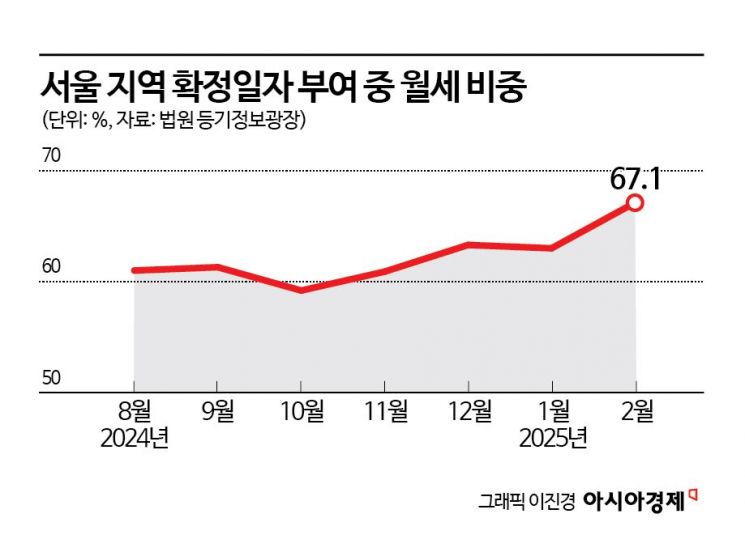
According to the Court Registry Information Plaza on the 1st, the proportion of monthly rent among confirmed-date contracts in Seoul in February was recorded at 67.1%, the highest since statistics began in 2010. This is 4.1 percentage points higher than the previous month (63%) and 4.5 percentage points higher than the same period last year (62.6%).
The proportion of monthly rent gradually rises
In the past, confirmed-date jeonse contracts overwhelmingly dominated. The proportion of monthly rent remained around 30-40%, but has risen to about 50% since 2022. The share of monthly rent has gradually increased. In February last year, the proportion of monthly rent confirmed-date contracts rose to 62.6%, entering the 60% range for the first time since September 2011 when it recorded 60%. Since then, it has consistently remained above 60% from November last year.
Tenants appear to be deeply conflicted between monthly rent and jeonse. As the proportion of monthly rent rises, the average jeonse deposit trend has declined. It is analyzed that as jeonse demand shifts to monthly rent, the deposit amounts have also decreased. The average deposit amount for jeonse contracts with confirmed dates in February was 414.01 million KRW, down 4.1 million KRW from 418.11 million KRW in the previous month. The average jeonse deposit amount had been rising since it recorded 391.94 million KRW in November last year, but the upward trend stopped in February.
One of the reasons for the reduced jeonse demand is the increased difficulty in obtaining jeonse loans. Banks such as Hana Bank and NH Nonghyup Bank have stopped issuing new jeonse loans in Seoul unless conditions such as cancellation or reduction of senior claims with priority over the jeonse deposit, or disposal of houses by multi-homeowners, are met.
It will become even harder to prepare jeonse funds in the second half of this year. The Housing and Urban Guarantee Corporation (HUG) calculates the jeonse loan guarantee limit based on the borrower's income and existing loans to reflect repayment ability. Tenants could receive guarantees from HUG, the Korea Housing Finance Corporation (HF), or Seoul Guarantee Insurance, and then obtain jeonse loans. However, if the guarantee limits are reduced, banks may raise the loan screening threshold and interest rates.
The impact of jeonse fraud is also a factor causing people to avoid jeonse. Rather than being exposed to the risk of jeonse fraud, tenants prefer to spend more on housing costs to reduce anxiety.
Jeonse appeal in higher-end areas of Seoul expected to decline
Experts forecast that the attractiveness of jeonse will decline, especially in higher-end areas of Seoul. Kwon Young-sun, team leader of the Real Estate Investment Advisory Center at Shinhan Bank, said, "Due to difficulties in obtaining loans and concerns about fraud, it has become inconvenient to secure jeonse, leading to increased demand for monthly rent. In the past, living on jeonse allowed tenants to save a lump sum and leverage that money to purchase their own home. Currently, with housing prices rising too quickly, this advantage is gradually diminishing." He added, "In Seoul, especially in higher-end areas where housing prices are rising sharply, jeonse may become less preferred."
Meanwhile, a confirmed date is the date verified by the court or community service center confirming the housing lease contract date. It plays an important role in protecting the tenant's rights. If the house goes into auction or public sale, the tenant’s confirmed date must be earlier than the creditor’s to prioritize the return of the deposit (priority repayment right) after the auction. Since the confirmed date is usually obtained immediately after the lease contract, it is used as an indicator to check the number of jeonse and monthly rent contracts.
© The Asia Business Daily(www.asiae.co.kr). All rights reserved.
![Clutching a Stolen Dior Bag, Saying "I Hate Being Poor but Real"... The Grotesque Con of a "Human Knockoff" [Slate]](https://cwcontent.asiae.co.kr/asiaresize/183/2026021902243444107_1771435474.jpg)












