73% of Atmospheric Mercury in Ulsan During Summer Originates from Non-Ferrous Metal Industry
Published in Journal of Hazardous Materials
A technology capable of accurately identifying the sources of mercury in the atmosphere has been developed.
A research team led by Professor Choi Seongdeuk from the Department of Earth and Environmental Engineering at UNIST has developed an assessment technology that can precisely determine the sources and spatial and seasonal distribution of atmospheric mercury.
 Professor Sungdeuk Choi at UNIST.
This technology is based on high-resolution atmospheric monitoring and mercury isotope analysis. Mercury exists in various isotopic forms, and by analyzing the ratios of these isotopes, the sources of mercury can be identified. The accuracy was enhanced by employing a technique that classifies mercury sources into three categories for analysis.
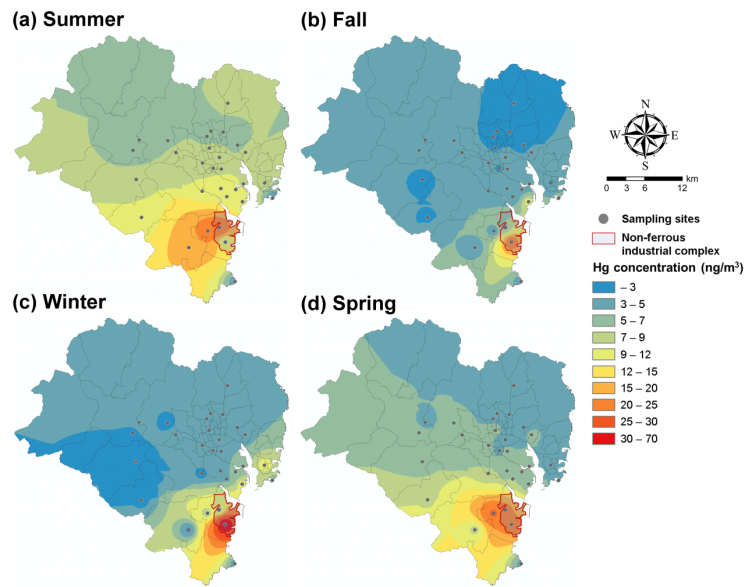
The research team applied this assessment method to analyze the atmosphere in Ulsan. Air samples were collected and analyzed from 30 locations over a year, revealing significant differences in mercury concentrations depending on the season and region. The average concentration was highest in summer at 9.3 ng/㎥, and lowest in autumn at 4.4 ng/㎥. The highest concentration, 21.9 ng/㎥, was observed in the non-ferrous metal industrial complex, indicating that the non-ferrous metal industry is a major source of mercury emissions.
It was found that seasonal winds have a significant impact on the dispersion of mercury. During summer and spring, southeasterly winds predominated, causing mercury emitted from coastal industrial complexes to spread inland in Ulsan. In autumn and winter, northwesterly winds carried atmospheric mercury over the East Sea, resulting in lower concentrations. Notably, in summer, 73% of the mercury concentration was attributed to anthropogenic emissions such as those from the non-ferrous metal industry.
The research team is conducting long-term analyses in other regions with industrial complexes, and explained that this analytical method will also help accurately determine the contribution of mercury transported from neighboring countries.
Mercury is a heavy metal that, when exposed in excess, can cause brain and kidney damage, lung disease, digestive disorders, increased blood pressure, and skin rashes, and can lead to mercury poisoning or Minamata disease in the long term. Due to its low boiling point and vapor pressure, it can exist in a gaseous state in the atmosphere.
Professor Choi Seongdeuk stated, "Although the detected mercury concentrations do not exceed the US Environmental Protection Agency's recommended standard (300 ng/㎥), mercury is a highly persistent substance, so continuous monitoring and management of industrial complexes are necessary."
This study was conducted with Jo Inkyu from UNIST as the first author, and Professors Kwon Seyoon from POSTECH, Lim Jaehyun and Hwang Dongwoon from the National Institute of Fisheries Science as co-researchers.
 Jin Kyu Jo (First Author).
The research was supported by the Ulsan Green Environment Center, the Korea Institute of Marine Science & Technology Promotion, and the National Research Foundation of Korea. The results were published in the April issue of the Journal of Hazardous Materials, a top-tier journal in the field of environmental science.
© The Asia Business Daily(www.asiae.co.kr). All rights reserved.

















