Professor Yoo Seungjun's Team at the Department of Materials Science and Engineering
Enhancing Energy Density of Supercapacitors
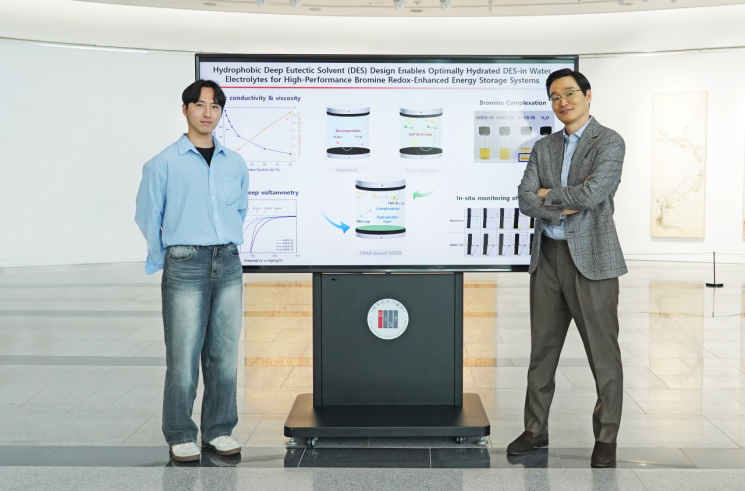
Gwangju Institute of Science and Technology (GIST, President Lim Ki-chul) announced on the 1st that the research team led by Professor Yoo Seungjun of the Department of Materials Science and Engineering has developed a new electrolyte that can dramatically enhance the performance of bromine-based redox supercapacitors (Redox EC), which are gaining attention as next-generation energy storage systems (ESS).
This research achievement is expected to solve the problem of low efficiency caused by natural self-discharge after charging and significantly improve the stability of conventional aqueous electrolytes.
Supercapacitors are drawing attention as future-oriented energy storage devices with fast charging speeds and long lifespans. However, low energy density and self-discharge issues have been obstacles to commercialization.
The redox supercapacitor, developed to overcome these limitations, is designed to store additional charge by utilizing redox reactions (oxidation-reduction reactions) occurring within the electrolyte. As a result, it is evaluated as an innovative technology that simultaneously offers high energy density and fast response speed.
In particular, the bromine-based redox system has attracted attention as a promising technology due to its high reduction potential (the ability to easily accept electrons) and the excellent solubility of bromine in the electrolyte. However, during the charging process, the formation of polybromide leads to unexpected migration within the cell, causing self-discharge and reducing charge-discharge efficiency.
To address these issues, the research team developed a water-containing "hydrated deep eutectic solvent (HDES)" electrolyte by combining tetrabutylammonium bromide (TBAB) and ethylene glycol (EG).
Additionally, the team succeeded in developing a "DES-in-Water" electrolyte with a high water content, which had been difficult to achieve in previous studies due to instability.
This electrolyte simultaneously possesses the electrochemical and thermal stability of organic electrolytes and the high ionic conductivity and flame retardancy (resistance to burning) of aqueous electrolytes. Furthermore, by adjusting the amount of water in the HDES, the team induced bromine to form a stable solid phase, thereby reducing self-discharge and ensuring long-term stability.
Professor Yoo Seungjun stated, "Through this research, we have developed a next-generation electrolyte that is both eco-friendly and highly stable," adding, "By combining the advantages of conventional aqueous and organic electrolytes, we expect to contribute to extending the lifespan of energy storage devices and maximizing charge-discharge efficiency."
© The Asia Business Daily(www.asiae.co.kr). All rights reserved.

















