"Sinkhole Risk Lies More in Water Supply Pipes Than Sewage Pipes"
Powerful Water Jets Create Underground Cavities
"No Preventive Measures... Water Pipes Must Be Replaced Quickly"
Many sinkhole accidents occurring consecutively are often caused by empty spaces in the geological layers, that is, underground cavities, but it is pointed out that even with advanced equipment, detection is not easy. It is said that since preventing sinkholes is practically difficult, timely replacement of aging water pipes to minimize cavities is the way to reduce damage.
Cracks in Water Pipes Create Cavities Underground
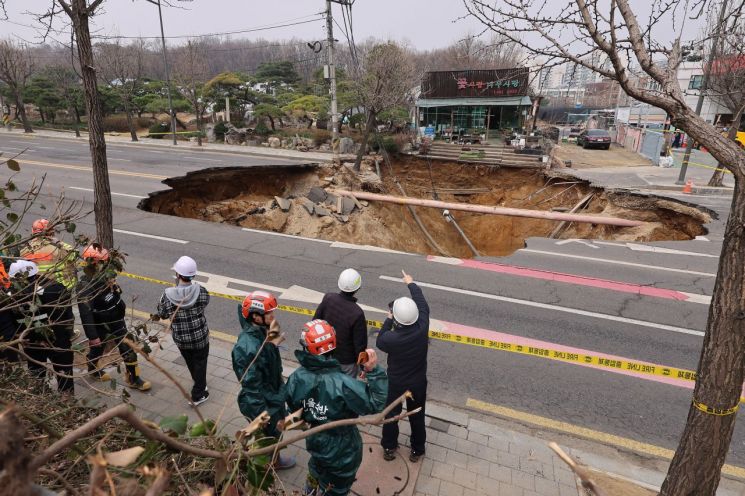 The scene of the large sinkhole that occurred the previous day on the road near Daemyeong Elementary School in Gangdong-gu on the 25th of last month. Photo by Yonhap News
According to Seoul City, the sinkhole that occurred on the 24th of last month in Myeongil-dong, Gangdong-gu, was located beneath an ongoing extension construction of Subway Line 9 Phase 4. It is also known that leaks were detected in the water pipes near the accident site. The fire authorities investigating the accident stated at a briefing, "The water pipe ruptured and water leaked out," and "It appears that cracks occurred in the ground." Authorities are investigating whether the excavation work and pipe rupture led to ground weakening.
In fact, old water pipes are considered a major cause of repeated sinkhole accidents. An expert who served as an external panel member of the Ministry of Land, Infrastructure and Transport's investigation committee explained, "Water pipes are pressure pipes, so if cracks occur in aging underground water pipes, the damage within the geological layers increases," adding, "Water spurting from the cracked parts of the pipes causes the underground soil layers to be washed away."
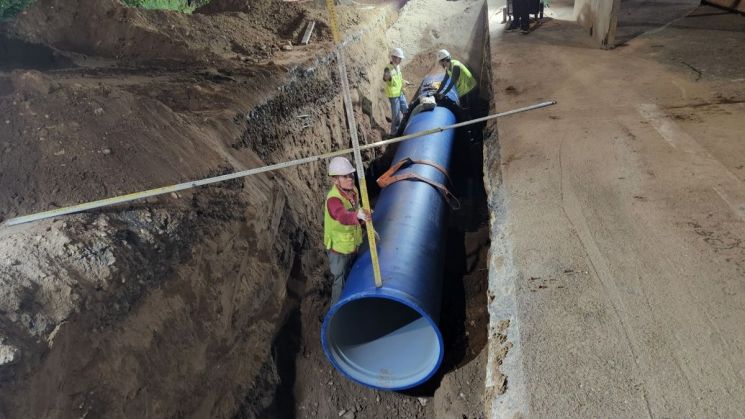
Water pipes are broadly divided into water supply pipes and sewage pipes. Sewage pipes carry used water to treatment plants, so even if they rupture, the damage is not significant. However, water supply pipes are pressure pipes that supply water to each household, so they discharge water with strong pressure. The powerful water jet spurting through cracks in the water supply pipes erodes the ground, creating empty spaces in the soil known as underground cavities. When the ground weakened by these underground cavities subsides, a sinkhole forms.
Large sinkholes can lead to accidents threatening human lives. In December 2019, during underground road construction in Yeouido, ground collapse caused one worker to fall and be buried, resulting in death. In July 2022, a sinkhole occurred in Bupyeong-gu, Incheon, where a worker fell and died. In August last year, a 2.5-meter-deep sinkhole appeared in Yeonhui-dong, Seodaemun-gu, Seoul, swallowing a passenger car. An elderly couple on their way to the hospital were seriously injured in this accident. According to data received by National Assembly member Yeom Tae-young (Democratic Party) from the Ministry of Land, Infrastructure and Transport, 2,085 sinkholes occurred nationwide from 2014 to 2023.
Clear Limits Even with GPR for Detecting Cavities: "Complete Prevention Is Impossible"
Underground cavities can be detected early using advanced sensors called Ground Penetrating Radar (GPR). GPR emits special electromagnetic waves that penetrate the ground, allowing the acquisition of underground terrain information without excavation. Using this equipment, the shape and approximate distance of empty spaces, i.e., cavities, in the geological layers can be identified.
Seoul City introduced GPR for the first time in Korea in 2015. Since then, a dedicated team of GPR experts was formed to conduct a full survey of underground cavities in Seoul using GPR exploration methods, discovering approximately 6,394 cavities over about ten years until 2023. Detected cavities have been filled with soil to prevent sinkholes. The actual number of sinkhole occurrences in Seoul peaked at 57 cases in 2016 and gradually decreased to 23 cases in 2023.
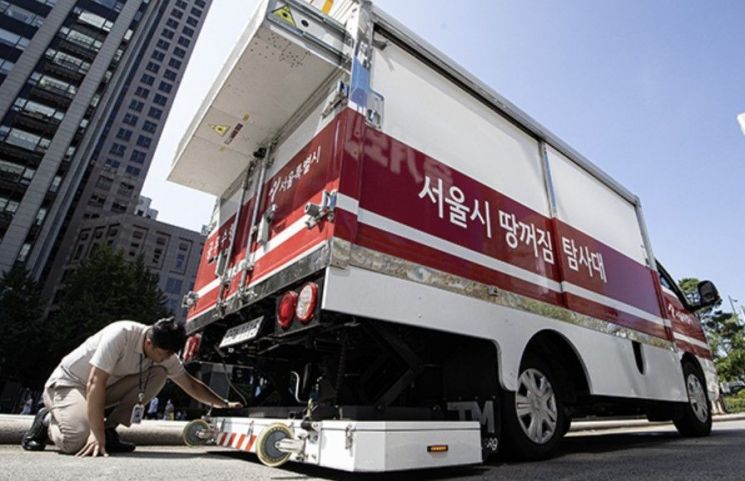 A vehicle equipped with Ground Penetrating Radar (GPR) owned by the Seoul Metropolitan Government. Seoul Metropolitan Government
However, even with GPR inspection methods, not all sinkholes can be prevented. An expert explained, "It is true that GPR is an efficient method for detecting underground cavities," but added, "If the cavity is outside the detection range of the GPR, its effectiveness decreases." He further explained, "The penetration depth of GPR radar waves is only about 3 to 4 meters, and if underground structures or facilities block above or below the cavity, detection is impossible," adding, "GPR radar waves cannot penetrate iron facilities."
GPR can detect currently existing underground cavities but cannot assess the aging condition of underground buried water pipes. If a water pipe suddenly ruptures and creates a cavity after a full survey, no one can know until the next full survey. Since 2018, Seoul City has supplemented this by selecting tens to hundreds of kilometers of roads as 'ground subsidence risk zones' and conducting 2 to 4 repeated GPR inspections intensively, but limitations remain. After the Yeonhui-dong sinkhole accident last year, the Ministry of Land, Infrastructure and Transport conducted a special GPR inspection near Gangdong-gu, but no significant risk factors were detected at that time.
An expert emphasized, "Preventing sinkholes is practically difficult, but diligently identifying the aging of water pipes and replacing them quickly is the way to reduce damage."
© The Asia Business Daily(www.asiae.co.kr). All rights reserved.



















