Trade Uncertainties Rise Due to U.S. Trump Tariffs
Political Turmoil Continues... Private Consumption Contracts
Supplementary Budget Not Reflected... Passage May Aid Recovery
The National Assembly Budget Office (NABO) announced on the 31st that it has significantly lowered its forecast for South Korea's economic growth rate this year to 1.5%, down 0.7 percentage points from the previous estimate. This revision reflects increased consumption contraction due to trade uncertainties such as U.S. tariff impositions and domestic political turmoil.
If the supplementary budget (Chugyeong) currently under discussion by the ruling and opposition parties is passed, it could help economic recovery; however, the effect is expected to vary depending on the specific items included.
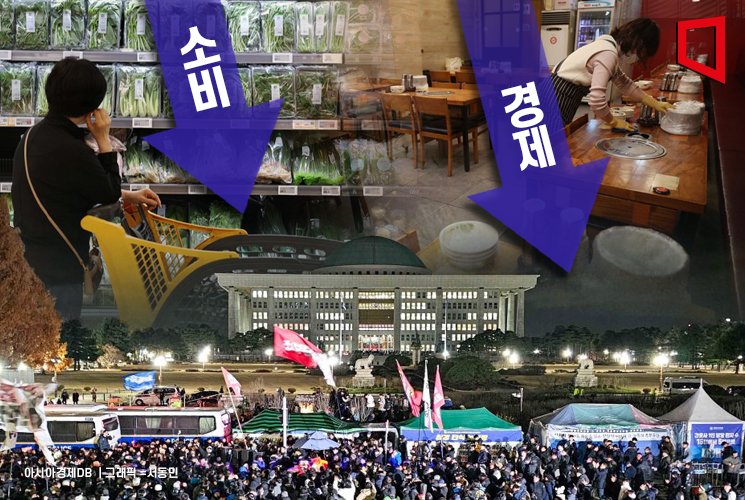
In the '2025 NABO Economic Outlook' released on the same day, NABO lowered this year's growth forecast from 2.2% to 1.5%, predicting a 'low-high' trend with 1.3% growth in the first half and 1.8% in the second half.
Recently, major domestic and international institutions have been successively revising down South Korea's economic growth forecast for this year. The Bank of Korea lowered its forecast from 1.9% to 1.5%, the Ministry of Economy and Finance from 2.2% to 1.8%, and the Korea Development Institute (KDI) from 2.0% to 1.6%.
Looking in detail, domestic demand is expected to experience prolonged sluggishness in private consumption and construction investment.
Government consumption was slightly lowered reflecting trends in health insurance benefit expenditures and a slowdown in government spending growth, while private consumption was revised down by 0.4 percentage points from the previous forecast (1.9%) due to continued weak consumption.
Construction investment was lowered by 0.1 percentage points from the previous forecast (-1.1%) reflecting the deepening slump in the real estate market and recent deterioration in the financial soundness of construction companies. Manufacturing is expected to worsen due to export slowdown, and the service sector due to weak domestic demand.
NABO explained, "Government consumption and private consumption were revised downward reflecting the slowdown in government spending growth and the contraction of consumer sentiment due to domestic political uncertainties," adding, "The supplementary budget was not reflected in the baseline forecast due to high uncertainty regarding its timing and scale."
On the external front, growth is expected to rapidly slow down as global trade uncertainties have expanded since the inauguration of U.S. President Donald Trump.
NABO stated, "The main reasons for the downward revision are uncertainties in the global trade environment such as U.S. tariff policies affecting total exports, and the slowdown in domestic and export demand affecting total imports," adding, "If trade disputes escalate due to aggressive U.S. tariff policies, the growth rate could fall an additional 0.1 percentage points below the baseline forecast."
NABO explained, "This year, real gross domestic product (GDP) growth is expected to be 1.5%, lower than last year, as prices stabilize and real income conditions improve, leading to a moderate recovery in domestic demand, but uncertainties in the trade environment expand."
This year's potential growth rate is forecasted to decline by 0.1 percentage points from the previous year to 1.9%. While the Bank of Korea, KDI, and the Organisation for Economic Co-operation and Development (OECD) estimate South Korea's potential growth rate at 2.0%, NABO's estimate is lower. This reflects the continuous decline in potential growth due to recent low birth rates and slowing investment growth, as well as the decreasing contribution of labor and capital production factors to potential growth.
The NABO Economic Outlook is published every March and October based on analysis of changes in domestic and international economic conditions.
© The Asia Business Daily(www.asiae.co.kr). All rights reserved.

















