Divergent Reactions to Trump's Tariff Moves
China Rides AI Boom and Economic Stimulus
US Faces Triple Threat: Inflation, Consumer Sentiment, and Tariffs
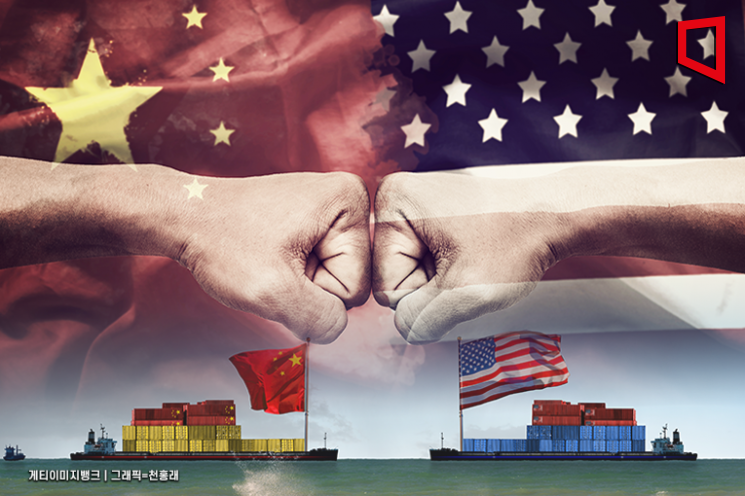
Despite concerns from global markets and central banks, the Trump administration's second term pushed forward with tariff policies, leading to a stark divergence in fortunes for US and China stock market investors. While the US stock market, which had rallied to record highs last year, lost momentum, the Chinese stock market is sailing smoothly, buoyed not only by positive news from the US but also by the AI boom and the Chinese government's economic stimulus measures.
As of the close on the 28th (local time), the Hong Kong H-Share Index (HSCEI) stood at 8606.51, up 18.1% compared to the end of last year. The Hong Kong H-Share Index consists of major Chinese mainland companies listed on the Hong Kong Stock Exchange. It is easily accessible to foreign investors and is interpreted as reflecting the perspective of overseas investors on China. The sentiment in the Chinese stock market, which had been sluggish after the fading expectations for additional stimulus in September last year, reversed in six months.
The turnaround in sentiment began after the "DeepSeek shock" in January this year. Following the emergence of DeepSeek, a Chinese company that shocked the global market with its high-performance AI model, expectations grew that a second wave of DeepSeek-like companies would emerge from China. Thanks to double-digit gains recorded by Alibaba, led by Jack Ma, Xiaomi, and electric vehicle maker BYD, the market sentiment improved.
Major securities firms are also raising their target prices for Chinese stocks, buoyed by optimism about AI companies and positive policy signals from the Chinese government. Global investment bank Morgan Stanley last week raised its year-end target for the Hong Kong H-Share Index to 9500. This implies more than a 10% upside from the current level (8606.51). Goldman Sachs raised its target for the China CSI 300 Index from 4600 to 4700 last month.
Jenny Johnson, CEO of Franklin Templeton, stated at the HSBC Global Investment Summit held on the 27th that "China definitely has investment value." Frederick Neumann, HSBC's Chief Asia Economist, also told the US economic magazine Fortune that "the narrative has changed impressively," adding that "optimism and interest in China have grown significantly."
In contrast, the US stock market's performance during the same period has been dismal. The US S&P 500 Index closed on the 28th down 5.1% year-to-date, marking its first quarterly loss since September 2023. This level is comparable to that of September, before President Trump's election victory in November last year. The S&P 500, which broke above the 6100 level at a close of 6129.58 on February 18, has been declining for over a month amid tariff concerns. US CNN reported that the US stock market is facing a triple threat of inflation, consumer sentiment, and tariffs.
The most fundamental concern is President Trump's tariff policy. US stock investors are worried about the impact of the reciprocal tariffs set to take effect on April 2 on both the US and the world. Consumer sentiment in the US has also weakened. The University of Michigan's consumer sentiment index for March plunged 12% compared to the previous month. Additionally, the February Personal Consumption Expenditures (PCE) index rose 2.5% year-over-year, exceeding the Federal Reserve's inflation target of 2%. This suggests limited room for the Fed to cut interest rates.
However, the US reciprocal tariffs pose risks not only to the US but also to the Chinese stock market due to the high trade interdependence between the two countries. As of 2024, China is the fourth-largest trading partner of the US in goods, with total trade volume between the two countries reaching $582.5 billion (approximately 857 trillion KRW). The US trade deficit with China increased by $16 billion (approximately 24 trillion KRW) compared to 2023. Rohit Chopra, portfolio manager at Lazard Asset Management, told Bloomberg US, "After adding more Chinese stocks last year, we have been selling some stocks that have appreciated in value this year," adding that "the fund's exposure to China is currently somewhat reduced."
© The Asia Business Daily(www.asiae.co.kr). All rights reserved.

















