Trump's Phone Interview with NBC News
Up to 50% Tariffs on Countries Importing Russian Oil
"Angry and Pissed Off at Putin... Will Call Him This Week"
On Possibility of a Third Term: "There Are Ways"
U.S. President Donald Trump stated that if Russia does not agree to a ceasefire in the Ukraine war, he could impose up to a 50% 'secondary tariff' on all trading partners purchasing Russian crude oil. Addressing President Vladimir Putin, he expressed dissatisfaction using phrases such as "very angry" and "pissed off." As Russia refuses a full ceasefire agreement for a month and sets preconditions even for partial ceasefire implementation, showing a lack of active engagement in ceasefire negotiations, President Trump appears to be escalating pressure.
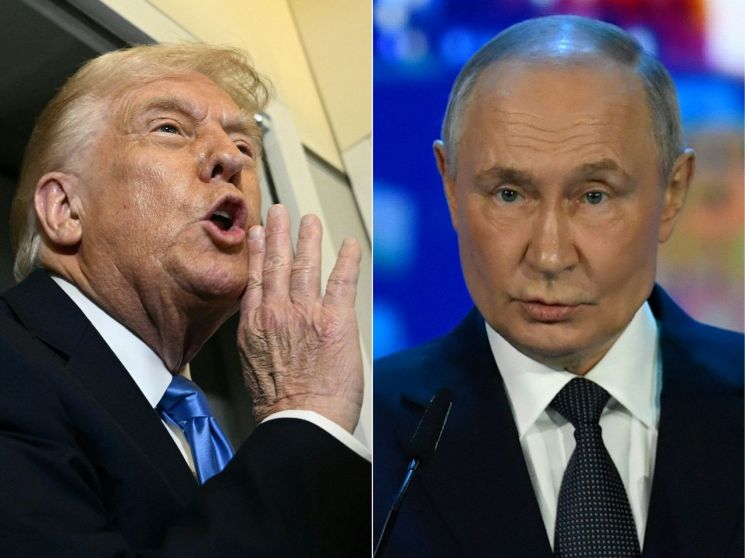
On the morning of the 30th (local time), in a phone interview with NBC News, President Trump said, "If Russia and I cannot negotiate a halt to the bloodshed in Ukraine, and I believe that is Russia's fault, I will impose secondary tariffs on all oil coming from Russia."
He added, "If you buy oil from Russia, it means you cannot do business in the United States," and stated, "All oil will be subject to tariffs ranging from 25% to 50%." He further mentioned that if a ceasefire agreement is not reached, secondary tariffs on Russia would be imposed within a month, pressuring for a swift resolution to ceasefire negotiations.
The secondary tariffs mentioned by President Trump refer to 'secondary boycotts (third-country sanctions),' which sanction other countries trading with the sanctioned nation. This means that if Russia refuses a ceasefire agreement, other countries trading with Russia will face tariffs when exporting products to the U.S. Earlier, on the 24th, President Trump used the term 'secondary tariffs' when stating that countries importing Venezuelan oil and gas would have to pay a 25% tariff in future trade with the U.S.
President Trump also expressed that he was "very angry and pissed off" at President Vladimir Putin's criticism of Ukrainian President Volodymyr Zelensky's leadership, pointing out that it "did not go in the right direction." Putin had demanded the establishment of a transitional government in Ukraine on the 28th, effectively signaling an intention to oust President Zelensky, which is interpreted as the target of Trump's remarks.
Previously, during his presidential campaign last year, President Trump repeatedly said he would end the Ukraine war within 24 hours of taking office. However, even two months after his inauguration, peace negotiations are still ongoing. With President Trump’s unfavorable stance on supporting Ukraine, Putin, who gained a favorable position in the conflict, is assessed as not actively engaging in ceasefire talks. Putin previously rejected a full ceasefire proposal for 30 days and agreed only to a ceasefire limited to the Black Sea maritime area and energy facilities. He also stated that even the partial ceasefire agreement would only take effect if sanctions against Russia were lifted. In this context, President Trump, reportedly aiming to conclude Ukraine ceasefire negotiations by April 20, is analyzed as applying active pressure on President Putin for ceasefire talks.
However, President Trump expressed his intention to continue dialogue with President Putin.
He said, "I have a very good relationship with him, and if he does the right thing, my anger will quickly dissipate," and mentioned plans for the two leaders to have a phone call this week.
Additionally, President Trump did not rule out the possibility of running for a third presidential term, which is prohibited by the U.S. Constitution.
He said, "It's too early to think about it, but I'm not joking," adding, "There are ways." He also said, "Many people want me to do it," but did not specify any concrete legal methods to serve a third term. President Trump will be 82 years old at the end of his second term.
The 22nd Amendment to the U.S. Constitution, enacted after President Franklin D. Roosevelt (FDR), who served four terms, states that "no person shall be elected to the office of the President more than twice." The consensus is that this applies regardless of whether the terms are consecutive. However, some within President Trump's camp argue that since Trump served one term and then returned to office after four years as a 'bridge,' the three-term limit does not apply to him.
© The Asia Business Daily(www.asiae.co.kr). All rights reserved.
![Clutching a Stolen Dior Bag, Saying "I Hate Being Poor but Real"... The Grotesque Con of a "Human Knockoff" [Slate]](https://cwcontent.asiae.co.kr/asiaresize/183/2026021902243444107_1771435474.jpg)
















