Hanwoo Lee, CEO of Hyundai Engineering & Construction, along with the company’s management team, held a CEO Investor Day at a hotel in Seoul on the 28th to share the mid- to long-term business plan with major investors and analysts. They decided to increase the proportion of energy business centered on nuclear power while focusing on competitive sectors expected to see growing demand in the future, such as data centers and offshore wind power, to enhance profitability.
The first area emphasized was the energy business. The plan is to establish themselves as a leading player in the energy transition sector. While their business has mainly focused on the Middle East and Asia regions, they will now actively expand into advanced markets such as Europe and the United States. With explosive growth in electricity demand across society due to artificial intelligence (AI) and other factors, demand for related infrastructure is expected to increase.
They plan to introduce new package products linked to nuclear power plants, including large nuclear power plants, small modular reactors (SMRs), hydrogen production plants, and power grid sectors. They aim to build a value chain across the entire industry, including energy production, storage, transportation, and utilization.
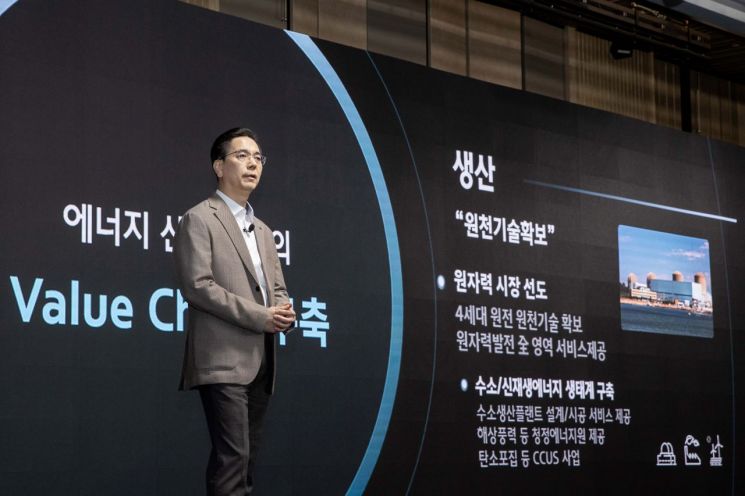 Lee Han-woo, CEO of Hyundai Engineering & Construction, held a CEO Investor Day on the 28th at the Fairmont Hotel in Yeouido, Seoul, where he presented the future growth strategy. Photo by Hyundai Engineering & Construction
CEO Hanwoo Lee stated, "We have developed advanced cooperation plans with partners to expand our entry into the global nuclear power market, including the United States, and last week we met with key figures from Bulgaria’s new cabinet and secured a commitment to smoothly advance the Kozloduy nuclear power plant project." He added, "We will accelerate the expansion of our global nuclear power territory by leveraging these solid partnerships."
Since each country faces different circumstances, they will create customized business portfolios. In Bulgaria, Sweden, Slovenia, and Finland, they will focus on establishing a foundation for large nuclear power plant projects, while in other major European countries such as the United Kingdom, they will work on standardizing SMR designs. In the United States, they will primarily engage in nuclear power, solar power, liquefied natural gas (LNG), and data center businesses. In Australia, they plan to expand hydrogen and power grid projects centered on solar power, and in New Zealand, they will expand their housing business.
To enhance competitiveness in urban redevelopment, they decided to extend the warranty period for defects in apartments and other multi-family housing to five years. Previously, warranties for finishing work or insulation and interior woodwork were only about two to three years, but this extension aims to increase customer satisfaction. They expect many redevelopment projects to be ordered mainly in Seoul and plan to increase sales activities centered on the Gangnam area. Additionally, they will steadily increase large-scale complex development projects recently gaining attention, such as the CJ and Hilton Hotel projects in Gayang-dong.
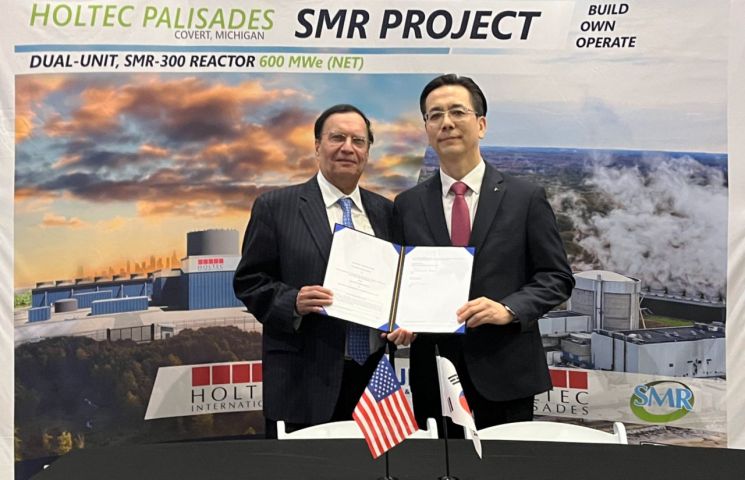 Chairman Chris Sing of Holtec (left) and Lee Han-woo, CEO of Hyundai Engineering & Construction, are posing for a commemorative photo after agreeing last month to collaborate on expanding nuclear power projects. Photo by Hyundai Engineering & Construction
They set a target to increase sales, which are currently around 17.5 trillion KRW this year (on a standalone basis, same below), to over 25 trillion KRW by 2030, five years from now. Sales are expected to grow from 16 trillion KRW to over 25 trillion KRW during this period, and operating profit margin will increase from the current 3-4% level to over 8%. By 2030, they plan to increase the scale of energy business orders to about 7 trillion KRW annually, including 3.7 trillion KRW from large nuclear power plants. Currently, the sales proportion by business is only about 3% for the energy sector and 24% for core products, but they aim to increase these to 21% and 48%, respectively, in five years. The company expects that the profit contribution from energy and core products will account for 75% of the total.
They will also strengthen shareholder return policies. Starting this year, the minimum dividend per share was adjusted from the previous 600 KRW to 800 KRW, a 33% increase. Through share buybacks and cancellations, they plan to raise the total shareholder return ratio to over 25% by 2027.
© The Asia Business Daily(www.asiae.co.kr). All rights reserved.


















