Naju City and the Korean Society for Railway Hold Public Hearing
Vitalizing the Local Economy and Overcoming Regional Extinction
United Call for Passing the Preliminary Feasibility Study in June
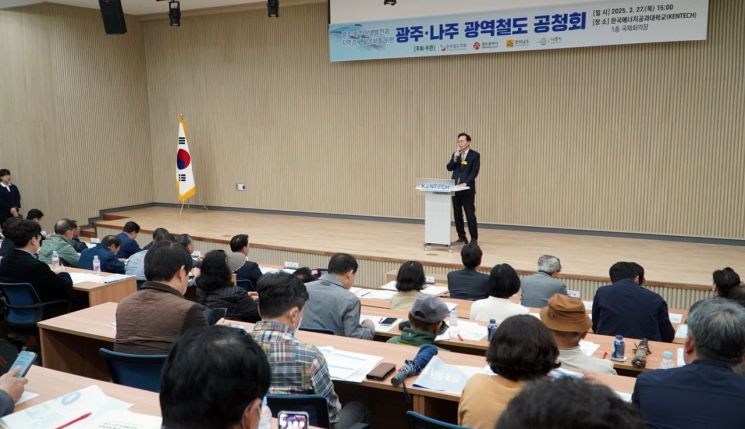 Naju City held the "Gwangju-Naju Metropolitan Railroad Public Hearing" on the 27th at the first-floor international conference hall of Korea Energy Polytechnic University, jointly with the Korean Railroad Society, Gwangju Metropolitan City, and Jeollanam-do. Provided by Naju City
Naju City in Jeollanam-do, together with the Korean Society for Railway, held the 'Gwangju ~ Naju Metropolitan Railway Public Hearing' and unanimously called for the successful passage of the preliminary feasibility study scheduled for June.
On the 27th, Naju City, in cooperation with the Korean Society for Railway, Gwangju Metropolitan City, and Jeollanam-do, held the 'Gwangju ~ Naju Metropolitan Railway Project Public Hearing' at the International Conference Hall on the first floor of Korea Energy Engineering University.
The public hearing featured keynote presentations, expert panel discussions, and a card section performance wishing for the successful passage of the preliminary feasibility study.
More than 100 participants, including Naju Mayor Yoon Byungtae, City Council Chairperson Lee Jaenam, local provincial and city council members, transportation and railway experts, and citizens, gathered to share the current status, plans, and expected effects of the metropolitan railway project, and exchanged opinions.
Kim Taegyun, head of the Studio Galilei Consulting Business Division and former lead researcher for the preliminary feasibility study of the metropolitan railway project, presented on the progress and development strategies for the Gwangju ~ Naju metropolitan railway infrastructure.
The Gwangju~Naju metropolitan railway is the first national metropolitan railway project in the southwestern region, connecting the only joint innovation city in the country, with the aim of balanced national development and overcoming regional extinction.
The project plans to build a 26.26 km double-track electric railway by 2030, connecting Gwangju Sangmu Station, Daechon, Naju Nampyeong, Innovation City, and KTX Naju Station, with a total project cost of 1.5192 trillion KRW.
The project was included in the 4th National Railroad Network Construction Plan in 2021, selected as a subject for the Ministry of Land, Infrastructure and Transport's preliminary feasibility study in May 2023, and is now awaiting the study's review in June this year.
Once the line is completed, travel time between regions is expected to be reduced to around 30 minutes.
The expert panel discussion was chaired by Lee Joon, head of the Railway Policy Research Division at the Korea Railroad Research Institute, with participation from Kim Chaeman, a researcher at the Gyeonggi Research Institute; Kwon Seongdae, a researcher at Chonnam National University; Lee Sangjun, a researcher at the Jeonnam Research Institute; and Kim Junghyun, executive director at Kyungho Engineering. They exchanged views on the necessity, current progress, and expected effects of the metropolitan railway project.
In particular, the experts unanimously agreed that the metropolitan railway project is essential not only for building transportation infrastructure and revitalizing the local economy, but also for overcoming regional extinction and achieving balanced national development.
Naju City, Gwangju Metropolitan City, and Jeollanam-do plan to establish a cooperative system for the successful implementation of the metropolitan railway project and will focus their administrative efforts on passing the preliminary feasibility study in June.
Naju Mayor Yoon Byungtae stated, "The Gwangju-Naju metropolitan railway project is a symbol of balanced national development and will serve as a catalyst for win-win economic growth between the two regions by improving mobility rights and activating exchanges in transportation and living infrastructure. We request active support and cooperation from the government and related organizations so that the preliminary feasibility study can be passed as soon as possible and lead to the start of construction."
© The Asia Business Daily(www.asiae.co.kr). All rights reserved.
![Clutching a Stolen Dior Bag, Saying "I Hate Being Poor but Real"... The Grotesque Con of a "Human Knockoff" [Slate]](https://cwcontent.asiae.co.kr/asiaresize/183/2026021902243444107_1771435474.jpg)











