Promoting a Major Overhaul of the Wildfire Response System
Temporary Modular Housing to Be Provided for Disaster Victims
On the 28th, the North Gyeongsang Provincial Government held a press briefing regarding five major policy directions in response to the large-scale wildfire in the northern region of North Gyeongsang: support for disaster victims, assistance for the recovery of small and medium-sized enterprises and small business owners, a comprehensive overhaul of the wildfire response system, the establishment of a large-scale wildfire disaster response headquarters, and the provision of emergency disaster relief funds to restore daily life.
Lee Cheolwoo, Governor of North Gyeongsang Province, expressed his deepest condolences to the bereaved families and residents affected by the large-scale wildfire that spanned five cities and counties, pledging to provide the utmost support possible.
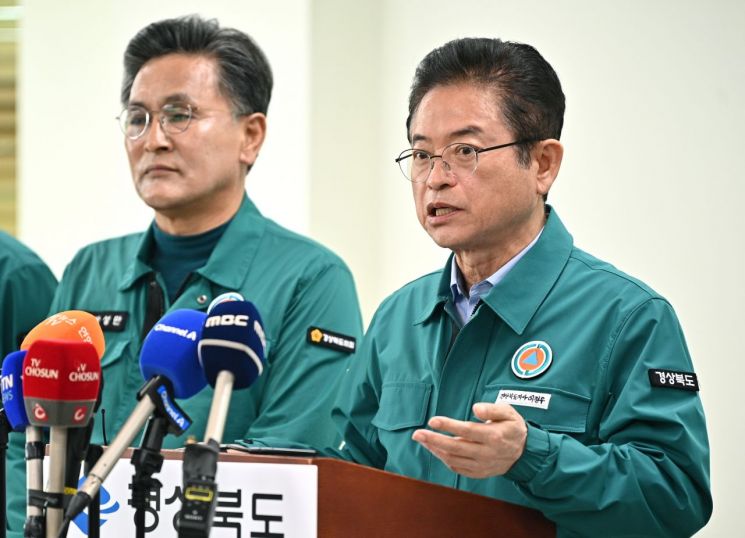 Lee Cheolwoo, Governor of Gyeongbuk Province (right), is conducting a press briefing on wildfire damage restoration.
The recent large-scale wildfire that started in Uiseong in northern North Gyeongsang Province spread rapidly due to springtime high temperatures and dry conditions, combined with strong winds reaching speeds of up to 27 meters per second?equivalent to a medium-strength typhoon?making the fire's spread not only extremely fast but also unpredictable, resulting in significant damage.
In particular, the phenomenon known as "climate whiplash," where droughts, wildfires, and floods occur alternately due to climate change, is making large-scale disasters more frequent and a part of daily life. A representative case of climate whiplash is the 2025 Los Angeles wildfire, which recorded the worst wildfire damage in U.S. history with losses amounting to $50 billion. However, the area affected by the recent large-scale wildfire in northern North Gyeongsang has already surpassed twice the size of the LA wildfire.
North Gyeongsang Province is pushing for a complete overhaul of its wildfire response system to minimize damage from large-scale disasters like this recent wildfire in the northern region. The province will introduce night-time wildfire response systems such as drones and unmanned firefighting robots, and will revise the wildfire evacuation standard manual to include evacuation guidelines based on wind speed, thereby establishing a risk management system. In addition, together with the central government, the province plans to consider the use of military transport aircraft for large-scale wildfire response and develop fire trucks specialized for mountainous terrain, focusing on the expansion and modernization of firefighting equipment.
Secondly, the province will make every effort to support disaster relief for victims at a quasi-wartime level. Essential items such as blankets and toiletries will be provided without shortage, and mobile medical services and psychological counseling centers will be operated for the health of disaster victims.
Emergency temporary housing facilities will be provided in stages. Evacuees currently staying in gyms and schools will be quickly relocated to advanced residential facilities such as government and corporate training centers, hotels, resorts, and air dome-type facilities that are immediately available for occupancy, and temporary modular housing will be provided swiftly. In the long term, the province plans to create "K-Disaster Relief Homes," which will remain as cultural heritage, to provide new homes for the disaster victims.
Thirdly, the province will provide economic support for small and medium-sized enterprises and small business owners affected by the wildfire to help them recover. The province will seek designation as an employment crisis area by the Ministry of Employment and Labor and as a special support area for SMEs by the Ministry of SMEs and Startups, to support workers and stabilize business operations through extended unemployment benefits and support for SME sales channels. In addition, the province will help offset business losses due to the wildfire and reduce the burden on business owners by supporting their contributions to health insurance and the national pension. The province will also focus on expanding loan programs and providing low-interest financial support for SMEs and small business owners.
Fourth, North Gyeongsang Province will establish a "Large-Scale Wildfire Disaster Response Headquarters" under the direct supervision of the governor, bringing together public and private sectors to minimize wildfire damage and ensure swift recovery of daily life. This headquarters will work closely with the central government and affected areas to expedite recovery and rebuild the foundations of life.
Lastly, the province will promote livelihood stability by providing emergency disaster relief funds. Approximately 270,000 residents in the five affected cities and counties (Uiseong, Andong, Cheongsong, Yeongyang, Yeongdeok) will each receive 300,000 won in emergency disaster relief funds, and the province will also request measures from the central government.
Governor Lee stated, "Although the fire has not yet been fully extinguished and we must do our utmost to achieve complete containment, it breaks my heart to see residents sleeping in shelters such as gyms and schools," emphasizing, "We will do everything possible to ensure the swift recovery of daily life for disaster victims through prompt recovery measures and relief efforts."
© The Asia Business Daily(www.asiae.co.kr). All rights reserved.

















