Yeongpung Holds Surprise Stock Dividend Before Shareholders' Meeting
Claims to Have Resolved Cross-Shareholding by Lowering SMH's Stake
Korea Zinc Expected to Push Ahead With Voting Rights Restrictions
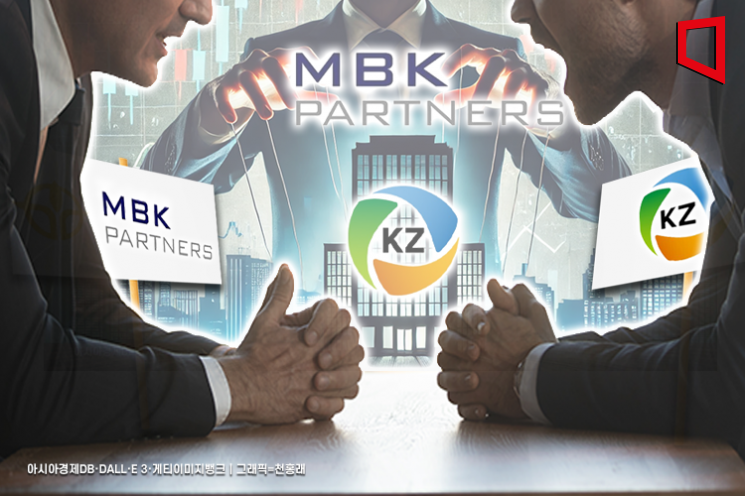
Yeongpung conducted a surprise stock dividend the day before the regular shareholders' meeting of Korea Zinc, claiming that it resolved the 'cross-shareholding relationship' created by Chairman Choi Yoon-beom's side and secured voting rights. Chairman Choi's side argues that it is reasonable to restrict Yeongpung's voting rights due to the cross-shareholding relationship, and that the court has also ruled in their favor. As both sides are employing various methods to engage in disputes, there is a high possibility that the regular shareholders' meeting scheduled for the 28th will also end in chaos.
According to the industry on the 28th, Yeongpung and MBK Partners announced that they resolved a stock dividend of 0.04 shares per share at Yeongpung's regular shareholders' meeting the previous day. As a result, the stake of Sun Metal Holdings (SMH), an overseas affiliate of Korea Zinc, in Yeongpung will decrease from 10.33% to 9.96%. This is because SMH was not a shareholder as of the record date for Yeongpung's shareholders' meeting on December 31 of last year and thus is not eligible for this stock dividend. Consequently, SMH no longer meets the condition of exceeding 10% shareholding required for restricting voting rights under the Commercial Act's cross-shareholding rules, and Yeongpung claims that the voting rights for its 25.4% stake in Korea Zinc have been secured.
Chairman Choi's side is expected to push forward with restricting voting rights. They are likely to use the court's dismissal of the injunction request filed by the Yeongpung-MBK alliance against Korea Zinc to allow voting rights at the regular shareholders' meeting as justification. Earlier, on January 23, during the extraordinary shareholders' meeting, Korea Zinc formed a cross-shareholding relationship when its Australian affiliate Sun Metal Corporation (SMC) acquired 10% of Yeongpung's shares. After the court ruled on the 7th that this was unfair, Korea Zinc transferred SMC's Yeongpung shares to its parent company SMH, creating a new cross-shareholding relationship. The Yeongpung-MBK alliance filed an injunction claiming this was also unfair, but the court rejected it. Since SMC is a limited liability company, voting rights cannot be restricted under the cross-shareholding rules of the Commercial Act, but SMH is a stock company, so it is possible. With conflicting claims from both sides, the regular shareholders' meeting to be held in Yongsan-gu, Seoul, on the same day is also likely to end in disruption, similar to the extraordinary shareholders' meeting in January.
In this situation, with the National Pension Service expressing support for the agenda to cap the number of directors and for the cumulative voting system, the competition for board control between the two sides is likely to become a prolonged battle. If the proposal to limit the number of directors to 19, put forward by Chairman Choi, passes, Yeongpung and MBK will find it difficult to frequently hold extraordinary shareholders' meetings to appoint their preferred directors. This is because dismissing directors requires a special resolution, which needs approval from at least two-thirds of the voting rights present. The cumulative voting system, which benefits shareholders with smaller stakes by allowing them to concentrate votes and has already been introduced, is also an obstacle. This system prevents Yeongpung and MBK, who hold larger stakes, from appointing only their preferred directors every time. Chairman Choi's side must secure control of the board while considering the expiration of their directors' terms. Furthermore, if various lawsuits between Chairman Choi and Yeongpung-MBK arise, this could become a very long-term conflict. Yeongpung and MBK have already filed an appeal against the court's dismissal of the injunction the previous day.
A financial investment industry official said, "With public opinion turning hostile toward MBK due to the Homeplus incident, if disputes increase in the Korea Zinc management rights battle, the burden on MBK will grow even more," adding, "No matter how much time remains on the fund's maturity and how much support LPs give, there are limits, so they may need to find a strategic move to change the atmosphere."
© The Asia Business Daily(www.asiae.co.kr). All rights reserved.

















