Included in Next Month's 'Emergency Measures for the Automobile Industry'
Responding to 'Tariff Impact' by Boosting Domestic Demand
Kia President Choi Junyoung: "Maintaining Domestic Production"
The government has decided to include an extension of the individual consumption tax (ICT) reduction on new cars in the 'Emergency Measures for the Automobile Industry' scheduled to be announced next month. As the Donald Trump administration in the United States decided to impose a 25% tariff on imported cars, raising concerns about damage to the domestic related industry, the government views the extension of the ICT reduction as one of the response measures. The related industry has clearly stated that Kia, an affiliate of Hyundai Motor Group, has no plans to reduce domestic production regardless of the expansion of overseas production.
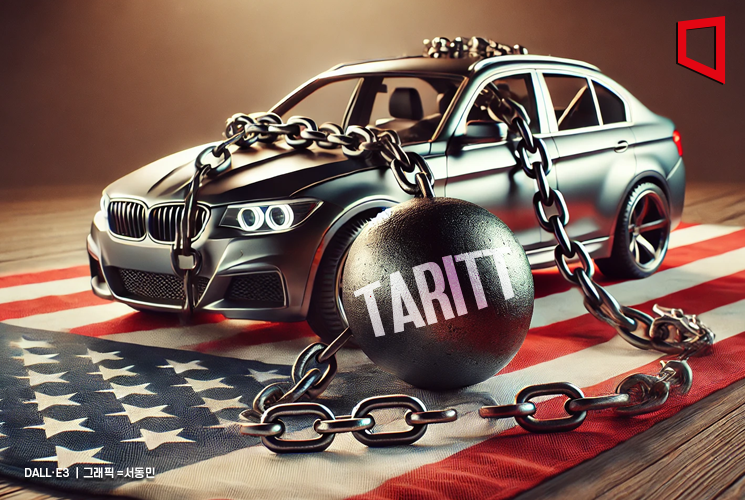
According to the industry and related ministries on the 28th, the government plans to categorize domestic demand stimulation as one of the measures in the automobile industry policy to be announced next month and include related tax reductions as part of the measures. Since the automobile industry accounts for a large portion of domestic exports and is expected to be hit, the government aims to activate domestic demand to compensate for this. According to the Korea International Trade Association, last year’s automobile exports to the U.S. exceeded $34.7 billion (about 51 trillion KRW), accounting for 27.1% of total exports to the U.S. ($127.8 billion). The domestic automobile parts industry's exports to the U.S. also reached $8.222 billion (about 12 trillion KRW).
The government’s move to bring up the ICT reduction is largely because the current reduction is set to expire in the first half of the year. The passenger car ICT reduction has been reinstated since January 3 this year, lowering the ICT calculation rate from 5% to 3.5% of the vehicle price, and is applied to vehicles delivered until the end of June. The maximum limit is 1 million KRW. For eco-friendly vehicles such as electric cars and hydrogen fuel cell cars, the ICT is further reduced with limits of 3 million KRW and 4 million KRW respectively. The ICT reduction measure was revived after a 1.5-year hiatus following its expiration at the end of June 2023 to stimulate domestic demand. A Ministry of Trade, Industry and Energy official said, "Given the U.S. tariff imposition and other circumstances, it is necessary to activate domestic consumption," adding, "We will consider various measures including tax policies such as ICT to encourage consumers to open their wallets."
Stimulating consumption also aims to maintain domestic production. On the 27th, right after the emergency public-private joint countermeasure meeting on U.S. automobile tariffs held at the Korea Chamber of Commerce and Industry in Jung-gu, Seoul, Kia President Choi Jun-young told reporters, "We will continue domestic production without reduction." This was to dispel concerns that Hyundai Motor Group’s announced $21 billion (about 31 trillion KRW) investment plan in the U.S. over the next four years might lead to a decrease in domestic production.
President Choi said, "Although there will be impacts in the U.S. if domestic production continues, we are preparing countermeasures and plan to expand production in other regions to offset the impact," adding, "The government said it will not leave companies to respond alone to the U.S. tariff issue. They indicated that while preparations have been made so far, they will now take full-scale action."
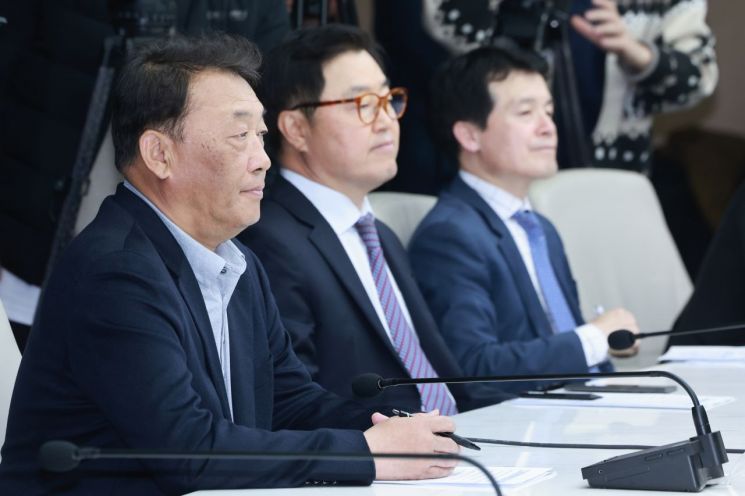 Kia President Choi Jun-young (left), Hyundai Motor Executive Director Shin Seung-gyu, and other automotive industry officials are attending the urgent public-private joint countermeasure meeting on U.S. automobile tariffs held on the 27th at the EC Room of the Korea Chamber of Commerce and Industry in Jung-gu, Seoul, listening to remarks by Minister Ahn Deok-geun of the Ministry of Trade, Industry and Energy. Photo by Yonhap News
However, concerns remain that government and corporate responses are limited to finished vehicles. The domestic automobile parts industry now faces survival challenges as the Trump administration decided to apply a 25% tariff on parts as well.
Bang Je-uk, Executive Director of the Korea Automobile Industry Cooperative, said, "As Hyundai Motor Group increases production in the U.S., parts suppliers cannot avoid considering local expansion, and existing companies already operating there need to increase production, but they cannot just expand or enter blindly," pointing out, "Investment costs, raw material supply, and high labor costs are problems." He added, "Since the damage scale varies by company, we have made overall requests and will discuss local production and supply issues in cooperation with the government and finished vehicle manufacturers."
A secondary vendor supplying parts to the major parts company Mando said, "Since we supply to first-tier vendors, we have not yet been directly affected, but if the first-tier partners face difficulties, we cannot be free from the impact either," adding, "However, it is difficult to enter the U.S. market, so we have no suitable alternatives."
Another issue is that even if parts companies diversify their sales channels, it is difficult to escape tariff risks. This is because the relationship between the country of the finished vehicle manufacturer and the U.S. must be considered. If Chinese parts or software are used, the risk increases further. An industry insider advised, "Supply chain transparency management will become extremely important in the future," adding, "It is necessary to pay attention to supply chain transparency management not only to respond to the U.S. but also to comply with Europe’s eco-friendly regulations."
Park Sung-kyu, Managing Director of HMG Management Research Institute, said at the 'Spring Automobile Parts Industry Development Strategy Seminar' held recently at Seoul EL Tower, "The Trump administration believes that tariffs imposed during its first term did not lead to price increases or reduced trade," and added, "The tariff imposition policy will continue strongly until next year’s U.S. midterm elections." He suggested selective responses citing Mexico as an example. Mexico is considered a representative case where tariff imposition was deferred while blocking China’s circumvention exports.
© The Asia Business Daily(www.asiae.co.kr). All rights reserved.


















