Supporting and Nurturing Hanji Successors
Revitalizing the Hanji Industry
Jeonju City in North Jeolla Province and Hansol Paper (CEO Han Kyungrok) have joined hands to preserve traditional Hanji.
On the 27th, the city and Hansol Paper signed a “Business Agreement for the Preservation of Hanji Culture and the Establishment of the Hanji Industry Ecosystem” at the Jeonju Millennium Hanji Center, attended by key officials from both organizations, including Mayor Woo Beomgi of Jeonju.
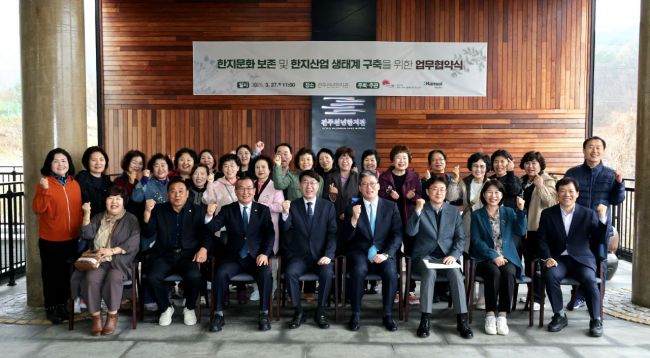 Jeonju City has joined hands with Hansol Paper, the largest paper company in Korea, to preserve traditional Korean paper, Hanji. Photo by Jeonju City
According to the agreement, the city and Hansol Paper have agreed to actively cooperate in promoting joint projects to revitalize the Hanji industry, including ▲expanding the cultivation and supply of daknamu (paper mulberry) and ▲supporting and nurturing successors in Hanji production.
In particular, as part of this project, the city and Hansol Paper plan to establish a stable supply chain for Hanji raw materials by supporting the cultivation of daknamu, thereby maintaining the quality of traditional Hanji and expanding its industrial applications.
Through these efforts, the city expects to overcome the limitations of traditional Hanji, which has relied heavily on imports, and take a step closer to localizing the raw materials for Jeonju traditional Hanji.
Additionally, from a long-term perspective, the city and Hansol Paper will operate programs to support and nurture successors in Hanji production, encouraging younger generations to participate in Hanji making and providing practical support for the continued activity of Hanji artisans, thereby contributing to the succession of traditional culture.
Previously, the city has worked to preserve, industrialize, and globalize Jeonju Hanji. Notably, since 2017, the city has established a stable supply base for daknamu, the main raw material for Hanji, by contracting with farms for cultivation and purchasing the harvest, and has designated artisans who possess traditional Hanji manufacturing techniques and have operated Hanji factories in Jeonju for over 30 years as “Jeonju Hanji Master (Hanji Jang).”
Last year, under the vision of “Connecting Tradition, Adding Innovation, and Elevating Hanji to the World,” the city presented the “Comprehensive Plan for the Promotion of the Jeonju Hanji Industry (Master Plan),” which consists of three core strategies?▲high-quality traditional Hanji ▲growing machine-made Hanji ▲co-prosperous Jeonju Hanji?along with seven major tasks and 17 action plans.
A Hansol Paper representative stated, “The daknamu planting and Hanji successor nurturing support project is not only about preserving traditional Hanji but also an important initiative to prepare for the future of the Hanji industry. Hansol Paper will continue to promote various projects to revitalize the Hanji industry and further strengthen cooperation with Jeonju City.”
Mayor Woo Beomgi said, “It is very encouraging that Hansol Paper, the largest paper company in Korea, is partnering with Jeonju for the preservation and succession of Hanji. We will continue to work together with the private sector and government to achieve tangible results in fostering the Jeonju Hanji industry.”
© The Asia Business Daily(www.asiae.co.kr). All rights reserved.

















