Improved Thermal Stability of Interlayers by Molecular Combination
World's Highest Efficiency Achieved
Performance Remains Intact After One Year... Published in Joule
Unlike commercial silicon solar cells, perovskite solar cells are thin and lightweight, making them applicable to curved surfaces such as building exteriors or vehicle roofs. They can also be easily manufactured at room temperature using solution processing, resulting in lower production costs.
For commercialization, it is crucial to develop technologies that can maintain high efficiency for a long period, and a domestic research team has succeeded in developing such a technology.
 Professor Sangil Seok, UNIST.
On the 27th, UNIST School of Energy and Chemical Engineering Distinguished Professor Seok Sangil, together with researchers Kim Jongbeom and Park Jaewang, announced that they have succeeded in simultaneously achieving high efficiency and durability by forming an interlayer on the surface of perovskite solar cell thin films using the specificity of cations.
 Research team. (From left) Nahye Shin, Jongbeom Kim (first author), Jaewang Park (first author), Jaehee Kim, Junseok Kim. Provided by UNIST
Perovskite solar cells use a material called perovskite as the light-absorbing layer. The principle is that the charge carriers generated when the light-absorbing material receives light are delivered to the electrodes, producing electrical energy. Suppressing the defects in this light-absorbing material is essential to effectively transfer the charge carriers to the electrodes and thus improve cell efficiency.
To address this, previous studies have used single organic cations, but there were issues such as thin film structure collapse and energy level mismatch due to the escape of single organic cations. Energy levels act as "steps" for charge movement, and if the energy levels between layers are misaligned, charge loss occurs, reducing cell efficiency.
The research team designed a thermally stable interlayer by using two types of organic cations together. Through molecular interactions between the two substances with different electron-attracting abilities, the interface structure was stabilized and an energy level favorable for hole transport was naturally induced. The defect density in the perovskite thin film was also reduced, significantly improving charge loss due to defects.
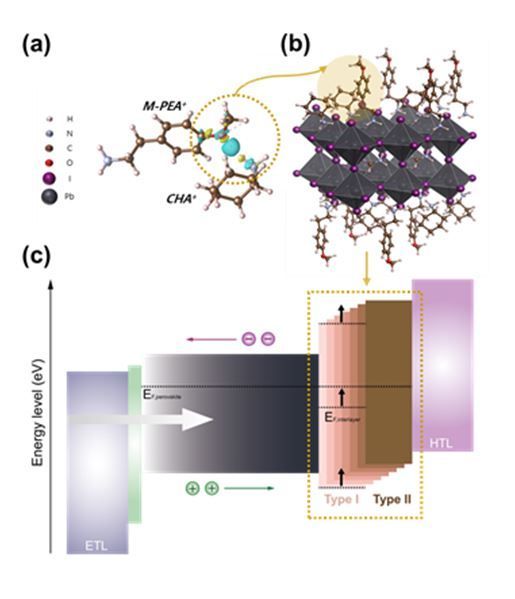
The perovskite solar cells with this interlayer technology achieved a power conversion efficiency of 26.3%, comparable to the highest efficiency of commercial silicon solar cells. In 2023, the National Renewable Energy Laboratory in the United States certified this as the world’s highest efficiency (25.82%). In addition, the cells maintained nearly 100% of their performance even after being stored at room temperature for 9,000 hours, demonstrating high storage stability.
Researcher Kim Jongbeom said, “This technology is significant in that it forms a stable interfacial layer through a simple solution process, improving both the durability and manufacturing efficiency of perovskite solar cells. The new method of combining organic ammonium cations holds limitless potential.”
The research team added that, based on this study, they aim to develop perovskite solar cells with ultra-high efficiency above 28% and high durability, and will continue research toward the commercialization of perovskite solar cells.
The results of this study were published online on the 17th in Joule, a leading sister journal of Cell.
© The Asia Business Daily(www.asiae.co.kr). All rights reserved.


















