Seven More Damage Cases Reported on the 26th
Gounsa Temple Burned Beyond Recognition
Cultural Heritage Administration Sprays Water and Installs Fire-Retardant Covers
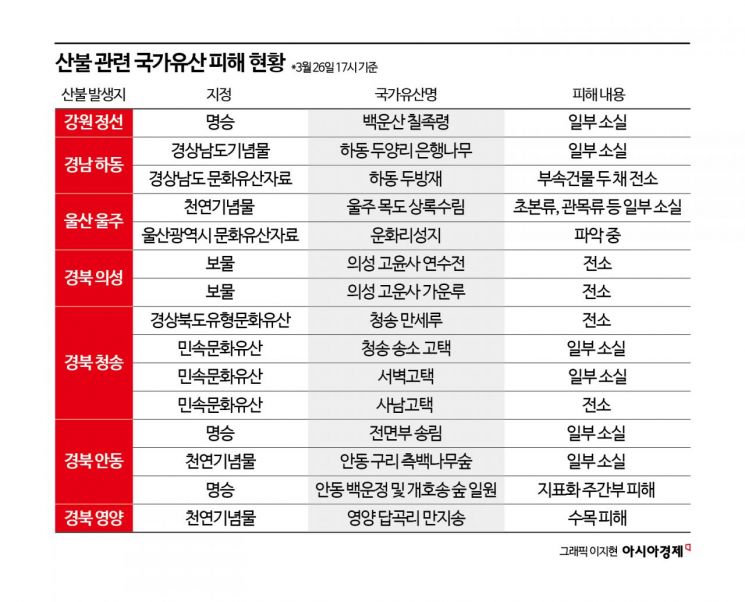
As wildfires continue unabated in Gyeongbuk's Uiseong, Andong, and Cheongsong areas, damage to national heritage sites is rapidly increasing. According to the Cultural Heritage Administration on the 26th, fifteen cases of damage had been identified by 5 p.m. that day. By type, there were three cases each of scenic sites, natural monuments, and national folk cultural heritage, and two cases of treasures. Two cultural heritage materials, one intangible cultural heritage, and one monument were also damaged.
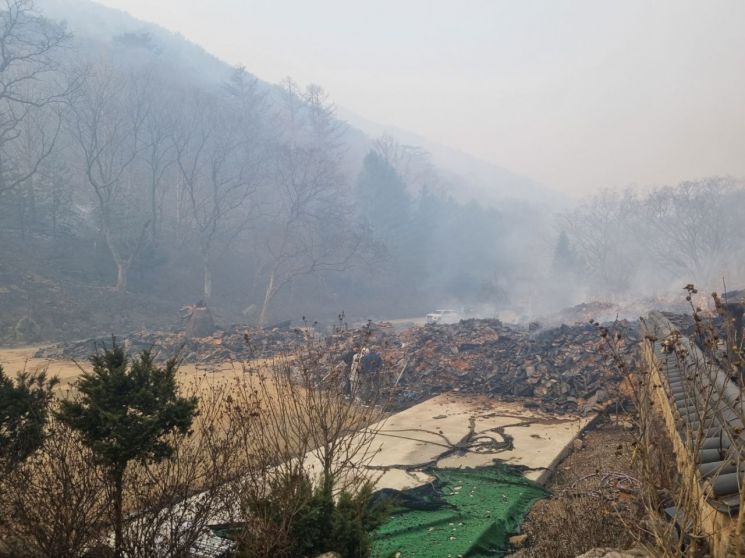 The Uiseong Gounsa Temple, known as a "thousand-year-old temple," was reduced to ashes by the recent wildfire.
 [Photo by National Heritage Administration]
As firefighting efforts continue day after day, the number of damage cases is gradually increasing. Until the previous day, eight cases had been recorded, but seven more were added on this day alone. Parts of Cheongsong Songsogotaek and Seobeokgotaek, which are national folk cultural heritage sites, were burned, and Sanamgotaek was completely destroyed by the flames. The natural monument 'Andong Guri Thuja Forest,' one of Korea's representative native thuja habitats, lost 0.1 hectares. Damage also occurred in the scenic site designated as 'Andong Baegunjeong and Gaeho Pine Forest Area.'
The cultural heritage site with the greatest damage is Gounsa Temple in Uiseong, known as the 'Thousand-Year-Old Temple.' By the previous day, most of the buildings had turned to ashes, making it difficult to recognize their original form. A Cultural Heritage Administration official stated, "Out of the thirty buildings in total, only nine remain in good condition, while the rest, including the treasure-designated Yeonsujeon and Gaunru, were completely destroyed."
Yeonsujeon, the only gilosu (耆老所) built within the temple, was highly valued for its exquisite dancheong (traditional multicolored paintwork) and murals, as well as motifs symbolizing the Korean Empire royal family, giving it significant historical and cultural importance. After the fire, only piles of roof tiles remain on the site, along with the surrounding earthen and stone walls.
Gaunru, constructed across the valley, is in a similar condition. Gaunru is a temple pavilion that preserves architectural styles popular in the mid to late Joseon Dynasty. It was designated as a treasure in July last year but was engulfed by fire just eight months later. The structure is now barely recognizable, making it difficult to maintain its status as a treasure. According to the current 'Act on the Protection and Use of Cultural Heritage,' cultural heritage designated as national heritage such as national treasures or treasures can have their designation revoked if they lose their value. In fact, in April 2005, a wildfire that swept through Naksansa melted the bronze bell, and after review by the Cultural Heritage Committee, its treasure designation was revoked in July of the same year.
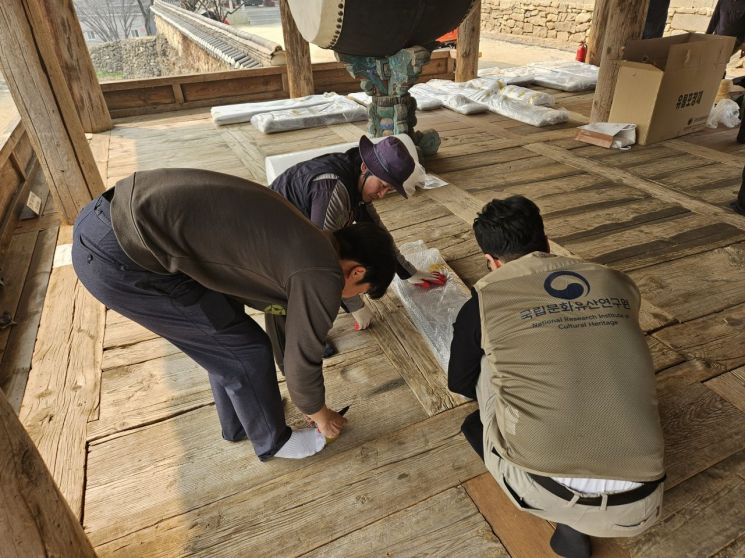 Employees of the Cultural Heritage Administration are moving artifacts from Bongjeongsa Temple in Andong.
 [Photo by Cultural Heritage Administration]
In response to the ongoing wildfires, the Cultural Heritage Administration has deployed about 750 personnel on site and installed fire-retardant covers on major cultural heritage sites, including the National Treasure Andong Bongjeongsa Geungnakjeon, considered the oldest wooden building in Korea. To prepare for any unforeseen circumstances, fifteen important relics housed in major temples, such as the Goryeo woodblock prints and Obulhoe Gwaebultang of Buseoksa Temple, and the wooden seated Avalokitesvara statue and Yeongsanhoe Gwaebul of Bongjeongsa Temple, were transferred to nearby museums and the National Gyeongju Cultural Heritage Research Institute. A Cultural Heritage Administration official said, "We are continuing emergency measures such as spraying water and installing fire-retardant covers as a preventive measure to protect national heritage from wildfire risks."
© The Asia Business Daily(www.asiae.co.kr). All rights reserved.



















