Musalem: "Further Tightening May Be Needed"
Tariffs Expected to Drive Up Domestic Goods Prices
In Contrast to Powell's Statement That "Tariff Impact Is Temporary"
Alberto Musalem, President of the Federal Reserve Bank of St. Louis, warned on the 26th (local time) that the inflation impact caused by the tariff policy of the Donald Trump administration may not be temporary. This view contrasts with Federal Reserve Chairman Jerome Powell's statement that the inflation shock from tariffs would be a temporary phenomenon, suggesting that Chairman Powell was overly optimistic. He expressed concern about the 'second-round effects' that cast a longer shadow on inflation and predicted that if tariff increases push prices up, interest rates could be maintained at the current level or even raised.
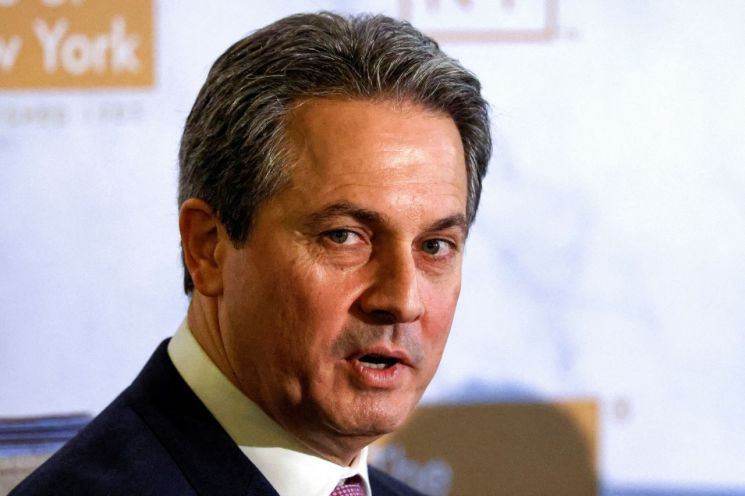
According to Bloomberg News, President Musalem said in a public speech at an event hosted by a regional economic organization in Kentucky, "We should be cautious about assuming that the impact of tariff increases on inflation will be entirely temporary."
He particularly distinguished between the direct effects of tariffs (one-time price increases) and the secondary effects that could have a more persistent impact on inflation, advising, "We need to be wary of the second-round effects caused by tariffs." This means that the ripple effects of tariffs may last longer than the short term. President Musalem emphasized, "The indirect and secondary effects on non-imported goods and services could have a more lasting impact on core inflation."
Considering this, he stated that monetary policy should be managed while monitoring the effects of tariffs. President Musalem said, "If labor market resilience is maintained and the secondary effects of tariffs become evident, or if medium- to long-term inflation expectations influence actual inflation to rise or persist, it may be appropriate to maintain a moderately restrictive policy for a longer period or even consider a more restrictive policy." This implies that there could be situations where interest rates need to be raised depending on the impact of tariffs on prices.
Earlier, after the March Federal Open Market Committee (FOMC) meeting, the Fed maintained its forecast for two rate cuts within the year. However, among the 19 FOMC members, eight expected at least one rate cut or no cuts at all this year.
After his speech, President Musalem met with reporters and predicted that the timing for inflation to reach the Fed's policy target of 2% would be delayed to 2027, later than the end of last year. He viewed that if tariff increases reduce the competitiveness of imported goods, demand for some domestically produced goods could be stimulated, leading to price increases.
He said that if inflation expectations become unsettled, the Fed is likely to prioritize price stability. President Musalem introduced a Fed staff study indicating that if the effective U.S. tariff rate rises by 10% due to the tariffs announced so far, prices could increase by up to 1.2 percentage points. Of this, the direct tariff effect is 0.5 percentage points, but the indirect tariff effect, or second-round effect, is expected to be larger at 0.7 percentage points. This would make it difficult to achieve the Fed's 2% inflation target.
President Musalem's remarks contrast with Chairman Powell's view, which considers inflation caused by tariff shocks as likely a temporary phenomenon in the baseline scenario.
Earlier, at a press conference on the 19th, Chairman Powell responded to a question about whether the tariff shock was temporary by saying, "I think that is kind of the baseline scenario."
Chairman Powell also said, "If inflation is a temporary phenomenon expected to disappear quickly without our actions, sometimes it may be appropriate to overlook such inflation," adding, "That could also be the case with tariff inflation."
Meanwhile, as the tariff policy of the Donald Trump administration adds uncertainty to the market, more major financial firms are lowering their U.S. stock market outlooks. The equity strategy team led by Venu Krishna at Barclays significantly lowered the year-end target price for the S&P 500 index from 6600 to 5900 in a report released that day. This implies that the S&P 500 index is expected to remain around last year's closing price (5881.63) by the end of this year.
Barclays stated, "The baseline scenario assumes that tariffs contribute to a significant slowdown in U.S. economic activity, with corporate earnings being hit at a level where a real recession does not occur," estimating the probability of the baseline scenario at 60%. increased.
© The Asia Business Daily(www.asiae.co.kr). All rights reserved.

















