No Unusual Questions in Korean Compared to Last Year’s CSAT
English Listening Section Already Presents Challenges in Choosing Correct Answers
This year’s first nationwide joint academic achievement evaluation (Hakryeok Pyeongga) was analyzed by the admissions industry as having similar difficulty levels in Korean and Mathematics compared to last November’s College Scholastic Ability Test (CSAT), while English was considered more difficult.
On the 26th, Uway Education Evaluation Research Institute assessed the March academic evaluation (for 12th graders) organized by the Seoul Metropolitan Office of Education, stating that the difficulty levels of the Korean and Mathematics sections were generally similar to those of the 2025 CSAT.
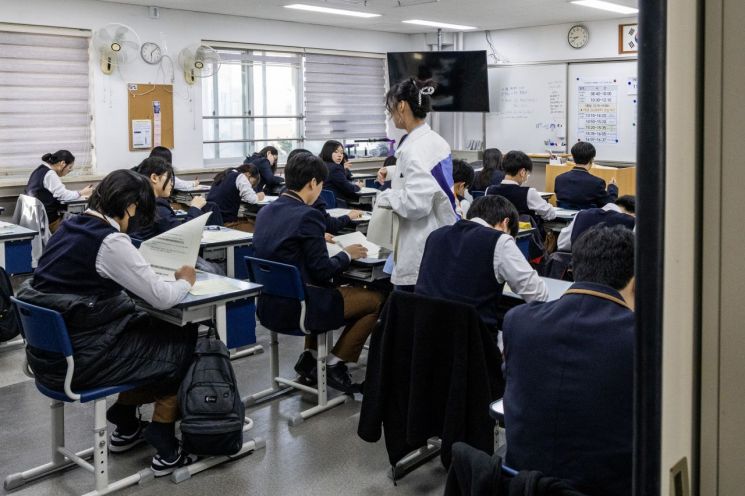 Students preparing for the March National Joint Academic Assessment at Geumcheon High School in Geumcheon-gu, Seoul. Photo by Joint Press Corps
The Korean section was analyzed as having no unusual questions compared to last year’s CSAT.
However, Uway noted that in the reading section’s scoring, the points for reading theory were lowered from 7 to 6, while the points for integrated themes were increased from 13 to 14.
Questions such as Integrated Theme number 8, which requires applying information to specific cases, and Social Studies number 12 were identified as having high difficulty. Mathematics was also described as similar or slightly easier compared to last year’s CSAT.
In particular, common subjects and 'Probability and Statistics' were similar in difficulty, while 'Calculus' and 'Geometry' were considered slightly easier. However, since Mathematics was not entirely easy in last year’s CSAT, it was expected that the overall perceived difficulty by examinees was somewhat higher.
Notable questions included Common Subject number 22, which involved inferring functions using continuity and differentiability, Calculus number 30, which used the limit of a geometric sequence, and Geometry number 30, which involved inferring the relationship between ellipses and parabolas.
English was analyzed as having difficult questions starting from the listening section, making it challenging for examinees to select the correct answers.
English, graded on an absolute scale, awards the top grade (1st grade) to those scoring 90 points or above. While last year’s CSAT had the top 6.22% within the 1st grade, this academic evaluation is expected to lower the 1st grade cutoff to within 4%.
Lee Mangi, director of Uway Education Evaluation Research Institute, said, "Overall, the difficulty was similar to last year but not easy," and added, "Students should plan their studies to identify and improve their weaknesses."
© The Asia Business Daily(www.asiae.co.kr). All rights reserved.

















