HIRA Releases Korea's First Infertility Treatment Statistics
200,000 Procedures in 2022, Average Age 37.9
IVF Success Rate 37%, Artificial Insemination 13%
Infertility treatments have been increasing every year, surpassing 200,000 cases in 2022 alone. The probability of successful pregnancy through infertility treatments decreases with age, dropping sharply after the mid-40s.
 Infertility-related project sketch - The Seoul Station Infertility Center of Cha Women's Medical Research Institute. Photo by Yongjun Cho jun21@
On the 26th, the Health Insurance Review & Assessment Service (HIRA) published for the first time a booklet titled "Infertility Treatments Seen Through Statistics," which contains detailed information on the number of infertility treatments, causes of infertility, pregnancy rates, and other related data.
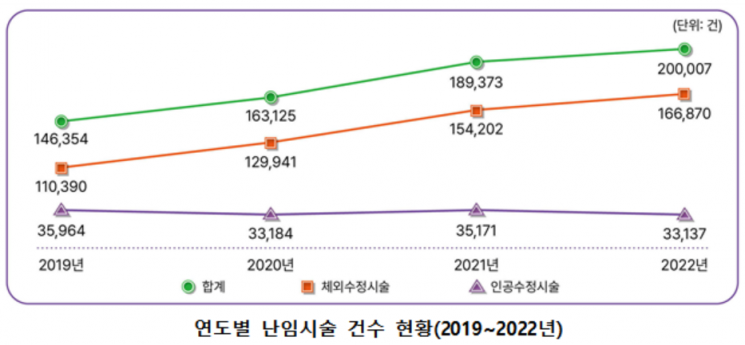
As of 2022, there were 201 institutions performing infertility treatments, with a total of 200,007 procedures conducted. The number of infertility treatments has steadily increased each year, rising by 36.7% over three years compared to 146,354 cases in 2019. With the trend of increasing marriage age and expanded government support for infertility treatments, it is estimated that the number of infertility treatments continued to rise after 2023.
By cause of infertility, 64.2% were cases where only the woman was infertile, 15.0% where only the man was infertile, and 20.8% where both partners were infertile.
Among the 200,000 cases, in vitro fertilization (IVF) accounted for 166,870 cases, making up 83.4%, while artificial insemination accounted for 33,137 cases, or 16.6%. Artificial insemination is a procedure where highly motile sperm are directly injected into the woman's uterus, whereas IVF involves retrieving eggs and sperm, fertilizing and culturing them outside the body, and then implanting the embryo into the uterus. IVF is further divided into fresh embryo transfer and frozen embryo transfer. HIRA explained that artificial insemination is decreasing while IVF is on the rise.
In 2022, a total of 78,543 individuals received infertility treatments, with an average age of 37.9 years. Those who underwent IVF tended to be relatively older.
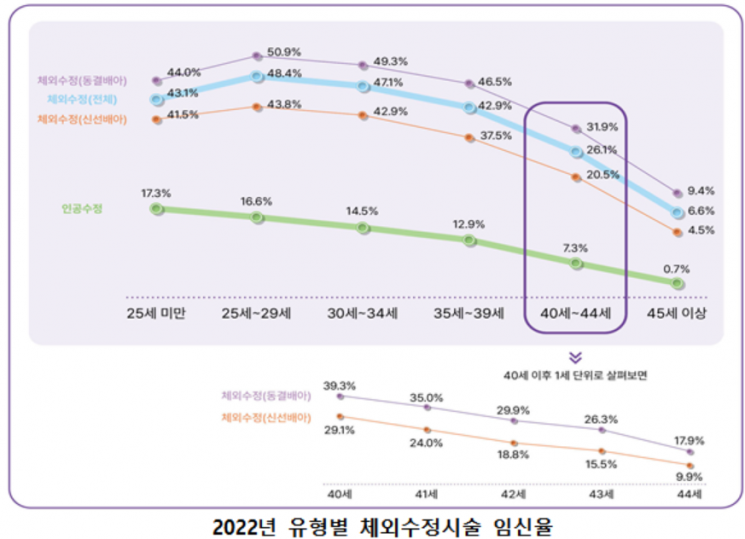
The pregnancy rate, defined as the proportion of cases where a gestational sac was confirmed by ultrasound after completing infertility treatment, was 36.9% on average for IVF and 13.0% for artificial insemination. For both procedures, pregnancy rates were generally higher in younger age groups and dropped sharply after age 40.
Among IVF cases, the pregnancy rate for fresh embryo transfers was highest at 43.8% for ages 25-29, followed by 42.9% for ages 30-34, 37.5% for ages 35-39, and 20.5% for ages 40-44, then plummeted to 4.5% for those aged 45 and older. The pregnancy rate for frozen embryo IVF was over 50.9% for ages 25-29, but decreased to the 40% range in the 30s, the 30% range in the early 40s, and dropped sharply to 9.4% for those 45 and older. Even when comparing pregnancy rates by each single year over age 40, a noticeable decline was observed as age increased.
For artificial insemination, the success rate was generally lower than IVF, with the highest rate of 17.3% for those under 25, 14.5% for ages 30-34, 7.3% for ages 40-44, and an extremely low pregnancy rate of 0.7% for those aged 45 and above.
Experts suggest that considering the rising age of first marriage and the expected continued increase in the population undergoing infertility treatments, couples planning pregnancy should visit medical institutions for examinations as early as possible. Professor Lee Jeong-ryeol of Bundang Seoul National University Hospital advised, "At the very least, visit a medical institution before age 35 to undergo fertility testing and prioritize attempts at natural pregnancy, but if necessary, receive timely infertility treatments."
© The Asia Business Daily(www.asiae.co.kr). All rights reserved.
![Clutching a Stolen Dior Bag, Saying "I Hate Being Poor but Real"... The Grotesque Con of a "Human Knockoff" [Slate]](https://cwcontent.asiae.co.kr/asiaresize/183/2026021902243444107_1771435474.jpg)


















