Pilot Searching for Missing Plane Discovers Wreckage
Survivors Endure 12 Hours on the Wing
"Survived Because the Plane Did Not Completely Sink"
A small plane crashed on a frozen lake in Alaska, USA, but the passengers survived after enduring 12 hours on the plane's wing.
On the 25th (local time), the Associated Press (AP) reported that "on the 22nd, a Piper PA-12 Super Cruiser small plane crashed into Tustumena Lake in Alaska." According to AP, the plane was carrying three family members: the pilot and two teenagers. They were on a sightseeing trip from Soldotna to Skilak Lake in Alaska. The plane suddenly crashed into the lake, with most of the fuselage submerged except for the wings. The passengers climbed onto the plane's wing and endured about 12 hours, but as night fell, the temperature dropped below freezing, forcing them to battle the cold.
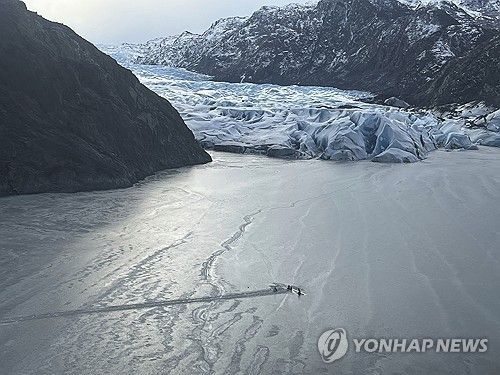 A light aircraft crashed into Lake Tustumena in Alaska, USA, but all passengers survived. Provided by Alaska National Guard. AP·Yonhap News Agency
The next morning, after hearing about the missing plane, 12 pilots took their own planes to search for the missing aircraft. One of the pilots, Terry Gose, spotted an object believed to be the crashed plane on Tustumena Lake. Gose informed the other pilots that the missing plane had been found, and the Alaska National Guard dispatched a helicopter to rescue the family. Alaska police stated, "All three people were alive and were transported to the hospital with injuries."
Gose recalled, "At the time, the fuselage except for the wings and rudder was submerged in water," adding, "As I descended lower, I saw three people on the wing." He continued, "They were alive and responded by waving toward the plane I was flying. Because the plane had not completely sunk, the survivors were able to endure on the wing despite the cold weather. It was a miracle."
The exact cause of the accident has not yet been determined, and the U.S. National Transportation Safety Board (NTSB) and Federal Aviation Administration (FAA) are investigating. AP reported, "Alaska relies heavily on small planes for transportation due to underdeveloped roads," and "the Tustumena area, where the accident occurred, often experiences sudden strong winds."
© The Asia Business Daily(www.asiae.co.kr). All rights reserved.

















