Utilizing the Obsolete Section 338 of the Tariff Act as Legal Grounds
Internal Disputes Over the New Tariff System and Methods of Imposition
The Donald Trump administration in the United States is reportedly considering imposing the announced reciprocal tariffs on May 2 in two phases, according to the Financial Times (FT) on the 25th (local time). Amid President Donald Trump's inconsistent moves regarding tariff policies, this is interpreted as an intention to invoke emergency powers to impose tariffs by finding justification in legal provisions.
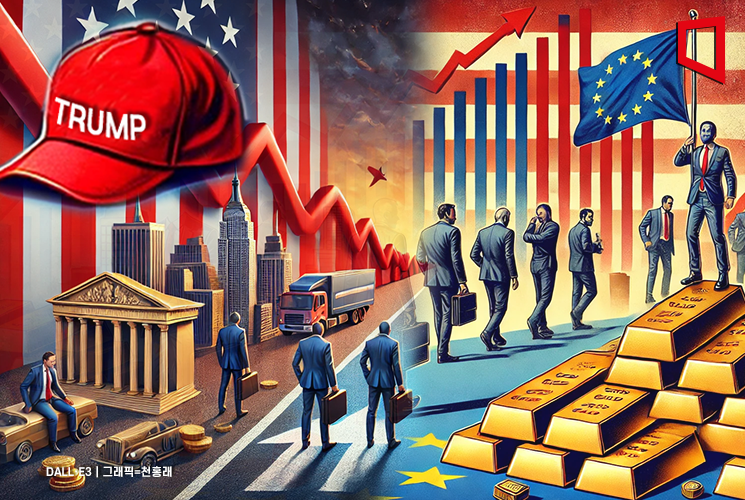
According to sources, the Trump administration is reviewing a plan to immediately impose emergency tariffs by exercising legal provisions that have rarely been used until the investigation of trading partners is completed.
The plan under discussion includes initiating investigations on trading partners based on Section 301 of the U.S. federal law and immediately applying tariffs using Section 338 of the Tariff Act of 1930 or the International Emergency Economic Powers Act (IEEPA). Section 338 is a little-known provision that allows imposing tariffs of up to 50% on trade partners when used as a basis for tariffs.
Earlier, Reuters also reported last month that the Trump administration might invoke this provision. President Trump complained that trading countries treat the U.S. unfairly and threatened to impose tariffs based on U.S. tariff rates. However, apart from the investigation results for tariff rate calculation, the administration shifted to a method of temporarily imposing tariffs by exercising emergency powers.
The reason for revisiting a law provision that has become almost obsolete seems to be that although the Trump administration announced tariffs, it takes considerable time to actually impose them. Since taking office, President Trump has warned of tariffs on Canada, Mexico, and China, as well as tariffs on specific items like automobiles and reciprocal tariffs, but actual tariffs have only been imposed on China, steel, and aluminum.
Foreign media also reported that the Trump administration is overwhelmed by simultaneous tariff bombardments. The Wall Street Journal (WSJ) said on the 28th of last month, "Inside the U.S. government, there is an analysis that it could take more than six months to fully implement reciprocal tariffs due to the tight deadline of April 2."
Forbes in the U.S. introduced the FT report on the same day, noting, "President Trump's hesitation on reciprocal tariffs may be the result of his administration seeking a strong legal basis for such broad measures and adopting a two-step approach."
Sources said President Trump could immediately apply tariffs on imported vehicles on May 2, and the national security study on the global automobile industry, which was suspended during the first trade war, could be resumed. President Trump said the automobile tariffs could be announced "within the next few days."
FT also mentioned Section 122 of the Trade Act of 1974 as a recently discussed but unlikely adopted option. This provision allows the U.S. to temporarily impose tariffs of up to 15% for a maximum of 150 days.
Ahead of the reciprocal tariff announcement, President Trump has caused market confusion by changing his statements on the timing of imposition. FT criticized Trump's trade policy as inconsistent, stating, "He announced devastating tariffs on allies like Mexico and Canada but withdrew the tariffs within hours due to intense corporate lobbying."
He showed a tough stance of "no exceptions," but as the reciprocal tariff announcement approached, he changed his position, saying "many countries could be exempted." The day before, President Trump indicated that while he would impose significant tariffs on trading partners, many countries might receive exemptions. FT interpreted these mixed messages as reflecting ongoing debates within the Trump administration over the new tariff system and enforcement methods.
Meanwhile, the Korea Institute for International Economic Policy advised in a report titled "Domestic Legal Grounds and Implications of the U.S. Administration's Tariff Policy" published in July last year that "Sections 338 (Trade Act of 1974) and 122 could be used as legal grounds for the U.S. administration's new tariff policy," and "If the U.S. administration implements tariff measures, judicial responses are expected to be difficult, so close monitoring of the strengthening of the U.S. tariff policy and careful operation and resetting of South Korea's foreign trade policy are necessary."
© The Asia Business Daily(www.asiae.co.kr). All rights reserved.
![Clutching a Stolen Dior Bag, Saying "I Hate Being Poor but Real"... The Grotesque Con of a "Human Knockoff" [Slate]](https://cwcontent.asiae.co.kr/asiaresize/183/2026021902243444107_1771435474.jpg)
















