Canadian Visits to the U.S. Down 23% in February
Concerns Over a 5% Decline in Total Foreign Visitors
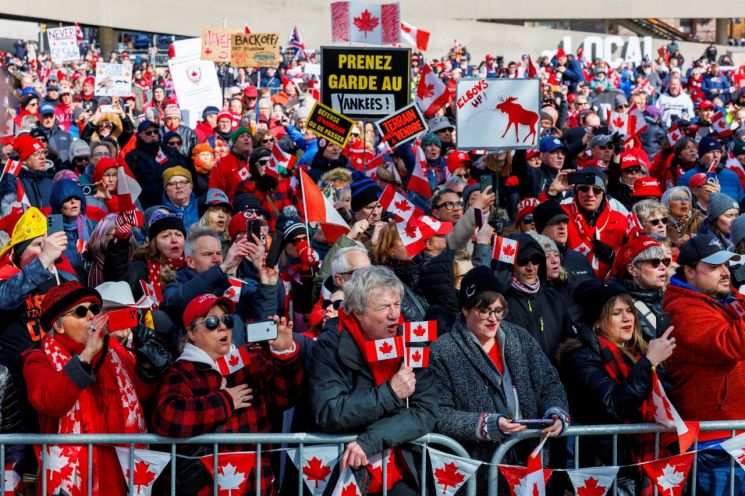 On the 22nd (local time), citizens in Toronto, Canada, are protesting against the United States' tariff policies and Canada's merger policies. Photo by Reuters and Yonhap News.
The number of Canadian visitors to the United States, which had been the largest group among annual U.S. visitors, has significantly decreased. This is due to many Canadians canceling their trips to the U.S. amid growing anti-American sentiment fueled by President Donald Trump's tariff pressures and merger threats. The U.S. tourism industry is on high alert, fearing a continuous decline in tourists visiting the U.S. due to deteriorating relations with allies such as the European Union (EU) and Mexico.
Canadian Visits to the U.S. Down 23% in February... Shift to Domestic Travel
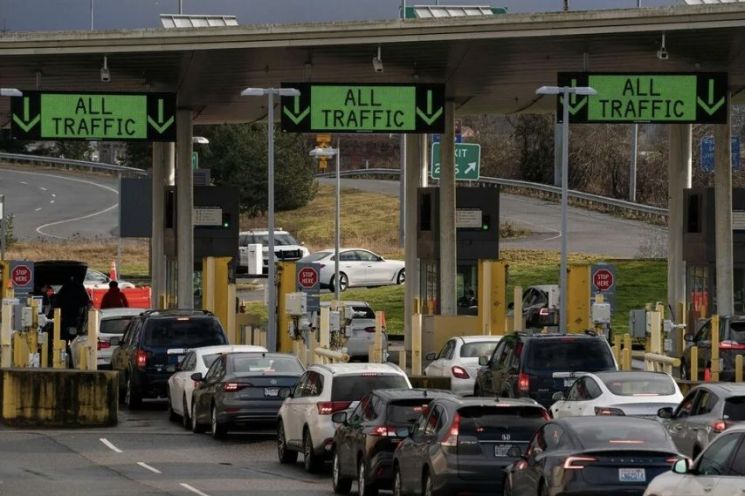 The border checkpoint between the United States and Canada located in Blaine, Washington, USA. Photo by AFP and Yonhap News.
Statistics Canada reported that the number of border crossings by Canadian residents last month decreased by 23% compared to the same month last year. The number of trips to the U.S. by air also dropped by 13% year-over-year. The number of visitors to the U.S. has sharply declined amid growing anti-American sentiment within Canada.
According to data compiled by Cirium, an aviation data analytics company, the number of reserved seats on flights from Canadian airlines to the U.S. for April to June has decreased by an average of 6.1% compared to the end of January this year. WestJet, a Canadian airline, stated that "Canadians have been observed booking other destinations such as Mexico or the Caribbean instead of the U.S."
The Wall Street Journal (WSJ) reported that Canadians feel great anger and fear over President Trump's merger threats. In an interview with WSJ, a Canadian tourist said, "I had planned a trip to Arizona recently but canceled it after Trump's remarks about merging Canada. I paid a cancellation fee of $500 (about 730,000 KRW). Although the cancellation fee was burdensome, I thought it was wrong to spend money in the U.S., so I changed my plans to travel within Canada."
President Trump openly declared even before his inauguration in January this year that he would merge Canada as the 51st state of the U.S. He also insulted former Prime Minister Justin Trudeau by calling him a "Canadian governor" and said, "If you come to the U.S. governors' meeting, you will be welcome."
Anti-Trump Sentiment Spreads, Tourism Industry on Alert... Concerns Over Decline in U.S. Visitors
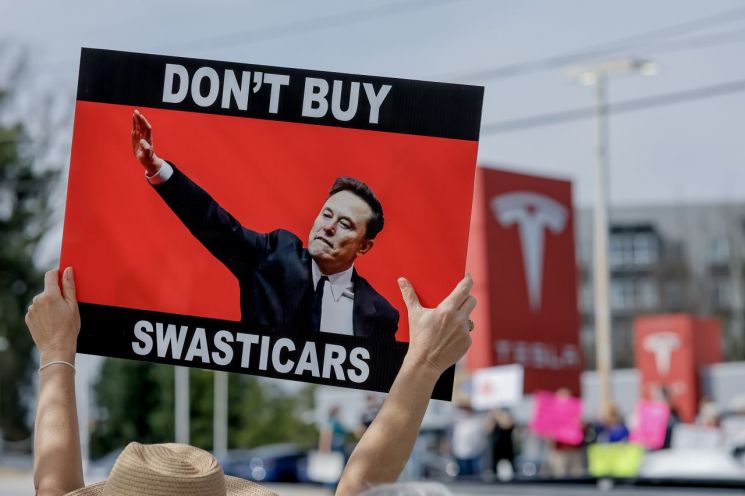 On the 8th (local time), citizens in Georgia, USA, held a protest against the policy of reducing public officials led by Elon Musk, Tesla CEO and head of the Department of Government Efficiency (DOGE), a close aide of President Donald Trump. Photo by EPA and Yonhap News
The U.S. tourism industry is concerned about the economic damage caused by the decline in Canadian tourists. According to the U.S. Travel Association, 20.2 million Canadians visited the U.S. last year, the highest number among foreign visitors. The association warned that every 10% decrease in Canadian visitors could reduce travel-related spending by $2 billion (about 2.93 trillion KRW) and result in the loss of 14,000 jobs.
Tourism Economics, a U.S. tourism statistics and analysis firm, recently reported, "There are concerns that tourists from Canada, the EU, Mexico, and China will significantly decrease, and the total number of foreign tourists visiting the U.S. this year is expected to decline by more than 5% compared to last year." It also pointed out that "a considerable number of Canadian and European tourists have already turned their attention to Latin American destinations."
Major U.S. airlines have also downgraded their performance forecasts, citing worsening economic conditions such as the tariff war and a slowdown in domestic and international travel demand. American Airlines projected that its first-quarter revenue would underperform initial expectations, forecasting a loss per share of $0.60 to $0.80 for the first quarter. The previous estimate was $0.20 to $0.24. In an interview with CNBC, American Airlines stated, "Travel demand is expected to slow due to recent airline accidents in the U.S. and macroeconomic uncertainties."
The government efficiency office (DOGE) within the Trump administration is pushing for civil servant reductions, which is also feared to significantly reduce travel demand. The CEO of United Airlines said at the JP Morgan Aviation Industry Conference, "Domestic and international government travel accounts for about 2% of total revenue, and travel by government consultants and contract workers affects about 2-3% of revenue. Due to government budget cuts and civil servant restructuring, revenue from the U.S. government is expected to be halved."
© The Asia Business Daily(www.asiae.co.kr). All rights reserved.



















