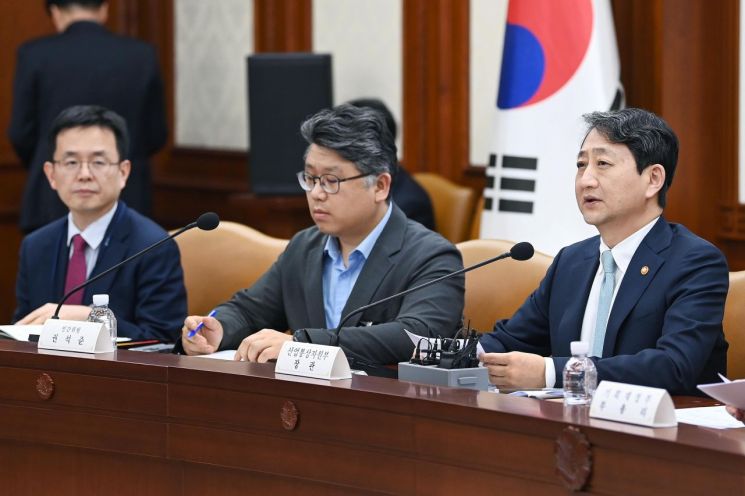
The government announced the "Promotion Direction for Activating Core Mineral Recycling" at the 4th Supply Chain Stabilization Committee held at the Seoul Government Complex on the 25th. Core mineral recycling is an industry that produces essential core minerals such as nickel, cobalt, and lithium for advanced industries by utilizing recycling raw materials like waste batteries, waste printed circuit boards (PCBs), and waste catalysts. It is considered a practical alternative to establish a domestic supply base for core minerals.
The government has set a goal to achieve a 20% recycling rate for the top 10 strategic core minerals by 2030 and established four major promotion strategies: ▲creating an industrial ecosystem ▲fostering companies ▲rationalizing regulations ▲building infrastructure.
First, a core mineral recycling industrial cluster covering the entire value chain of raw materials, materials, and products will be created, and an industrial ecosystem will be built through promising technology demonstration and commercialization, as well as support for raw material and product composition analysis and certification.
Additionally, to ensure stable supply of recycling raw materials, a supply chain database will be established, and plans include conducting overseas raw material procurement surveys and introducing a full lifecycle traceability system for used batteries.
Support for companies will also be expanded. The government plans to increase direct investment and loan support from the Supply Chain Stabilization Fund and review direct investment support measures by the Korea Mine Reclamation Corporation. Market demand will be created through the establishment of recycling facilities and equipment, support for core technology development, and stockpiling of recycled products (metals, oxides, etc.).
For regulatory rationalization, the scope of new growth and source technologies will be expanded, and support measures for tariff allocation on recycling raw materials will be reviewed. Furthermore, policy exchanges and joint technology development cooperation with the EU, Japan, and others will be strengthened by utilizing global multilateral consultative bodies such as the Mineral Security Partnership (MSP).
Moreover, plans will be pursued to expand recognition and designation of circular resources considering the harmfulness of major recycling raw materials, and to establish an integrated management system for used batteries by enacting the "Used Battery Act."
In addition, to expand core mineral recycling infrastructure, the government will enlarge the public-private joint forum, operate inter-ministerial task forces and private expert committees to discover new support policies. A special industrial classification system for core mineral recycling will be developed to support industrial complex settlement, and the statistical system will be improved through industrial surveys and development of key statistical indicators.
A government official stated, "This measure is expected to play an important role in strengthening the domestic core mineral supply chain and securing competitiveness in advanced industries."
© The Asia Business Daily(www.asiae.co.kr). All rights reserved.

















