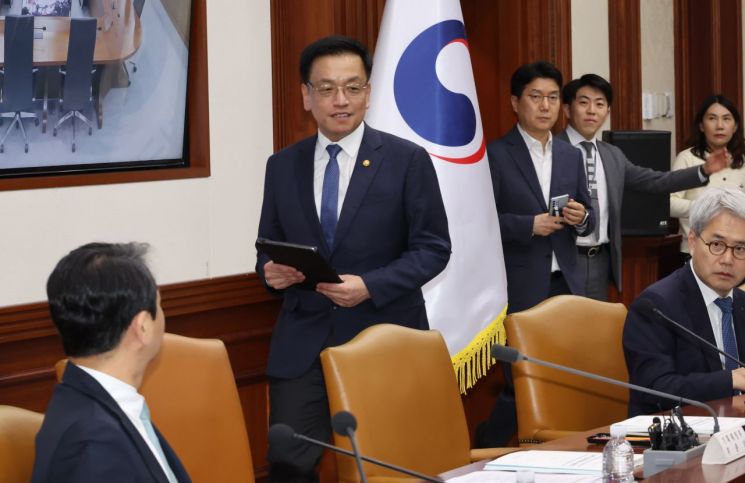
Choi Sang-mok, Deputy Prime Minister for Economy and Minister of Strategy and Finance, emphasized on the 25th, "We will confront changes in external conditions and supply chain disruptions with the determination that building a solid and stable supply chain is the most powerful economic policy needed by companies."
On the same day, Deputy Prime Minister Choi presided over the "4th Supply Chain Stabilization Committee" at the government complex in Jongno-gu, Seoul, stating, "Global supply chain instability is intensifying as the new U.S. administration imposes tariffs without exceptions even on allies, and China responds by strengthening export controls on critical minerals."
During the meeting, measures to stabilize the supply of vehicle urea, directions to activate the recycling of critical minerals, and plans for operating the supply chain stabilization fund were discussed.
Regarding the stabilization of vehicle urea supply, Deputy Prime Minister Choi explained, "Through a policy combination of expanding reserves and diversifying imports, we aim to establish a stable supply system against any external disruption factors. We will expand the current public stockpile (other consumption stockpile) from about 50 days to about 70 days and diversify overseas import sources from the existing Vietnam, China, and Japan to the Middle East and Europe."
He continued, "Since we rely entirely on imports for critical minerals, it cannot be overstated how important recycling to extract critical minerals from used products is. We will solidly build the industrial base related to recycling with the goal of achieving a 20% recycling rate of critical minerals by 2030."
© The Asia Business Daily(www.asiae.co.kr). All rights reserved.

















