Largest Investment Since Entering the U.S. Market
Additional 200,000-Unit Capacity at HMGMA
New Steel Mill in Louisiana
Stabilizing the Steel and Automotive Supply Chain
Trump Says "Thank You" During Speech
Hyundai Motor Group's investment of 31 trillion won in the United States, including the construction of an integrated steel mill, is the largest since its entry into the U.S. market in 1986. Analysts say this move aims to achieve a twofold effect by responding to the U.S. administration's policies under Donald Trump, such as rebuilding American manufacturing, avoiding tariff bombs, and expanding business opportunities in future industries.
By increasing the production capacity of Hyundai Motor Group Meta Plant America (HMGMA), which is set to hold its completion ceremony this week, and establishing a production system of 1.2 million units solely in the U.S., it is expected to significantly reduce the tariff burden imposed on imported cars.
In particular, by building an electric arc furnace steel mill in Louisiana, the group aims to avoid the 25% steel tariff and stabilize the supply chain that connects steel, parts, and automobiles. Investments in future industries such as robotics and artificial intelligence (AI) will also be expanded to strengthen cooperation with American companies.
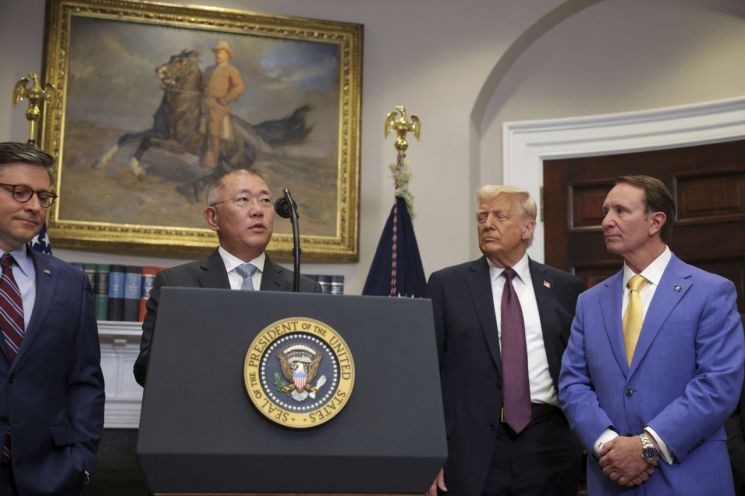
On the 24th (local time), Hyundai Motor Group Chairman Chung Euisun met with U.S. President Donald Trump in the Roosevelt Room of the White House in Washington, D.C., to announce this investment plan, emphasizing the "local supply chain stability."
Chairman Chung introduced the plan to increase U.S. automobile production by 200,000 units and the newly established steel mill in Louisiana, stating, "The core of this record-breaking investment is a $6 billion investment to strengthen the supply chain of steel and automobile parts in the United States." He added, "All these efforts will accelerate the localization of supply chains within the U.S., expand operations, and increase American employment."
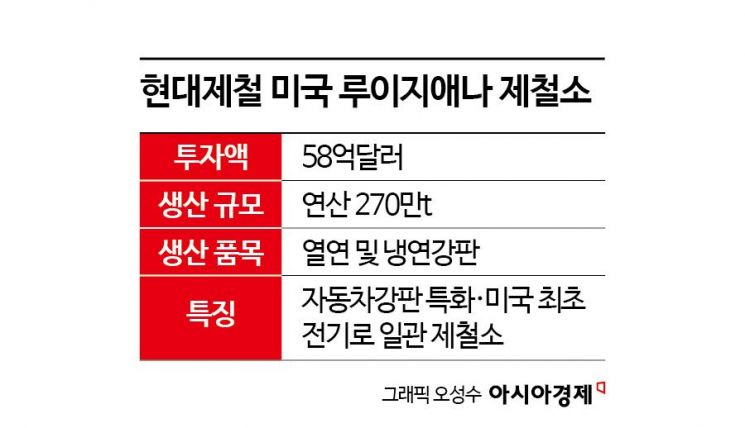
The electric arc furnace steel mill in Louisiana, constructed by Hyundai Steel, will have a capacity of 2.7 million tons and specialize in producing low-carbon automotive steel sheets. The plan is to respond to external risks such as tariffs by locally supplying high-quality automotive steel sheets. Chairman Chung emphasized, "The Louisiana steel mill will create 1,300 new jobs for Americans and will serve as the foundation for a more independent and stable American automobile supply chain."
The announcement was made in a warm atmosphere. Upon entering the Roosevelt Room, President Trump immediately extended his hand to Chairman Chung, and later greeted Vice Chairman Jang Jae-hoon, who is in charge of finished vehicles, Hyundai Motor President Sung Kim, a former U.S. Ambassador to Korea, and Hyundai Steel President Seo Kang-hyun. He said, "This will be a beautiful announcement. I am very excited," introducing Chairman Chung and Hyundai Motor officials, and added, "It is a great honor."
Introduced by President Trump, Chairman Chung took the podium and repeatedly expressed gratitude to President Trump. When he congratulated President Trump on the successful start of his new term, President Trump responded, "It has been good," which elicited laughter from the audience.
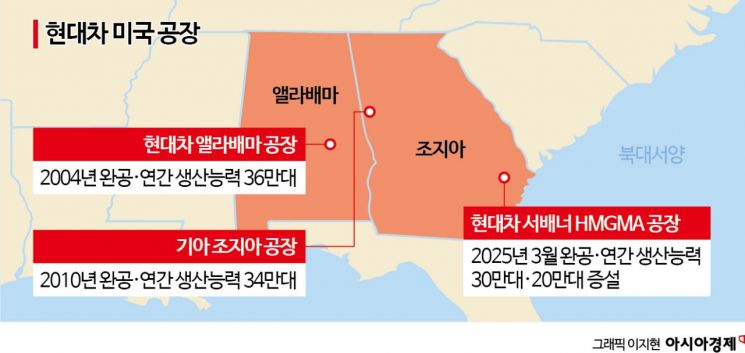
Chairman Chung recalled the connection with President Trump regarding the Georgia plant where the new investment was announced. Referring to the investment in the Savannah, Georgia plant, he said, "It started with a meeting with President Trump in Seoul in 2019," and "The plan to establish the plant was mentioned in Dallas the following year, in 2020." President Trump briefly said "Thank you" during Chairman Chung's speech.
After Chairman Chung's announcement, President Trump emphasized, "Hyundai will produce steel in the United States and make cars in the United States. As a result, they will not have to pay tariffs," adding, "This investment clearly shows how powerful tariffs can be."
High-ranking U.S. political figures, including Louisiana Governor John Bel Edwards, U.S. House Speaker Mike Johnson (Louisiana), and Republican House Majority Leader Steve Scalise (Louisiana), were present at the event.
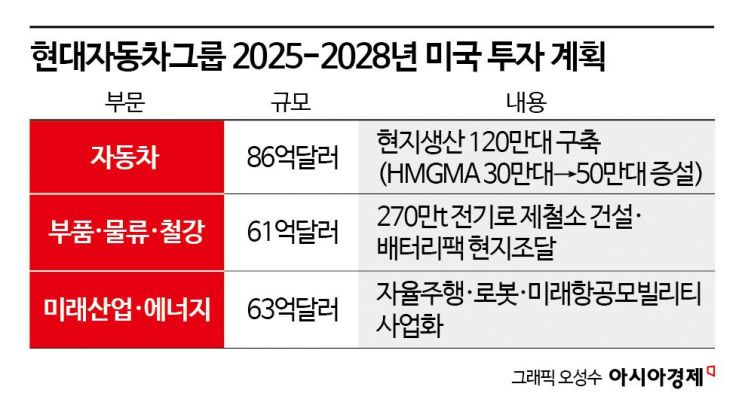
Hyundai Motor Group's investment in the U.S. is divided into the automotive, parts/logistics/steel, and future industries/energy sectors. A total of $8.6 billion will be invested in the automotive sector to increase HMGMA's production by 200,000 units, raising the total production capacity of U.S. plants, including those in Alabama and Georgia, to 1.2 million units.
In the parts, logistics, and steel sectors, a total of $6.1 billion will be spent by group companies, including $5.8 billion for the construction of the steel mill. The localization rate of parts will be increased, and local procurement of key electric vehicle components such as battery packs will be promoted.
In the future industries and energy sectors, including autonomous driving, robotics, AI, and Advanced Air Mobility (AAM), $6.3 billion has been allocated. Projects are underway to intelligentize mobility solutions such as NVIDIA and Software-Defined Vehicles (SDV), and to apply AI technology across the business. The autonomous driving taxi service "Waymo One" will be expanded using the U.S. autonomous driving company Waymo and the Ioniq 5.
Subsidiary Boston Dynamics and the Robotics and AI Institute (RAI) are developing intelligent robots based on reinforcement learning, and Supernal aims to commercialize AAM aircraft by 2028, collaborating with several U.S. states on unmanned aircraft testing.
Efforts will also be made to support future technologies in nuclear and renewable energy fields and to expand electric vehicle charging stations. Hyundai Engineering & Construction is pushing to start construction of a Small Modular Reactor (SMR) in Michigan by the end of this year in partnership with Holtec International. Charging stations will also be increased through IONNA, an alliance for ultra-fast electric vehicle charging services.
A Hyundai Motor Group official stated, "We will create future opportunities through bold investments, internalization of core technologies, and strategic cooperation with top-tier domestic and international companies."
© The Asia Business Daily(www.asiae.co.kr). All rights reserved.



















