Auto Tariffs to Be Announced Before Reciprocal Tariffs
Tariff Policy Claimed to Induce Investment and Factory Relocation in the U.S.
Foreign Media: "Tariff Announcement Plans Increasing Confusion"
On April 2, U.S. President Donald Trump, who had announced reciprocal tariffs and item-specific tariffs, withdrew his original plan on the 24th (local time), saying he might announce tariffs on automobiles and pharmaceuticals first. He stepped back from his previous hardline stance of "no exceptions," suggesting that many countries could be exempted from tariffs. Critics say President Trump's repeated flip-flopping is causing confusion in the global trade order.
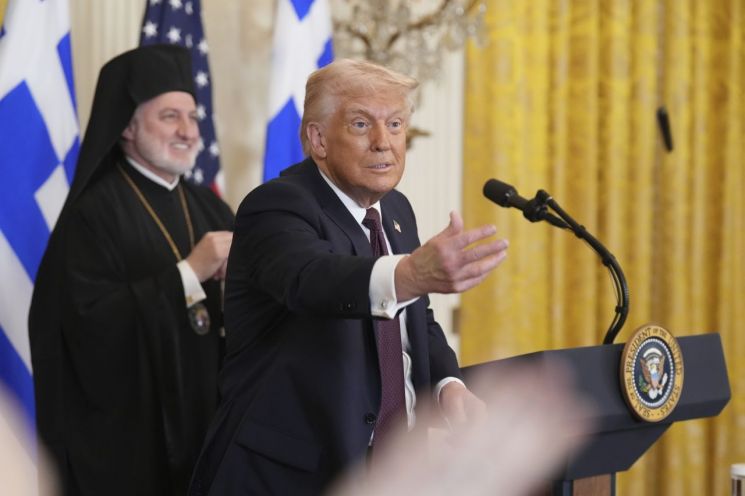
At a White House cabinet meeting that day, President Trump said, "We will announce tariffs on automobiles quite soon (over the next few days, fairly soon)," and added, "At some point not far off, we will also announce tariffs on pharmaceuticals."
This was interpreted as indicating that the previously expected joint announcement of item-specific tariffs and reciprocal tariffs might be made separately. Initially, tariffs on automobiles were expected to be announced together with reciprocal tariffs on April 2, as President Trump had previously indicated. In February, President Trump reaffirmed tariff policies on product sectors such as automobiles, semiconductors, and pharmaceuticals, proposing a tariff rate of 25%.
Later, at a Hyundai Motor Group investment announcement event held at the White House, when asked whether sector-specific tariffs would be imposed together with reciprocal tariffs, he replied, "That will be everything," but also said, "Not all tariffs will be included in that day's announcement."
He also hinted that tariffs on pharmaceuticals and other products were imminent. Regarding sector-specific tariffs on lumber and semiconductors, he said plans would be made "in the future," without providing detailed timing. He stated, "If we have war-like problems, we need steel, pharmaceuticals, aluminum very much, but we no longer produce them," adding, "But we can produce them. So, not in the distant future, but very soon, we will announce these tariffs."
At this event, President Trump reiterated the rationale for imposing tariffs, claiming, "We have been exploited by every country in the world, whether friend or foe," and "We have been used in ways no one has ever seen."
However, regarding the reciprocal tariff plan, he showed a somewhat softened stance from the previous principle of no exceptions for specific countries. Four days earlier (on the 21st), when asked about considering tariff exemptions, he said, "If you give it to one country, you have to give it to all countries," indicating no exceptions. But on this day, he suddenly changed his position, saying, "We may give exemptions to many countries," and added, "It is reciprocal, but we can be nicer than their tariffs." This was interpreted as a conciliatory message to the market after the tough tariff policy stimulated the U.S. stock market.
Because of this, some criticize that, like the cases of Mexico and Canada, reversing the timing of tariff imposition causes confusion in the global trade order and markets. Bloomberg News evaluated President Trump's reciprocal tariff remarks as "increasing confusion over tariff announcement plans."
President Trump reaffirmed his intention to continue the current aggressive tariff policy, arguing that imposing tariffs induces investment and relocation within the U.S. He emphasized, "Many companies are coming to the U.S. We expect companies worth about $4 trillion to relocate or move to the U.S., and many of them are announcing they will create tremendous jobs."
He repeatedly criticized the Biden administration's semiconductor support law, which provides matching support for semiconductor investments in the U.S., calling it "a disaster," and said, "The good thing about tariffs is that they make them want to come back to the U.S. So they are coming back." Referring to Honda Motor's investment in the U.S., he said, "Remember, if you make it here, there are no tariffs." This was interpreted as a statement to pressure companies to invest in the U.S. before the reciprocal tariff announcement.
President Trump has promoted April 2 as Liberation Day and has pursued protectionist policies based on retaliation against trade partners he has long accused of "cheating" the U.S. People familiar with internal discussions told Bloomberg News that a more targeted tariff package would be implemented next week.
Countries targeted by U.S. tariffs are rushing to schedule meetings with Trump administration officials to seek tariff exemptions. Maros Sefcovic, the European Union (EU) trade commissioner, is scheduled to meet with Commerce Secretary Howard Lutnick and U.S. Trade Representative (USTR) Ambassador Jamison Greer on the 25th. The Indian government also plans to request tariff exemptions during scheduled talks with the U.S. delegation.
© The Asia Business Daily(www.asiae.co.kr). All rights reserved.

















