Gyeonggi Province Holds Advisory Meeting
with City, County Experts and Residents
to Realize RE100 on Riverbeds as Part of ESG Initiatives
Gyeonggi Province announced on the 25th that it held an expert advisory meeting on the 24th at the Northern Government Complex of Gyeonggi Province to discuss the RE100 park development project utilizing abandoned riverbed sites.
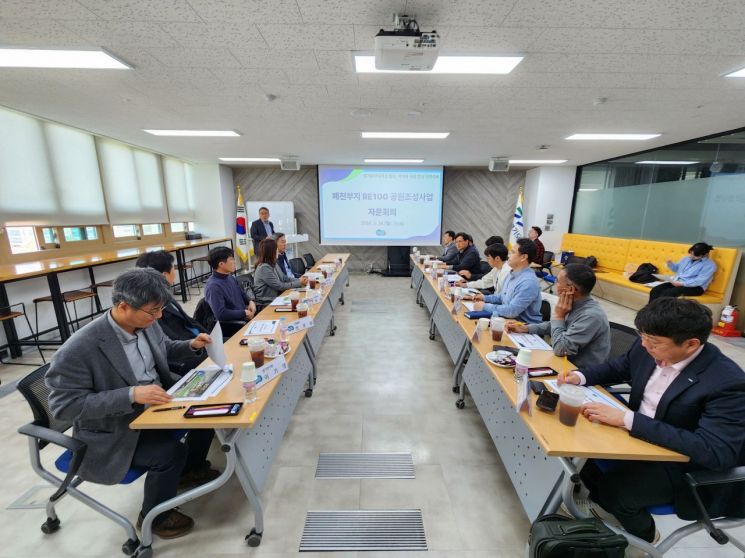 Gyeonggi Province held an expert advisory meeting on the 24th at the Gyeonggi Provincial Government Northern Office to discuss the RE100 park development project utilizing abandoned riverbed sites. Photo by Gyeonggi Province
The advisory meeting was attended by project managers from the four cities and counties selected as energy self-sufficient park development sites (Paju, Anseong, Yangpyeong, Gapyeong), as well as experts in the fields of environment, urban planning, and RE100, along with local residents. In-depth discussions were held regarding the appropriateness of the project direction and park facilities considering residents' perspectives.
The RE100 park development project utilizing abandoned riverbed sites is a project that allows residents to directly experience RE100 in their daily lives by using abandoned riverbed sites that are safe from a flood control perspective. The electricity generated by solar power facilities installed within the park will cover 100% of the electricity used in the park, and any surplus electricity will be used for supporting energy-vulnerable groups or for public purposes in surrounding areas.
Last May, the province called for applications from cities and counties for the RE100 park development project, and in September, through an evaluation committee, selected Seolma Stream in Paju, Geumseok Stream in Anseong, Buan Stream in Yangpyeong, and Sangdong Stream in Gapyeong as energy self-sufficient park development sites.
The main discussion points included ▲ environmental and technical feasibility of the project sites ▲ introduction and utilization plans for renewable energy ▲ measures to enhance acceptance of residents' opinions. Attending committee members expressed diverse opinions based on their expertise in each field.
In particular, representatives of local residents proposed practical utilization plans for the parks and ways to expand local community participation, while experts shared and discussed specific implementation strategies and cooperation plans to achieve the RE100 goals.
The province plans to conduct on-site advisory meetings by river in the second half of the year following this advisory meeting. They intend to continuously hold advisory meetings to enhance the effectiveness of policies through practical advisory opinions and to ensure smooth project completion until construction is finished.
Kang Seong-seup, Director of the Construction Bureau of Gyeonggi Province, said, “Through the advisory meeting, we will strive to reflect the shared opinions on specific implementation plans for creating an eco-friendly city in the RE100 park development project to enhance its effectiveness,” adding, “We will ensure that this project proceeds without any setbacks through continuous advisory meetings.”
Meanwhile, Gyeonggi Province plans to complete the detailed design by the second half of this year by reflecting the opinions from this advisory meeting and to begin full-scale project implementation from 2026. Additionally, as part of the large-scale development of northern Gyeonggi last December, the province plans to realize on-site the ‘Low-Carbon Waterfront Park Project’ currently underway in five northern cities and counties by forming and operating an advisory group. This project is a natural and resident-centered river maintenance and park development initiative that Gyeonggi Province is promoting as a policy.
© The Asia Business Daily(www.asiae.co.kr). All rights reserved.

















