On the 24th, the Constitutional Court ruled that Prime Minister Han Duck-soo did not actively participate in the December 3 emergency martial law, but did not make an explicit judgment on the unconstitutionality or illegality of the emergency martial law declaration. The impeachment grounds related to aiding the emergency martial law were directly connected to President Yoon Suk-yeol’s impeachment trial case, and this decision was expected to serve as a gauge for the future ruling on President Yoon’s impeachment trial.
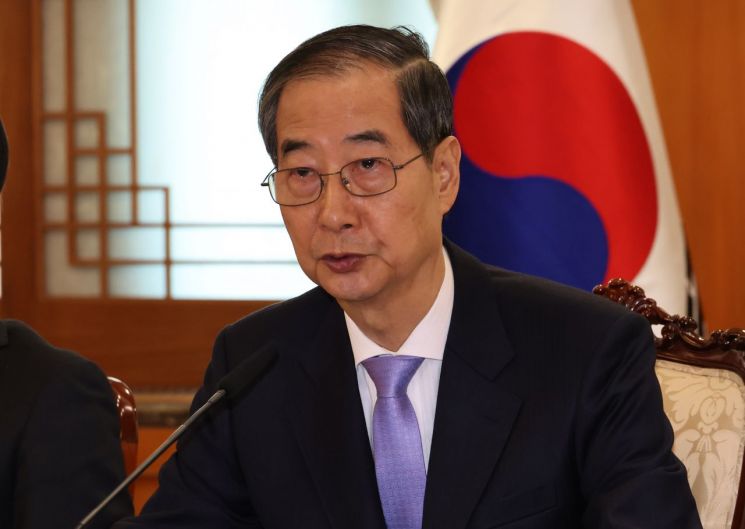
On that day, Justices Moon Hyung-bae, Lee Mi-seon, Kim Hyung-doo, and Jung Jung-mi, in their dissenting opinion, stated, “There is no evidence to recognize that Prime Minister Han took active actions such as recommending the convening of the Cabinet meeting to grant procedural legitimacy to the emergency martial law.” They added, “There is also no evidence or objective data to acknowledge facts related to the prosecution, such as not recommending the convening of the Cabinet meeting to the President after the National Assembly’s resolution demanding the lifting of the emergency martial law was passed.” The Constitutional Court judged that Prime Minister Han did not assist President Yoon’s declaration of martial law, but did not conclude on the legality of President Yoon’s declaration or whether the Cabinet meeting held before the declaration was a substantive and lawful meeting.
The Constitutional Court also deferred most judgments on procedural issues raised by President Yoon’s side in the impeachment trial. In particular, there was speculation that the Court might issue a ruling on whether the ‘withdrawal of the charge of rebellion’?a point contested by President Yoon’s side?was lawful. Previously, the National Assembly had taken the position, similarly to the Han Duck-soo case in President Yoon’s impeachment, that “the establishment of a violation of the Criminal Act (rebellion) will not be examined.” However, the Court did not rule on whether the National Assembly’s decision not to examine the establishment of rebellion under the Criminal Act in the impeachment trial constituted a ‘change’ in the grounds for prosecution or whether it was within a lawful scope.
However, regarding the important issue of the quorum for resolution, six justices judged that “there is no problem” and presented a new standard. Until now, there had been no precedent or Constitutional Court decision on the quorum standard for the acting president’s resolutions. Therefore, the issue was whether, at the time of the vote on the impeachment motion against Prime Minister Han, who was acting president, the quorum should be applied based on the majority of the total members of the National Assembly (151 members), considering Han as a cabinet member, or whether the higher threshold of two-thirds of the total members (200 members), as for the president, should be applied. The Court stated, “The acting president means the performance of functions and tasks pre-assigned to the deputy under the Constitution and laws, and this does not create a new status called ‘acting president.’” It judged that “the quorum for impeachment motions should be applied according to the original status.”
Some in the legal community interpret the Constitutional Court’s deferral of judgments on issues related to President Yoon’s case as meaning “the final conclusion on President Yoon’s case has not yet been reached.” Also, given the divided opinions among justices on Prime Minister Han’s impeachment, there is considerable speculation that the deliberation on President Yoon’s impeachment trial may be prolonged. However, since the grounds for impeachment differ between Prime Minister Han and President Yoon’s cases, some caution against overinterpreting this. A constitutional scholar who formerly served as a constitutional researcher said, “The Constitutional Court’s decision not to conclude on the unconstitutionality or illegality of the emergency martial law in Prime Minister Han’s ruling seems to be because it was unnecessary to do so,” adding, “Since the grounds for impeachment themselves differ, the dismissal of Prime Minister Han’s impeachment will have limited influence on the decision regarding President Yoon’s impeachment.”
Meanwhile, the National Assembly impeachment prosecution team, composed of 10 lawmakers from the three opposition parties (the Democratic Party of Korea, the Party for National Innovation, and the Reform Party), held a press conference in front of the Constitutional Court in Jongno-gu, Seoul, in the afternoon, stating, “The trial for President Yoon Suk-yeol’s impeachment case concluded on the 25th of last month, but a date for the verdict has not yet been set, and already a month has passed.” They urged, “The delay in setting the verdict date is intensifying national confusion and public anxiety, negatively affecting all aspects of state affairs including the economy, diplomacy, and security. We demand that the verdict date be set immediately.”
© The Asia Business Daily(www.asiae.co.kr). All rights reserved.
![Clutching a Stolen Dior Bag, Saying "I Hate Being Poor but Real"... The Grotesque Con of a "Human Knockoff" [Slate]](https://cwcontent.asiae.co.kr/asiaresize/183/2026021902243444107_1771435474.jpg)
















