Didimdol Income Consistency Study... Linked with 36 Programs
"Proactive Support Against Poverty... Need to Enhance Resilience"
Developing Experimental Models for Nationwide Expansion... Cooperation with Related Organizations
Seoul Mayor Oh Se-hoon mentioned the gradual nationwide implementation of Didimdol Income, stating that "it will stimulate the motivation to work and enable a self-reliant welfare system where individuals can stand on their own." Mayor Oh, who also proposed integration and linkage with 36 existing welfare programs such as livelihood benefits and basic pensions, predicted that "the nationwide rollout of the new system will eliminate welfare blind spots."
On the morning of the 24th, Mayor Oh announced the results of the "Consistency Study on the Nationwide Expansion of Didimdol Income" at Seoul City Hall.
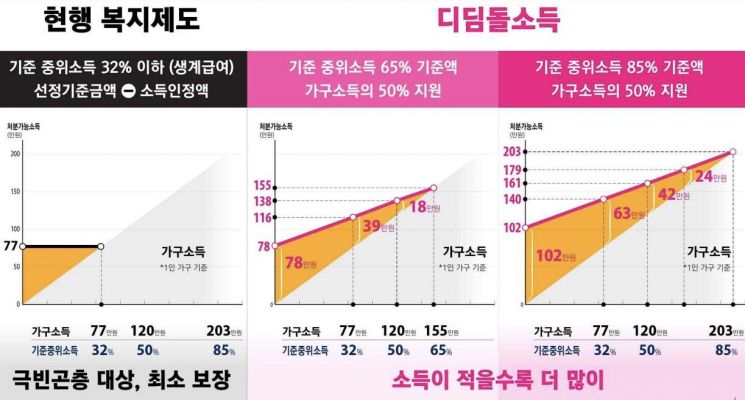
Didimdol Income, which started in 2022 and is now in its third year, is a system that supplements a certain portion of household income lacking compared to the standard income for households earning 85% or less of the median income (with assets of 326 million KRW or less). It is a progressive support model where lower income households receive more assistance, selecting participating households solely based on income and asset criteria, ensuring that low-income households in welfare blind spots receive sufficient support, and maintaining eligibility even if income exceeds the threshold. Currently, Seoul City provides Didimdol Income to a total of 2,076 households.
After more than three years of income experimentation, the rate of households exiting (?) the program?meaning those whose income exceeded 85% of the median income and no longer needed Didimdol Income?was 8.6%. Notably, 31.1% of households increased their earned income. Positive effects were also observed in areas such as productive activities like education and training, savings, increased essential consumption expenditures, and improved mental health.
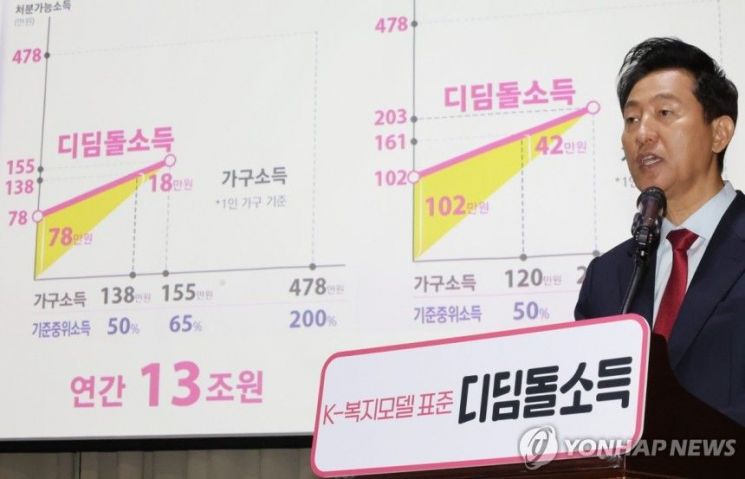 Seoul Mayor Oh Se-hoon is announcing the K-Welfare vision at the 'Stepping Stone Income K-Welfare Vision Presentation and Joint Research Business Agreement Ceremony' held at City Hall on the 24th. Photo by Seoul City
Oh Se-hoon: "Welfare blind spots still exist... Need to proactively support and transform welfare to enhance resilience"
On this day, Mayor Oh stated, "There are still welfare blind spots in our society where care does not reach," adding, "Instead of providing support after poverty occurs, it is necessary to proactively support before poverty happens to enhance resilience, requiring a paradigm shift in welfare." Regarding existing welfare systems, he pointed out "the limitations of the application-based system, complicated procedures, and a structure that inevitably operates retrospectively," emphasizing that "through the nationwide implementation of Didimdol Income, we will eliminate welfare blind spots while simultaneously encouraging self-reliance."
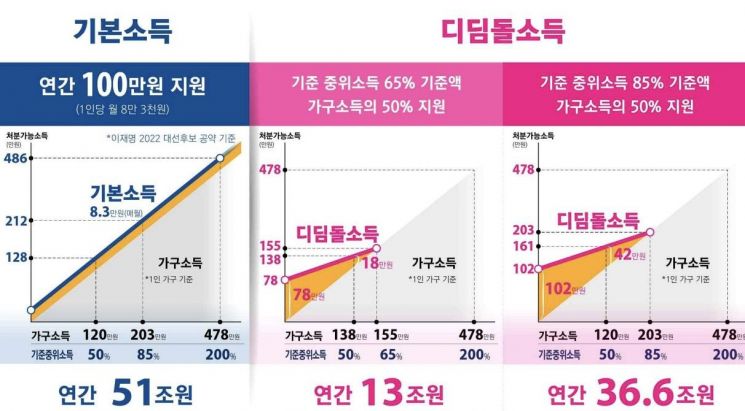
He also mentioned the difference from the basic income proposed by Lee Jae-myung, leader of the Democratic Party of Korea. Mayor Oh explained, "If 1 million KRW per year were paid as promised by candidate Lee Jae-myung during the presidential election, it would cost over 50 trillion KRW," adding, "With Didimdol Income, we can use manageable resources while simultaneously stimulating the work motivation of low-income earners."
He presented a vision for the K-welfare model centered on Didimdol Income. First, by efficiently integrating and linking similar cash benefits based on Didimdol Income and reorganizing the complex income security system, a more comprehensive welfare safety net can be established. He also proposed linking with national pension reform to build a retirement income security system through Didimdol Income. Beyond income support through Didimdol Income, he mentioned support systems related to social insurance and social services, including care, employment and job placement, education, and training. Mayor Oh elaborated, "We will establish a stable K-welfare framework to enhance resilience."
Additional research on various welfare models... Plans to engage with basic local governments for nationwide rollout
The consistency study was conducted by dividing groups into ▲high poverty risk (85% or less of median income), ▲poverty risk (75% or less of median income), and ▲low-income insecurity (85% or less of median income). The model targeting the high poverty risk group (65% or less of median income) guarantees income similar to current livelihood benefits while resolving blind spots caused by complex procedures and strict criteria such as support obligation standards, proof of work incapacity, and income conversion of assets, providing a timely and dense social safety net.
Applying this model nationwide would allow approximately 5.94 million households, about 27% of the total 22.07 million households, to receive Didimdol Income. This would require integration of 10 programs, including livelihood and self-support benefits under the National Basic Livelihood Security System, the National Employment Support System, and additional local government benefits. The necessary budget was estimated at about 13 trillion KRW.
The study also included a model covering the poverty risk group, i.e., households with income up to 75% of the median income, which is below the national emergency welfare standard. Unlike the current method of temporary, short-term support during specific crises such as unemployment or business closure, this model protects households living in conditions close to poverty from various crises. The key is that it can prevent entry into poverty in advance and guarantee living standards. It is estimated that about 6.53 million households, approximately 30% of all households nationwide, would receive Didimdol Income support, requiring an additional budget of about 23.9 trillion KRW.
Additionally, a model including the low-income insecurity group, up to 85% of the median income, similar to the current pilot project, was also studied. This inclusive model could support one-third of all households. Applying this model would exclude risks and anxieties related to income decline, enabling active social participation and self-realization support, and could integrate housing benefits under the Basic Livelihood Security System. As the guarantee level expands to 42.5% of the median income, additional budget requirements are estimated at about 36.6 trillion KRW.
Based on the results of this consistency study, Seoul City plans to develop various experimental models to expand Didimdol Income nationwide. Representative projects include ▲establishing a Didimdol Income-social service delivery system, ▲enhancing work incentives of Didimdol Income, and ▲studying gradual securing of welfare resources.
On the same day, Seoul City signed memorandums of understanding with the Korean Association of Social Welfare Policy, Korean Economic Association, Korean Labor Economics Association, Korean Fiscal Association, Anshim Income Association, Seoul Welfare Foundation, and Seoul Institute. Through this, they agreed to cooperate on researching future income security systems that can complement the blind spots and limitations of current income security programs and encompass new vulnerable groups. Mayor Oh said, "We will build the optimal Didimdol Income model and gradually nationalize it," adding, "There are places discussing Didimdol Income. We plan to continue engaging with various basic local governments."
© The Asia Business Daily(www.asiae.co.kr). All rights reserved.



















