The Norwegian Government Pension Fund, the world's largest sovereign wealth fund, expressed support for the proposals related to the regular shareholders' meeting of Korea Zinc, backing the largest shareholders, Youngpoong and MBK Partners.
The Norwegian Bank Investment Management (NBIM), which manages the Norwegian Government Pension Fund, disclosed the voting results on the Korea Zinc regular shareholders' meeting agenda on its website on the 24th.
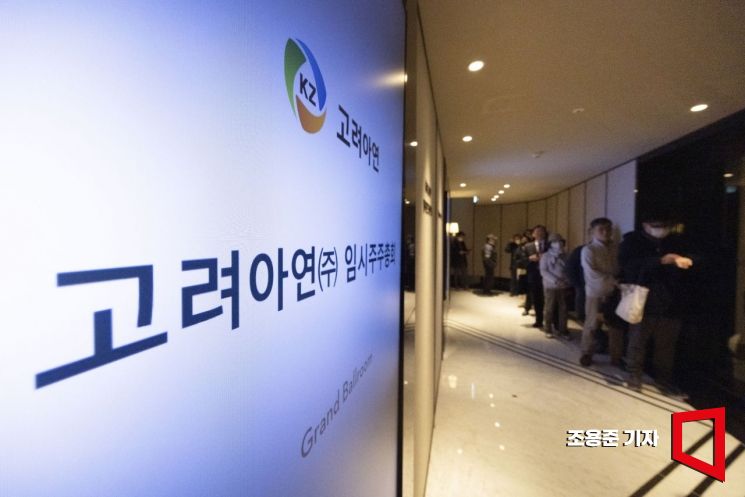 On the 23rd, when the temporary shareholders' meeting of Korea Zinc was held, Korea Zinc shareholders lined up to enter the shareholders' meeting hall at the Grand Hyatt Seoul in Jung-gu, Seoul. Photo by Jo Yong-jun
First, NBIM opposed all major proposals endorsed by Korea Zinc Chairman Choi Yoon-beom's side, including the cap of 19 directors, the increase of separately elected outside directors, and the appointment of 12 directors. They also gave a negative evaluation of all director candidates from Chairman Choi's side. Furthermore, in line with the recommendations of proxy advisory firms ISS and Glass Lewis, NBIM opposed all three audit committee candidates from Chairman Choi's side.
On the other hand, NBIM voted in favor of the shareholder proposal by Youngpoong and MBK to appoint 17 directors. They supported all 17 candidates proposed by Youngpoong and MBK (Kang Sung-doo, Kim Kwang-il, Kim Jeong-hwan, Jo Young-ho, Kwon Kwang-seok, Kim Myung-jin, Kim Su-jin, Kim Yong-jin, Kim Jae-seop, Byun Hyun-chul, Son Ho-sang, Yoon Seok-heon, Lee Deuk-hong, Jung Chang-hwa, Cheon Jun-beom, Hong Ik-tae, Kim Tae-sung).
NBIM expressed opposition to the cap on the number of directors, citing concerns about whether the board can operate efficiently and whether shareholders' rights can be protected.
NBIM pointed out, "Shareholders should have the right to change the board if it does not provide the best interests to shareholders," and added, "It is necessary to consider whether the board failed to take action on important shareholder requests, tried to avoid shareholder proposals, or implemented governance changes that restrict shareholders' rights without shareholder approval."
They further explained the reasons for their vote by stating, "We considered information raising reasonable doubts about board actions, including unsatisfactory financial and strategic performance, unmanaged risk-taking, unacceptable treatment of stakeholders, and undesirable environmental and social outcomes arising from company operations."
Meanwhile, the Norwegian Government Pension Fund, first capitalized by the Norwegian government in 1996, is currently one of the world's largest sovereign wealth funds managing 20 trillion kroner (approximately 2,549 trillion won). It holds about 1.5% of the shares of all publicly listed companies worldwide. As a long-term investor in about 9,000 companies across 70 countries, it focuses on considering environmental and social issues as well as aligning investment profitability with societal expectations of companies.
© The Asia Business Daily(www.asiae.co.kr). All rights reserved.

















